So, How Many Hats Do You Wear?

My photo
Pensacola, Florida, United States
Husband. *Dog Dad.* Instructional Systems Specialist. Runner. (Swim-challenged) Triathlete (on hiatus). USATF LDR Surveyor. USAT (Elite Rules) CRO/2, NTO/1. RRCA Rep., FL (North). Observer Of The Human Condition.

Thursday, March 11, 2010

Turn 8 Inches Into 10, Or 12, Or More...

One of my (recent) favorite establishments is a pizza bakery located near a movie theatre about four miles from my home. I've eaten at a few other franchise locations while on the road for triathlons, & became very excited when the local franchise opened up here. Okay, so it doesn't have the funky oeuvre the local joint (of which I am a FB fan) has. In fact, it's a little too bright, too colorful, & too television-laden...holy cow, I cannot believe I said that...for my taste. The music & the attitude of the wait-staff is fairly good, though. And they do have a 115-beer club (I think by now we're half-way there!); most of the beers are good stuff, too.
But naturally, if you're going to go to a pizza bakery, it's fairly well likely you're going to go after pizza, right? This place, like lots of other pizza joints, has varying sizes of pie. My loving wife & I can kill a 10-inch with no trouble; 14-to-16 inchers are a bit more of a challenge, & expect a couple of morning's-worth of Coach Mike post-swim brekkies if we foolishly decide to order something closer to 24...like the Philosopher's Pie.
Last Monday we had dinner & a couple of beers with a friend (& her son), a follow-up to some of my wife's business travel. I recommended the Philosopher's, & I think they ordered a 16. When the pie came out I noticed 12 ample slices of pie. As Maria & her son commenced to nosh on a couple of slices, they offered up also to Suzanne & me...who were nibbling on a salad & a meatball sub. Their pie was definitely big enough to accommodate all of us, with plenty left over. It got me to thinking about the relative size of pie slices; when our 10-inch came out the other weekend there were four slices...which I bet were probably equal in total surface to the slices on the 16. So, perhaps the 16 could feed six people as ably as the 10 could a couple?

This is not necessarily a mathematical dilemma but more of an economic one...and maybe even a sociological one, too. Events, clubs, coaches & retailers are seen often to compete for the same, small market share. I'll take as an example a recent look at my local running event calendar; I have at least two examples of two road running events of the same distance taking place in the same metropolitan area at the same time on the same day, with the same post-race fare & targeting the nearly-identical population of runners outside of their own constituents.
The challenge, if or when there are multiple providers in an area, is to figure out the niche population each provider best services. A good choice would be to then either leave that niche population be, or refer them to the provider who can best service them. This collaboration among competitors not only builds a sense of community, but might even lead to a Newtonian equal & opposite reaction. Each party has access to materials (customers, capital, community) which "make up the pie", so rather than squabble & fight over "pieces of the pie" becoming smaller because of another resource, why not collaborate and MAKE THE PIE BIGGER. If done correctly, there can be more than enough for every player who is willing to give-and-take with others rather than look out solely for their own interests. I'm not saying a business or a club shouldn't do what is in their best interest first, but if you work to not step on the toes of others, the chances are good you might get a little goodwill in return...and then some.
Of course, I'm probably looking at the world through idealistic, utopian spectacles. It's something I've done over the past (nearly) five years. This sort of thinking doesn't have to be strictly between not-for-profit groups; it would make things a lot easier for many if they were to work this way, but there can be healthy collaborative efforts between not-for-profit groups & for-profit providers. The worst thing a not-for-profit can do is to completely abdicate portions of their mission to the tender mercies of a for-profit group. Remember, the for-profit is in the endeavor to make a buck, either directly or indirectly. If it helps the community as a whole at the same time, then that's nice.
But giving up, or standing by silently as a for-profit adds another arrow to their quiver because the non-profit handed it to them is just plain bad business. Not being able to choose between a non-profit provider & a for-profit provider - whether it be coaching, a race, or even a financial institution - because the non-profit has decided to no longer engage in the activity with which it was once charged, is no choice at all.

No pizza for you. Not even eight inches.

Monday, March 8, 2010

The Greeter of the Pack

Another weekend in the great out-of-doors has ended. While there's still a bit of a chill in the air, there's no doubt spring is just around the corner. While it's still difficult to get myself motivated and out the door some mornings, at least I don't feel so badly about it once I'm on the move. Suzanne managed to somehow talk me into a near-instant replay of last Saturday's run: Do three miles to a coffee joint, stop for a cup & a bite, then do three miles back to the house. Seemed like a lousy idea at first; Weather Channel had the conditions listed as in the low 40s with a wind chill in the high 30s. While I had my Garmin & my HR strap on to keep track of the important data it wasn't the be all, end all for the morning. Suzanne wanted to get out of the house for a run & she wanted to have coffee. So be it.
Fortunately, the sun was bright, the air was slowly warming up & the sidewalks even seemed like a welcoming environment. It wasn't Esplanade Avenue to Community Coffee or the 5:20 Club, but it was close enough. The very combination of ingredients, including the presence of my loving wife, was just enough to make the morning's first effort seem like just enough.
Once we got back to the house the trials of real life, such as they are in Chez' Bowen, reared their head once more: Walk the dog, get the last-minute business accomplished, fit the swim workout in & go work packet pick-up in Gulf Breeze for Sunday's Midway 8K.

Sunday was just as nice, but the solo 10-miler hurt like hell. Perhaps it was still too soon since the half-marathon to do that many miles as a long run, but I can never tell when I'm going to have a nice Sunday morning...so... Home to walk the dog, then clean up & get some breakfast before heading over to the race to set up. Okay, so I forgot my laptop & had to go back home for it; I owe the company a round of brewskies for that transgression. I never forget my "coach hat", my "RRCA rep hat", and my soapbox. And I got to use them all yesterday at the event.
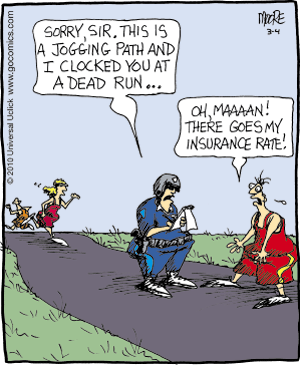
A young lady asked the inevitable question about headphone use at the registration table. Beverly was almost dead-on accurate with her response; I think she's heard my sermonizing as much as Steven has. We mentioned to her that as a RRCA event club, & because our event was covered by RRCA's event insurance, we were obliged to strongly discourage her from using the headphones. However, we were only going to strongly discourage her because of the inherent safety risks; she was going to run on a course which was not completely closed to traffic. While we did have volunteer workers at as many intersections as possible (another topic for future rumination - volunteers...) we could not completely guarantee her safety in the event an insane (or even sane!) motor vehicle operator decided to suddenly overtake her.

As a small event we want to develop a clientele. We also want to help educate runners & triathletes on safe practices. The first baby step we can do, & intend to do, is mention the hazards the headphones can cause...especially if the volume is jacked up so high the wearer cannot hear. (I still laugh at the comment of the masters' winner: He was doing a cool-down on the course with his phones on, & heard my car's stereo blaring about a quarter mile away from where he was. I thanked him for keeping the volume down low enough to hear his surroundings.) It's not like we have a means to enforce such a policy right now. But if we begin to tell participants it's hazardous to use those things, perhaps when we put a prohibition statement on a race flyer they'll abide by the request.
Okay, I'm off the soapbox for now. My wife has always told me I should participate in a race from the rear of the field in order to see (as Jacob Riis might have put it:) how the other pack lives. Since the local constabulary sent only one patrolman to cover the course, the race director & I were responsible for the lead & follow vehicles. George took the lead vehicle; I had the follow. There's a whole different dynamic when you're following walkers, compared to the elbows-&-a$$#@(@s pack you see at the front end of a race. I suspected I was going to spend the next 60-to-75 minutes following along with the walk division. Close, but not close enough, moose-breath. The last participant took a little over 90 minutes. That was the bad news. Was there good news? Kinda-sorta.
The weather was wonderful. We're talking roll-the-window-down,-lean-your-elbow-out-the-window-because-hanging-your-whole-head-out-would-look-silly wonderful. Unfortunately, I couldn't find a good radio station to play outside of the local NPR stations. Ah, one of those moments where I kick myself in the butt for leaving my favorite CDs at home...& not snagging up Suzanne's iPod to plug in the accessory jack, Jack. Oh, and this lady wanted so badly to give up at the first half-mile. She turned to look at me and wave me on forward, but I told her I was the follow vehicle, & while she was the last participant she was going to make it just fine. I didn't want to tell her how badly it would bite to not finish an eight-kilometer walk. So, I rolled along just behind her with the flashers flashing, plucking up course signs after she passed.
When she got to the last half mile to go, her husband came out to walk along with her. I continued to do my thing & she continued to do hers. At the last 100 yards before the finish, I rolled along side her & called out: "You know what that feeling is right now? What you're feeling is accomplishment!"
After that, I rolled into the parking lot & made a beeline for a beer & some italian bread. My day was pretty much complete. I can't say I picked up any observations from the @$$-end of the field, save for the fact that sometimes it's just something to finish...which was more than I could say for the two teenagers who turned off the course a block ahead of the woman an hour before her finish.

Tuesday, March 2, 2010

The Handicapper General Has Determined...

Not one of the typical threats we see on the road. Bart Yasso in Indonesia, I believe...

One of my wife's favorite science fiction short stories is a satire on social equality written by the late Kurt Vonnegut. In the story, "Harrison Bergeron," the more intelligent, athletic or beautiful a member of society is, the more they are handicapped so no one person will feel inferior to another. The main character, Harrison, is exceptionally intelligent, strong & attractive; the Handicapper General forces him to wear eyeglasses designed to give him headaches, black caps over his teeth, forty pounds of birdshot around his neck, another 300 pounds of weight strapped to his body, a rubber ball on his nose...& headphones which play distracting noises.
At first, we laugh at the thought of a society which forces each of us to be equal by handicapping the more gifted; if we were better than someone else we would never willingly submit ourselves to such a regime. If we were less gifted we wouldn't mind being enhanced some, but we wouldn't feel right about the more gifted being handicapped.
Would we? On either account?
I was at a Rock n' Roll Marathon event & heard about a conversation between a Rock n' Roll staff member & an out-of-town participant asking about headphone use. The participant asked if headphones were going to be allowed on the course. The staffer decided, rather than give a yes-or-no answer, to find out exactly what made this participant tick:
Staffer - "Okay...let me ask you something. Do you know the name of this event?"
Participant - "Yes. It's the Rock n' Roll Marathon."
Staffer - "And you're from out of town?"
Participant - "Yes. Philadelphia."
Staffer - "So you flew here to run this event?"
Participant - "Yes. We've been here all week."
Staffer - "Did you use the discount registration code for the event?"
Participant - "No."
At this point, the staffer quickly estimated what the trip cost the participant & said: "...so, you're willing to spend thousands of dollars for a week at the Rock n' Roll Marathon, an event with some of the best live music this city has to offer, & you would prefer to listen to your own music...?"
How many times have we run races in headphones, never listening to the cheering of spectators, the sound of our own labored breathing as we run, the music playing from stereos in houses or on curbs or corners, or, if we spent a few (more) bucks at an event like RnR, there are bands playing local music for our pleasure at every mile? Running closer to the middle or back of the pack at races can often sound like a silent movie without the piano background; every runner is tuned into their own little world. No one talks to any one.
Yet, we tell our non-running friends we go to races to meet people.
So, we willingly handicap, isolate, ourselves on the course with 100 decibels of sound blaring into our ears, enough to drown the siren of the emergency vehicle taking the unfortunate runner who "crashed & burned" a mile away from us to the hospital...we might have passed without knowing they were in distress because we were in our own little world. Those same 100 decibels are only a little less damaging to our ears than standing next to our mother's Electrolux vacuum cleaner...right now. Over time we handicap ourselves more permanently; wrecking our hearing with long-term exposure to loud everything, until we can't hear even the most sublime of sounds.
Why? Because we seek pleasure & avoid pain. We want to go to our happy place. We want to detach ourself from the message our brain is sending. Timothy Noakes' Central Governor Theory of Endurance says the brain tells us to stop or slow down because our brain wants the glycogen our muscles burn as fuel for itself, as well as the heart & lungs...it wants to keep us alive, even if we cannot run. Our brain is greedy. But when we detach ourself from the brain's "message center" which warns us of the damage we "might" do if we keep running, we also detach ourself from the same message center which warns us a threat (overtaking runner, bicyclist, mugger, automobile, etc.) is approaching from behind.
I hear the often rhetorical question, "well, what about folks who are deaf?" There are folks who are unable to hear, but as a result the senses of sight & touch have become more acute. Not so with those of us who still retain the ability to hear until we place headphone in ear. We can't see behind us & probably don't even think about looking because our happy place is better than anywhere we want to be at the moment.
We don't need a Handicapper General. Most of us do it to ourselves. Rather than be a Harrison Bergeron, willing to die as an unfettered person & release people from long-tolerated handicaps, we'd rather wallow in our equality & accept when others are shackled.

Thursday, February 18, 2010

When Your Local "Mom & Pop" Store Ain't Making The Cut

I grew up in a small town in southern New Mexico, 35 miles north of the Mexican border; a solid hour's drive from two university towns & a two-hour drive from a third. When I first moved there in the early 1970s we had a couple of small department stores, a Sears & Roebuck outlet, & a Montgomery Ward outlet to choose from when it was time to shop for clothing or durable goods. By the time I left home there was a K-Mart providing a choice to folks when it came time to comparison shop.


Wanting a big-ticket, major-brand item usually meant either you hoped the local store had it in stock, you took a major (one-day) road trip to Las Cruces or El Paso, or you ordered it through the catalogs & hoped for the Postal Service to do their thing. Thus, I grew up accepting a slightly less-distinguished brand name to support hometown merchants. More often than not, these merchants knew to do right by you, lest you take your business to the catalog outlet or drive to the big city. And you noticed local merchants would keep their business in town as much as possible.

Moving here has been like being in my home town, but with the internet added. I lived in Tampa for 16 years, & had no lack of shopping malls, booksellers & sporting goods purveyors; specialty stores of every type in which to spend my hard-earned dollar. As a small-town guy who never really lost the "spend less if you can" gene instilled during his youth, I would hit the "mom & pop" stores first, then go to the major chains as a next resort...if I really needed the item.Sometimes, a visit into those big stores could make you feel like you were an interruption in their day; if you weren't a top shelf musician or athlete (of which I was NOT) you weren't getting the attention of some clerks, even if you had your AMEX stapled to your forehead. To a lesser degree, some of the "mom & pops" would treat you that way...but if you were smart you knew you could raise your voice, & let them know "I chose to come here rather than go to such-and-such, so you better appreciate my business, damn it."

I've shamelessly plugged stores who have done right by me. I've also shunted friends to alternatives when the stores haven't done right by them. When I've recommended another store it's come with a certain degree of loss to my reputation, because I like to think I know the best place to purchase stuff.

Fortunately for me, and a few of my friends, when the local "mom & pop" decides to not do right we have the internet to back us up. If you're willing to do a little bit of research or play around on a few web sites you can sometimes find what is the best deal...and go back to the recalcitrant "mom & pop" with some ammunition, to say, "I can get this for this much at such-and-such a place, so you better do right by me, damn it."

Four on-line examples I want to recommend:

First of all...there's nothing like eBay. Talk about a place where capitalism is at its best...& its worst. You can find deals there...and you can get screwed there. But you also can find out what comparable items have been sold for in the past, as well as find out how reputable the seller is. If their rating numbers are low, tread carefully. If there's a reserve, odds are good you aren't going to get a good deal. I have several staple items on search, so I receive an e-mail almost daily of stuff for which I show an interest.

Amazon.com has a great search engine, where you can find electronics, books, music, computers, videos, & so on. They were pretty much the first one with "intelligent search" algorithms, which would recommend "stuff" to you based on your interests. A kinder, gentler form of "suggestive selling."

If you're looking for books, especially the ones which are out of print or you're willing to settle for used, abebooks.com has a search engine from hell. I found an Australian reprint of John Parker Jrs.' "Once A Runner" for 1/6th of the cost of a beat-up first printing. Reads just the same.

Shoes of all kinds can be found at Zappos.com. Not only can you find great stuff there at reasonable prices, but their shipping is free...well, I know there's nothing that's really free, but the shipping charge is hidden well within the cost of the shoe.

So, when "mom & pop" have decided to disown you, or at the least treat you like you're a red-headed stepchild, you do have a recourse.

Wednesday, February 17, 2010

ManBearPig Has Left The Building...

...I'm super serial! Well, I would have rather started this with a comment; in fact, I think I will. This last fortnight (that's a two-week period for those of you who graduated from a high school in Florida) has made me want to scream the same words I was greeted with by my friend Betsy when we showed up for Jackson Day, some 40 days ago...
Global warming, my @$$.
Of course, I'm certain the recent temperatures haven't cooled the ardor of my NOLA friends for their Mardi Gras celebrations, which would have taken place yesterday. Ever wonder what the difference would have been between if the Saints hadn't won the NFL championship & the way things are? According to what I recall from NPR, the city was going to celebrate, win or lose.

You have to love a city that can plan a parade in nothing flat. Ask my friend Betsy.
Now that we are in the Olympic fortnight there's plenty of sport to watch on the television. This can be a good thing if your training is focused on indoor stuff, like treadmills & elliptical trainers. I don't care what's on...it could be curling & I'd watch. I kind of draw the line at ice skating & ice dancing.

But, if you're doing track workouts & long road runs in preparation for a longer target event, say a marathon or a half-marathon in the next two weeks to a month...you fight the seemingly irrational desire to watch men beating each other with sticks (My joke term for ice hockey, a sport I have loved since I was old enough to watch televised games...thanks, Dad!) or chicks on ice (luge - as Robin Williams joked, let's not even talk about the two-man luge...'boys, get a room...'). I tip my (stocking) hat in the general direction of the folks who get out in the chill to plod out lap after lap on the track at the university...in the dark. Every time I see a jogger step onto the track & immediately go into what I would call a flamingo stretch I wait to see whether they're going to crash @$$-over-tin cup to the surface. There are easier ways to stretch that quadriceps, dude.

There's where the spinning instructors could teach joggers a thing or two; use the bench as a stretching aid, & don't stretch far beyond your range of motion.
Giving up anything for the next 40 days? Steven, Beverly & I started talking a little about it on the way home from Auburn Masters...obliquely. The discussion was more about cutting back on beer intake in the hope to drop a little extra weight. I go from no beer an evening to two or three an evening every couple of days. Perhaps a little consistency - one or two a night rather than zero, then three or more, then zero - might be a better thing. It's hard to say, & difficult to forecast; especially when you have friends who love the hop.

However, there are two things I want to drop off the buffet tray altogether, & this time period might not be a bad on in which to give it a jump start. I talked before about wanting good ab days; the goal was to put french fried anything on the verboten list. So, I'll be mourning for Mickey D's best offering, & Sonic's tater tots, as well as any other french fry-like products, until Easter. I was able to cut out mayonnaise this way a long time ago (I do mayo every so often, but not like I used to!); perhaps I can moderate or elminate my lust for pommes frites. Soda pop is also ix-nay, but it's small potatoes since I drink maybe 24 ounces a week of the stuff...at the most.
So, maybe lenten resolutions are little more than a re-resolve on the part of many folks; a mini resolution, or a step toward the inevitable new years' ones we consistently fail & try (Typed 'tri' the last time...am I thinking about the multisport thing, or what? What would Freud have to say?) over & over again.

What do you think? Is it better to try, fail, & re-try...or remain content with the status quo? I put my money on trial, screw-it-up, & do it again.

Tuesday, February 9, 2010

An "Ask Coach" Moment - Can You Hear Me Now?

I usually take a week off or so after running a half-marathon, then start another training plan from the beginning. I was thinking on the long drive home yesterday from the Surf City Half it would make more sense to take off a few days & start where the training plan ended. I think I've told you I had used Hal Higdon's beginner plan, just increasing the speed at which I train.
What if I started back in at week eight or nine instead of going back to week one & starting over? That way I can do more long runs &, most likely, be in even better shape when event time comes around? I also thought about trying the Hanson's training plan you showed me.
Oh yeah, I need to really make an effort to quit going out so fast & burning myself out. I planned to go out at a consistent 9:00/mile pace at Surf City. I looked at my watch at 5 miles & noted I was running 8:15-8:20/mile. Naturally, I felt like $#!+ when I got to mile 10, 11, 12. The "rule of thumb" usually is a day of no running for every hour, & a day of no hard training for every mile for the event. So, a couple of days of walking or elliptical after a half, followed by the next eight to ten days of easy running is usually a good recovery. After the recovery period I would look at what the next target event is going to be & structure your plan accordingly...working from the end backward. If you don't have an event planned, then I would either use the sixth week of a training plan as a baseline, or figure out how much time you can commit to run training without adversely affecting the rest of your life. I bet if you look at all the other aspects of your life you've probably let some work things slide, some family things slide and some other responsibilities go on the back burner. This would be the time to go back and mend those fences. The good thing is that you trained for a half-marathon, which doesn't take nearly the time/effort a good marathon training cycle does.

Reverting to a baseline training week, even at a lower intensity, will allow your body to recover from the past 10-to-12 weeks of training. Remember, racing (especially racing long) is NOT natural; you're putting damage on your body above & beyond normal fitness running. The hardest thing to learn - I've dealt with it way too many times over the past seven years of coaching myself & others - is pace discipline. For an example, I went out 6:05/6:07 for the first two miles of the last half-marathon I raced in Dayton, OH. When I hit mile two I knew it was a choice between backing off a notch or dying a horrible death at mile 10. I managed to back off the pace for the next four-to-five miles. If not for the fact I was just outside of the top-20 I would have maintained that pace & "mailed it in." However, I wanted to finish in the top-20; I hammered (suffered!) the next six miles to catch a couple of guys in front of me - at mile 12 - & stayed strong until the last mile (actually entering the stadium parking lot) where everything went to hell...but I ran a personal best of 1:23:45.
A good way to deal with the "go out hard early, feel like $#!+ late" syndrome would be to do something like the Yasso 800 workout once every couple of weeks...but cut the distance in half for the sake of half-marathoning:
Go out & do the typical warm-up for your workout. I have my folks do a mile easy, recover for a couple of minutes, then another easy mile, recover a minute, then 10x100 striders to warm-up.
The workout is 10 x 400, with 400 jog recovery - goal pace for the 400s should be the target time for your half. So if you want to go 1hr 50min for the half, do the 400 in 1:50. If you go out too hard you're probably going to feel really good for the first five, then friggin' DIE by eight or nine. Jog an easy 400 after, with 10x100 striders to cool down.
You'll learn your lesson after a couple of those workouts. I had one of my guys do a few Yasso 800 workouts in the last month leading up to the FirstLight Marathon in Mobile. The first time he ran them he went 10-15 seconds too fast for the first 800, & everything fell off after that...to the point where his last one was barely on time & he was hurting big. The next time I told him to remain on his goal pace; he felt like the first ones were too easy, but managed to keep all of them on goal. He developed the patience & pace discipline to go out comfortably in the first 10K, & subsequently ran a Boston Qualifying time.
The workouts weren't the key, only part of a good training plan...and a well-executed race plan.

Tuesday, February 2, 2010

The REAL Priorities

One nice thing about taking a vacation, especially in a place much different than where you live, is the opportunity to look critically at things without having to deal with them immediately.

There you go again, Bowen, failing to make sense.

What I mean is that it gives you a chance to put things into (a more proper) perspective. You realize what is important, what needs to stay unchanged, what cannot be changed, and what must be changed. Oh, and you figure out what isn't so important, too.

While looking at what could be tweaked and what needed to be tossed, I started to read a little more from an Endurance Nation coach. Pat McCrann posted on his blog Five Fit Life Commandments (You don't have to be a tri-geek to appreciate his common-sense approach to training. If you're a time-crunched athlete his ten-hours-a-week approach to endurance sport may save you some grief around the house or the workplace.), which I want to touch on in brief. If you want the details, go to the link I posted above.

#1 — Plan From The Ground Up - Right off the bat, McCrann tells me to toss my copy of Triathlete's Training Bible (at least for calculating annual training hours and trying to divide time over mesocycles) off to the side. There are all those things we are (son, husband, grandfather, worker, friend, coach, race director, course measurer, national organization rep, and so on...) and do outside of the 9-to-12 hours a week (for me, that much; for you, perhaps more...or less) we've set aside for running, cycling, swimming, cross-training. Training for my unsuccessful crack at IM FL last year I found the undivided support of my wife, my friends, and not a small amount of understanding from my boss, to be elemental to me making it to the starting line. I got beat up during the swim and melted down, but I learned what it takes to get to the starting line (and I'll be smarter next time!). Take away the five hours in the emergency department, and I can say it was an enjoyable week with my wife...I believe she would say the same.

#2 — Focus on Fun & Challenging Activities - I had 70.3 NOLA already on the 2010 schedule, and hadn't started the 2009 IM assault. Not the wisest idea looking from the forward, but it was probably the tonic I needed after IM FL. For me, a 70.3 is challenging, and fun; definitely an achievable distance within the constraints of my training and abilities. My wife told me she wanted to start running half-marathons again, and asked whether I would help her prepare for a half in New Orleans. Since the half was six weeks out from the 70.3, I figured it was the perfect training run/trip for me too; we have close friends in the area and it's a two hour-ish drive from our home...close enough for comfort, not so far we have to draw a major itinerary. For giggles, we did a 9K about seven weeks out from the half, also in NOLA. The road and climate conditions were great preparation for the half...and it served as a great excuse to get out of town after the holiday season. We're runners; we like these kind of trips...they beat her business travel.

#3 — Create A Basic Training Week - There are certain things etched in stone; work schedule, runs with other groups, swim practices. Oh, then you have real life, too. After a couple of years, and a year of experimenting with some other activities, I finally have a week laid out that I can accomplish, training-wise, consistently across a year regardless of seasonal and external commitments. McCrann mentioned that this is a baseline - something which seemed obvious. However, he mentions the idea of personal/social/professional capital stored since training has not been a constant drain on other areas of life. Deja vu Stephen McCovey's emotional bank account.

#4 — Integrated Nutrition & Recovery - something I've had a difficult time in learning, but getting better as I age...and recovery takes longer and is more necessary. I might love beer, but I also realize the alcohol in it hampers the development of human growth hormone, and makes me feel like I've been beaten about the head, shoulders, and upper torso with a big stick the next morning. Funny, I did not put this calculation together until the other morning; awakening on a Saturday after Friday night's (beer-free!) dinner with the daughter-in-law and grandkids...and feeling good. Changing my training schedule to place the lower impact activities in the morning and the running in the afternoon also lets me balance work with recovery.

#5 — Well-Organized External Commitments - Changing the workout a couple of mornings a week allows me to shower at home, rather than dragging my work clothes and shower items to work, worrying about where to store the wet, smelly shoes, and - worst of all - forgetting the shoes/socks/belt/skivvies/brush and feeling miserable about my appearance the remainder of the work day. Usually, the first 60 minutes of the day is taken up with e-mail and electronic posting of stuff which lands in my personal in-box and is forwarded; I'm already checking e-mail for work so this is giving me a second read. I spend less time punching up stuff on the computer on my time.

Of course, when you leave vacation world and come back to the real world, you have to execute the plan of action you drafted in your mind, or scribbled on a napkin at Cheeseburger Waikiki, or typed up on your laptop during that (seemingly) endless flight from Honolulu to Atlanta. There's where the trial/error/trust thing comes in. Give it a try...make certain to give enough time to see if things are really working...and adapt accordingly.