The runner's life requires discipline, sometimes the occasional denial of of life's more-pleasurable pursuits. But when a Simon's football (you may call it soccer) match and a hash kennel (mis-)management meeting falls on the same afternoon as a workout, common sense states it's better to defer the task and make many (female) family members happy. Because, like the old phrase says "when Mama (in this case, "Grammy" Suzanne...) ain't happy, ain't nobody happy."
And this coach is all for happiness.
Four-year-old footballers, like Simon, do not naturally exhibit the same skills as the first-division professionals I've enjoyed watching for the past three decades, with the exception of the one kid who had the "crumpled on the turf" posture at the mouth of the goal down pat, which occurred immediately after the opposing team's score. The match looked kind of like what happens when an order of french fries is dropped in the parking lot of a Burger King in Florida: The french fries represent the soccer ball, the seagulls are the players.
So I laughed and cheered both sides for twenty minutes, and marveled at the fun the small fry were having; it was clear they were enjoying themselves. What they were doing was - for their benefit - a simplified version of football, without corner kicks or offside rules. Everybody played the entire game, and - save a few handball calls - no real fouls in spite of the two goal mouth dives from that one kid.
"You beat my husband up pretty good on Saturday," said the hash treasurer.
I explained that her husband was as much responsible for his own beating as I. Suzanne concurred with my assessment of the situation, and suggested "hash cash" could keep him company at the next Saturday morning workout.
She said, "I just started a 'couch-to-five-kilometer' training program at the local running emporium, and all they do is tell us to 'go run.' I was paired up with a guy who runs slower than I do, and I really don't feel like I'm getting any benefit out of it."
"You couldn't run any faster?" I asked.
"No. And what about nutrition? What about core, stretching, and cross-training? Sure, they gave us an information sheet, but I feel like I paid for something..."
"More prescriptive?"
"Yes."
"Tell you what I'll do." I said. "Let's do dinner some Friday evening. We can talk about all this and find out what you want to get out of a training program. I'll try to answer your questions to the best of my ability, and point you in the right direction."
The "hash cash's" lament succeeded in winding me up in the manner of a cheap wristwatch, but, because I promised my wife I would not speak ill of local running impresari I made only weak comments. It wasn't until the following morning as I was preparing for work - amazing what a hot shower (and Tina Turner's "Private Dancer...") can do for encouraging deep thoughts - that it all came to me. The goal of a Cto5K program isn't that far removed from that of a recreational football program for four year-olds: Minimize the hard stuff, maximize the fun. So what if the other team beats you by two goals; everyone got to play, everyone got to chase after the ball, right? And everybody on the sidelines were cheering for you, right?
In Kenny Moore's biography, Oregon coach Bill Bowerman considered running an act which was as easy as brushing ones' teeth. Bowerman's protege' Bill Dellinger clarified that belief; running may have paralleled basic dental care, but training was like having ones' teeth cleaned for an hour each day. It's bad enough that middle and high school physical education teachers, athletic coaches at all levels, and the military service have turned running from a joyous activity into punishment and drudgery. Sometimes we need to take the activity and restore it back to it's most simple form of placing one foot in front of the other, repeatedly, for as long as we can enjoy it. When a world record holder in the marathon (Alberto Salazar) recommends running no more than 30 minutes a day for five or six days out of the week, and adding other forms of exercise to build muscle strength and flexibility, there might be something to be said about why we run for longer than that duration.
We run because it makes us happy. And if we aren't happy, and if we aren't running in a way that makes us happy...

So, How Many Hats Do You Wear?

- Michael Bowen
- Pensacola, Florida, United States
- Husband. *Dog Dad.* Instructional Systems Specialist. Runner. (Swim-challenged) Triathlete (on hiatus). USATF LDR Surveyor. USAT (Elite Rules) CRO/2, NTO/1. RRCA Rep., FL (North). Observer Of The Human Condition.
Showing posts with label cross training. Show all posts
Showing posts with label cross training. Show all posts
Monday, March 11, 2013


Thursday, May 31, 2012
There's Got To Be A Morning After...
It took a solid day and change, but I was able to walk normally in my Crocs Prepair sandals from the baggage claim at the airport to the spot where my car was parked in the garage. I don’t remember being quite as beaten down after a half-marathon, but it had been a solid 16 months between my last half marathon on Pensacola Beach and this one in Ottawa. It was great to “flip the switch” and have a much more satisfying day on the roads; sixteen months of frustration and pain can really drive a guy to desperation and doubt. Had I run faster for the distance? Absolutely; this performance was nearly a minute per kilometer slower than my best race, and thirty seconds per kilometer slower than my last half marathon when I was in triathlon training. Add age to the possible causes and effects and I cannot help but smile at what was really a good day.
But I want to turn the clock back a day, where I was hobbling like a person born about two decades, maybe three, before the date posted on my driver’s license. The “walking on hot coals” gait which brought my wife and my sister-in-law so much amusement could have been mitigated some eight hours earlier by following many of the commonly-held rules of thumb for recovery from race efforts and longer training runs.
Even if you’re running shorter races which last less than an hour, you can still benefit from many of the post-race recovery guidelines:
Cool-down – take the time to walk or jog easily once you’ve crossed the finish line. Back in the days when I ran 5,000 meter road races throughout the spring and fall seasons, my teammates and I would often go back out on the course and jog another loop. If you can jog another lap of the course, be careful not to interfere with other participants who are still racing – it often frustrated them to see half a dozen runners coming up from behind, and usually didn’t make us too many friends.
I finished about 30 minutes before the time I suspected Suzanne would arrive at the finish chute. In hindsight, it was probably enough time to walk the mile and a half back to the hotel, get a quick wash, and return to meet her. I’ve learned my lesson from running the Classic. When given the choice to wander half-blindly through tens of thousands of people asking “where’s my wife?” or to stay put at a place she has to eventually pass, I’ll choose to suck down a few cups of sports drink and wait. Which brings me to the second important point…
Nutrition and hydration – researchers have learned that in the first 20 minutes following a bout of exercise, your muscles are most willing to take in nutrition. If you’re the type of person who has tried without success in the past to take in fruit, breads, cookies or solid food (probably because the blood which should flow to the stomach is still being pumped near the skin to lower your core temperature), see if liquid nutrition helps. I tried a milkshake-like post-exercise supplement in Ottawa, and I’ve seen beverages of the same kind at my local gym and in many drug and grocery stores. If you don’t like the “sticker-shock” associated with sports nutrition products, 2-percent or nonfat chocolate milk is a very good substitute.
Regardless of the drink – water, carbohydrate drink or specialty product – take in 150 percent of what fluid weight you lost during the run. If you’ve been training for a long period of time, or for a long-distance race, you probably know more or less how much fluid you lose during an hour of running. Do the math and drink up. Save the beer for later in the day. This race was one of the few events where beer was not served at the post-race. For those who run races outside of the southern US, this can either be a shock or a pleasant surprise. For us, this was a non-issue; Canadian beer is good but it certainly is not inexpensive.
Throughout the day, and even into the following day, make certain to eat good, wholesome foods and drink plenty of fluids. We had two fantastic meals at a couple of downtown pubs (watching the human condition; guessing which patron had run and which had not), and didn’t feel guilty about polishing off a bag of pretzels and a bag of (fruit and nut) trail mix between lunch and dinner.
When it comes to races which last longer than an hour, it’s wise to approach recovery with the same level of care and attention as you would treat what Timothy Noakes, MD, author of Lore of Running, would call a grade 1 injury, where the pain or uncomfortable feelings do not arrive until a period of time following the cool down. In addition to the first two points, it’s also good to…
Rest – take a day off from running, perhaps even from cross-training (if this race is part of a lead-up to a target event) for every hour you’ve raced. After this, add a day of easy running for every mile in the race.
Some people are a fan of massage therapy, which research has shown to hinder removal of lactic acid from muscle tissues, but every once in a while it doesn’t hurt to have a strange (and caring) person put their hands on you. Just be certain to schedule a gentle massage after you’ve taken your days off, not before. Another questionable therapy which many runners swear by is the (traditional) immersion in a bathtub full of icy water, or a cool swimming pool, or time in a cool shower, or application of cool packs to joint areas which feel uncomfortable. Sure, they might not be as beneficial as we think they are, but some days (especially the hot ones) they can feel wonderful.
Compression – compression sleeves, socks and tights have been broadly accepted by the running and multisport world, both during and after races. While there appears to be little benefit during the exercise, medical research has found compression garments can assist in muscle recovery. I have four pairs of compression socks and I’m not afraid to use them – at least when I can hide them underneath a pair of long pants. But what can you do during the summer months to not look like a complete “athletogeek?” It suddenly came to me as I was getting ready for work this morning: Invest in a pair of wool hiking socks…the same kind that are used to make sock monkey dolls…and a pair of comfortable trail running shoes or hiking boots. Pull the wool socks over the compression sleeves, put on a pair of khaki walking shorts and voila! Hidden in plain sight!
Elevation – I didn’t mention when talking about rest the benefits of napping. To me and my wife, naps – and extra sleep, for that matter – are the greatest undervalued guilty pleasure. Any extra time after the race where you can put your legs up is time well spent. If you’re lucky on the flight home you might be able to get an empty row (as I did) or an exit row seat (which tends to have a little more legroom). Sure, you’re going to look a little silly sitting sideways in the booth at the local Denny’s, but it’s not the waitress who’s done a half marathon, 16 miles, or a marathon. It’s all about you right now.
The race preparation not only includes what you’re going to do in the days prior to the race, but also in the hours and days afterward. Smart post-race recovery will get you back on the trails and roads sooner.
But I want to turn the clock back a day, where I was hobbling like a person born about two decades, maybe three, before the date posted on my driver’s license. The “walking on hot coals” gait which brought my wife and my sister-in-law so much amusement could have been mitigated some eight hours earlier by following many of the commonly-held rules of thumb for recovery from race efforts and longer training runs.
Even if you’re running shorter races which last less than an hour, you can still benefit from many of the post-race recovery guidelines:
Cool-down – take the time to walk or jog easily once you’ve crossed the finish line. Back in the days when I ran 5,000 meter road races throughout the spring and fall seasons, my teammates and I would often go back out on the course and jog another loop. If you can jog another lap of the course, be careful not to interfere with other participants who are still racing – it often frustrated them to see half a dozen runners coming up from behind, and usually didn’t make us too many friends.
I finished about 30 minutes before the time I suspected Suzanne would arrive at the finish chute. In hindsight, it was probably enough time to walk the mile and a half back to the hotel, get a quick wash, and return to meet her. I’ve learned my lesson from running the Classic. When given the choice to wander half-blindly through tens of thousands of people asking “where’s my wife?” or to stay put at a place she has to eventually pass, I’ll choose to suck down a few cups of sports drink and wait. Which brings me to the second important point…
Nutrition and hydration – researchers have learned that in the first 20 minutes following a bout of exercise, your muscles are most willing to take in nutrition. If you’re the type of person who has tried without success in the past to take in fruit, breads, cookies or solid food (probably because the blood which should flow to the stomach is still being pumped near the skin to lower your core temperature), see if liquid nutrition helps. I tried a milkshake-like post-exercise supplement in Ottawa, and I’ve seen beverages of the same kind at my local gym and in many drug and grocery stores. If you don’t like the “sticker-shock” associated with sports nutrition products, 2-percent or nonfat chocolate milk is a very good substitute.
Regardless of the drink – water, carbohydrate drink or specialty product – take in 150 percent of what fluid weight you lost during the run. If you’ve been training for a long period of time, or for a long-distance race, you probably know more or less how much fluid you lose during an hour of running. Do the math and drink up. Save the beer for later in the day. This race was one of the few events where beer was not served at the post-race. For those who run races outside of the southern US, this can either be a shock or a pleasant surprise. For us, this was a non-issue; Canadian beer is good but it certainly is not inexpensive.
Throughout the day, and even into the following day, make certain to eat good, wholesome foods and drink plenty of fluids. We had two fantastic meals at a couple of downtown pubs (watching the human condition; guessing which patron had run and which had not), and didn’t feel guilty about polishing off a bag of pretzels and a bag of (fruit and nut) trail mix between lunch and dinner.
When it comes to races which last longer than an hour, it’s wise to approach recovery with the same level of care and attention as you would treat what Timothy Noakes, MD, author of Lore of Running, would call a grade 1 injury, where the pain or uncomfortable feelings do not arrive until a period of time following the cool down. In addition to the first two points, it’s also good to…
Rest – take a day off from running, perhaps even from cross-training (if this race is part of a lead-up to a target event) for every hour you’ve raced. After this, add a day of easy running for every mile in the race.
Some people are a fan of massage therapy, which research has shown to hinder removal of lactic acid from muscle tissues, but every once in a while it doesn’t hurt to have a strange (and caring) person put their hands on you. Just be certain to schedule a gentle massage after you’ve taken your days off, not before. Another questionable therapy which many runners swear by is the (traditional) immersion in a bathtub full of icy water, or a cool swimming pool, or time in a cool shower, or application of cool packs to joint areas which feel uncomfortable. Sure, they might not be as beneficial as we think they are, but some days (especially the hot ones) they can feel wonderful.
Compression – compression sleeves, socks and tights have been broadly accepted by the running and multisport world, both during and after races. While there appears to be little benefit during the exercise, medical research has found compression garments can assist in muscle recovery. I have four pairs of compression socks and I’m not afraid to use them – at least when I can hide them underneath a pair of long pants. But what can you do during the summer months to not look like a complete “athletogeek?” It suddenly came to me as I was getting ready for work this morning: Invest in a pair of wool hiking socks…the same kind that are used to make sock monkey dolls…and a pair of comfortable trail running shoes or hiking boots. Pull the wool socks over the compression sleeves, put on a pair of khaki walking shorts and voila! Hidden in plain sight!
Elevation – I didn’t mention when talking about rest the benefits of napping. To me and my wife, naps – and extra sleep, for that matter – are the greatest undervalued guilty pleasure. Any extra time after the race where you can put your legs up is time well spent. If you’re lucky on the flight home you might be able to get an empty row (as I did) or an exit row seat (which tends to have a little more legroom). Sure, you’re going to look a little silly sitting sideways in the booth at the local Denny’s, but it’s not the waitress who’s done a half marathon, 16 miles, or a marathon. It’s all about you right now.
The race preparation not only includes what you’re going to do in the days prior to the race, but also in the hours and days afterward. Smart post-race recovery will get you back on the trails and roads sooner.
Monday, March 14, 2011
My Sport Is Your Sport's Cross-Training
 This last weekend was, I believe, the thirty-first running of the largest 5K prediction run in the U.S., at McGuire's Irish Pub in Pensacola. The last time I ran it I swore I would never do it again. Too many people. However, my wife wanted to go out and enjoy the cameraderie (and a few beers), so I could not refuse. But I think the numbers were a little lower back then. This weekend's run had an official count of 11,057, give or take a couple, and gave me the chance to spend some time with some former athletes, present friends, and see if I could shock a couple of persons. One of my former athletes was definitely shocked, saying I looked larger in the upper torso than in the past...I had to disagree a skosh, though. If you have a well-developed neck and shoulder area, and tend to run in either short-sleeved or sleeveless t-shirts, then appearing in public in either a running-style tank (singlet) or a spaghetti-strapped top is going to make ANY PERSON'S neck and shoulder area look large. Place a long-legged woman in a pair of short shorts and you'll think she has, like Rod Stewart once sang, 'legs right up to her neck.'
 It's all in your perspective.
As a guy who likes a nice day in the sun as much as the next 'reformed vampire,' eleven thousand people is sufficient company for three miles and change. But if you're interested in testing your fitness, eleven thousand people for a 5K, without corrals or wave starts, is a few thousand runners to the dark side. When it takes (a rehabilitating runner) 34 minutes to get from the middle of the pack, across the starting line, to the finish, that's way too long, in my case ten minutes too long. That ten minutes was the only time where I could travel in a perfectly straight line; the rest of my run was a demented blend of road race and heavyweight bout: Bob and weave, stick and move... By the time I hit the first mile (since this was a prediction run there were no splits or timing), which went from FOUR LANES down to a single lane of roadway, half-filled with parked vehicles on both sides a quote from "The Big Lebowski," '...let's go bowling,' made perfectly good sense.
Speaking of bowling, I never thought I'd hear someone call running a form of cross training. That is, until I had a bowler come out to train with my group. Joe's mother, Vicki, is a friend of mine. She race-walks marathons, does triathlon, coaches charity runners and occasionally writes about her race day experiences, so we have a bit in common. I always wondered whether the bowling thing was an act of rebellion or something. I guess if I was a kid who's mother was "the balloon lady" at marathons - basically, the harbinger of doom - I'd find a sport which didn't have much to do with running, either.
So, we were chattering during the warm-up, and Deena, my marathoner, asked Joe what he did as cross training. Joe's response was, 'well, I'm a bowler, so I guess running is my cross training.'
It's all in your perspective.
Joe was recently accepted to a college which has a serious intercollegiate bowling program, which I guess to the average guy (including this coach!) seems like a multifaceted contradiction. But then again it's not that far a stretch from road running in the southeastern US, where beer drinking before 9 a.m. on Saturday appears the norm.
I guess the difference between a serious intercollegiate program (in Joe's case, Wichita State University) and a less-than-serious one is the implementation of a fitness test for prospective athletes. Yes, you have to love it. Joe is in great shape; he took everything I would normally dish out at the track to an unknown athlete and enjoyed it. I worried during one repeat, until he told me he was grooving to the music over the nearby softball field's public address system.
I've seen T-shirts which said "my sport is your sport's punishment." But I've never looked at running from the point of view (save for the occasional anaerobic athlete who disdainfully calls it "cardio") of someone who is slinging 15-pound composites a hundred times a weekend. I'll keep running, thanks. Bowling shoes are too darned ugly. At least for me. Perhaps young Joe thinks differently.
It's all in your perspective.
Saturday, October 23, 2010
S'weat's New?
Every once in a while I write something that upsets the few - outside of my immediate family and some close friends - who actually take the time to read this blog. Many of them overlook the caveat I shamelessly adapted from the blog of Canadian triathlete & two-time Olympic medalist Simon Whitfield: "Whatever is said here - as with any blog/"tweet"/mountain top announcement - is an opinion, a perspective, a rant, a cry for help; some innocent chest-thumping, painfully-inane humour, useless/useful banter and/or all of the above. Take all that is written within with the amount - grain, shake, shaker or entire box - of salt to make it palatable. Heck, you can even apply that to this disclaimer..." Today's thoughts may do exactly the same. However, these are my thoughts, supported (on many occasions) by reading, research & - at times - trial & error.
My body loves working out twice a day but my joints & tendons are too old to handle the cumulative stress of running on pavement for 60-to-70 miles a week. When I lived in Tampa I could drive 15-to-20 minutes from my home and run on dirt trails. However, I haven't seen trails like those where I now live, & I only get to run trails now when I travel up north. Thank heavens for Jay Yanovich at the gym on the base where I work, as well as my wife, Suzanne.
Jay is an ultrarunner & served as my strength coach in years past - he suggested using the elliptical trainer as a way to get that second workout without beating my achilles' tendons to death. My wife managed fitness centers in her younger days, she also knew the benefits of ellipticals. So when I've done a little too much on the pavement & I'm eating ibuprofen like candy I take a couple of days to do the elliptical at our local gym.
There are some people in this world who have high sweat rates. I'm one of them. The easiest warm-up leading into a workout or race can have me soaked within five minutes. When the comments begin, I often inform the source, "I sweat when I think." Naturally, when a person with a high sweat rate works out indoors on an exercise machine, all that sweat stays in one confined area. And when the workout is over the majority of my cool-down before going home is taken up by toweling down the machine & the area immediately surrounding.
The other day, the gym owner stopped to talk to me; I had just started my workout on one of the machines. "Mike, some folks have commented to me about your dedication & your effort, but they complain that you leave the machine soaking wet when you're done." I told him, "Ed, I wipe off the machine after every workout, believe me. I know what my sweat can do to machines...and electronics..." I - pun intended - stewed in my own juices for the 40 minutes of my workout, then walked to the office to get Ed's attention. I then showed him my exact post-workout wipe-down of the elliptical trainer. When I finished, I pointed to the footpads, which were still damp, & said, "This morning, the footpads were a little less damp than that, but everything else I showed you was the way I just wiped." Ed smiled, shook his head, & said: "Yes, I guess this is a gym, right?" The tone of his voice told me we were on the same page of sheet music.
I guess people look as critically at the way I work on machines as I look at the way they, um, don't work on the machines.
I marvel at elliptical trainer users who never get the RPM count above 60 per minute. I also marvel at users who never get their heart rate any higher than 50 percent of their maximum rate. And what really gets me spinning like a top is the user who decides to use the reverse pedaling workout. Really? Do you, when walking or running, go that slowly? Do you spend 15 to 20 minutes of your life continually walking or jogging in reverse? Unless you're an offensive lineman or a defensive back for the Saints I can't see any need for going in reverse on an elliptical trainer.
The objective of an elliptical trainer is to simulate the act of running without the potentially damaging impact. The most efficient runners, according to research done by Jack Daniels, Ph.D., & other coaches, have an average footstrike of 160-to-180 steps per minute...that's 80-to-90 RPM on the elliptical trainer.
I know the objective of most elliptical users is to burn fat rather than to maintain or build cardiovascular fitness, but most fat burning programs on the elliptical trainer are assuming a heart rate at least 50 percent of maximum heart rate. Ellipticals, for dinged-up runners like "yours truly," are used both to burn off that excess fat & to maintain or build the cardio. In that case, getting to 50 percent is not so much the issue...cardio enhancement needs a heart rate closer to 70 or 80 percent of maximum.
So, if you see me sweating all over an elliptical trainer, don't worry: I promise to wipe down everything that might potentially be touched by your skin. Now, let's talk about this time you're wasting on the machine, shall we?
Tuesday, September 14, 2010
Time For A Few Small Repairs
"...days go by, I'm hypnotized, I'm walking on a wire; I close my eyes & fly out of my mind..." - "Sunny Came Home" (Shawn Colvin, 1996)
 The thought didn't cross my mind until my last dental appointment. The dental hygienist who works on my mouth has done so for the past two and-a-half-years. She knows a great deal about me, seen me come in with my shoulder & arm in a sling, limping, or tired after a race. She knows me well, & the sudden decline in my dental health told her things she did not like.
"There are a couple of bad spots back there, & it's starting to look like it was during one of your first visits." She gently tapped on a couple of my molars and asked, "have you had any pain in these areas?"
 I told her there wasn't anything out of the ordinary, but that my sinuses had been acting up all summer; it seemed like every time I hit the pool for a workout I'd end up hacking for two to three days. She didn't say much but provided a topical treatment to the area, scheduled me for a follow-up visit in two weeks, & suggested a few small changes to my care plan: Hydration, mouth rinsing, a different toothbrush, to name a few.
But, as always, that was only the tip of the proverbial iceberg. Waking up to a mild case of otitis externa (swelling of the ear canal) - or "swimmer's ear" - on a Monday morning three weeks after the dentist's visit made me think about whether the problems I had with sleep (bed at nine, up at five, back to bed until seven...), diet (why won't this weight come off!?), infections, & motivation (in all areas, not just athletics) this summer was more than being sick, more than being tired, but perhaps overtraining. Perhaps it was closer to overreaching back in the spring, as I approached 70.3 NOLA. But even at that point, a week out from the event, I could sense something was very wrong. I'm not a strong swimmer, & the thought of getting back in the open water after a disastrous day last November in Panama City - triggered by a discussion about swim courses at a race director training course - took me to a state of sheer, physical panic. Thank heavens for the "no-swim" choice on the day, a (very thin) silver lining to the black cloud of trying to get through a very warm day - including an open water swim - under your own power.
The following week was a road trip down into central Florida for the Road Runners Club of America convention. I felt pretty good for a couple of morning runs; nothing stellar, but good...good being defined as state of fitness a week after bicycling and running 69 miles. A swim at a local pool showed the fatigue was still there, though. And then, reality set in after the second mile of a 10K on Saturday. I was reduced to alternating walking & running sections, in the same manner I got through the 70.3 run course. After finishing in a time which was nearly a minute slower than my average performance, I knew it was time to take some time away. A month of easy workouts on the elliptical trainer & swims in the pool were good, but the aches & pains I had getting up every morning were disconcerting. Feeling like a person who is much older & much slower than you prefer to be is not fun. So, Vicki's concern about my dental health, added to the state of mental health - burned out - were possibly little more than manifestations of a greater problem of overreaching or overtraining.
As I've started looking at the training plan for Rock n' Roll/Mardi Gras 2011, the mantra less is more is making sense. I guess at 48 we take a little bit longer to recover from our indiscretions than at 28. Ibuprofen is no substitute for the occasional rest day. And there's no nutritional supplement that can help you perform when your mind just isn't into it. So far things seem to be going well. An extra day of rest, & listening to the need of my body to do only the amount of training necessary for the next event (why train for 14 hours a week if you're 9 weeks out from a half-marathon?) has felt wonderful, both during the two-or-three cross-training sessions I'm doing each week, as well as the workouts. I'm not eating ibuprofen like candy, either.
Every so often, like Shawn Colvin's "Sunny," we have to sit down, take a hard look at what we're doing to ourselves, & make a few small repairs.
Perhaps it was closer to overreaching back in the spring, as I approached 70.3 NOLA. But even at that point, a week out from the event, I could sense something was very wrong. I'm not a strong swimmer, & the thought of getting back in the open water after a disastrous day last November in Panama City - triggered by a discussion about swim courses at a race director training course - took me to a state of sheer, physical panic. Thank heavens for the "no-swim" choice on the day, a (very thin) silver lining to the black cloud of trying to get through a very warm day - including an open water swim - under your own power.The following week was a road trip down into central Florida for the Road Runners Club of America convention. I felt pretty good for a couple of morning runs; nothing stellar, but good...good being defined as state of fitness a week after bicycling and running 69 miles. A swim at a local pool showed the fatigue was still there, though. And then, reality set in after the second mile of a 10K on Saturday. I was reduced to alternating walking & running sections, in the same manner I got through the 70.3 run course. After finishing in a time which was nearly a minute slower than my average performance, I knew it was time to take some time away.
A month of easy workouts on the elliptical trainer & swims in the pool were good, but the aches & pains I had getting up every morning were disconcerting. Feeling like a person who is much older & much slower than you prefer to be is not fun. So, Vicki's concern about my dental health, added to the state of mental health - burned out - were possibly little more than manifestations of a greater problem of overreaching or overtraining.As I've started looking at the training plan for Rock n' Roll/Mardi Gras 2011, the mantra less is more is making sense. I guess at 48 we take a little bit longer to recover from our indiscretions than at 28. Ibuprofen is no substitute for the occasional rest day. And there's no nutritional supplement that can help you perform when your mind just isn't into it.
So far things seem to be going well. An extra day of rest, & listening to the need of my body to do only the amount of training necessary for the next event (why train for 14 hours a week if you're 9 weeks out from a half-marathon?) has felt wonderful, both during the two-or-three cross-training sessions I'm doing each week, as well as the workouts. I'm not eating ibuprofen like candy, either.Every so often, like Shawn Colvin's "Sunny," we have to sit down, take a hard look at what we're doing to ourselves, & make a few small repairs.
Tuesday, October 14, 2008
Aquatic Alchemy
How do you know when you're fatigued & would benefit from an easier easy day, or a day off? If you have an easy day scheduled and the effort seems hard, or you have cross-training scheduled and the effort seems hard...you understand where I'm going here, I hope. Case in point: I hadn't raced in three months; so I jumped into a local, low-key 5,000-meter road race last weekend to show good-will (the race organizer serves as public safety coordinator on the island where we produce a couple of events) & to test my fitness. At the worst I could call it a hard workout without too much shame. While I ran 15-20 seconds slower than my typical 5K result this time of year (blame that nasty little headwind on the outbound) the rest of the performance was pretty much to my satisfaction.
 Sunday morning's eight-miler was a trudge. No worries; a couple of years back, one of the guys I used to run with always said: 'the day after a hard race, run easy; the day after a good race, run easy.' Naturally, it was more difficult to run easy after a good race; you were stoked over your fitness, blah, blah, blah... But I think every one of us were a little beat from recent efforts, so it wasn't a bad morning...if you look past the ten pounds of used kitty litter in an eight-pound bag feeling in your legs.
 The one place I always find out how badly beat down (beat up?) I am in the physical sense is the pool. You can fake the track or the road by altering the course to make your effort easier. The pool, however, is another story. Well, I stand corrected. You can fake the pool if you're swimming a solo workout by lengthening the intervals, or in my case, use the entire interval. If you're not training alone and you have a bad day you either pray for them to be hurting worse than you, or hope like hell your lane-mates won't water polo (for those of you who haven't seen water polo, it's a legalized form of the dunk tag you used to play as a kid in the neighborhood pool, with a volleyball added to make it look like a sport) your sorry @$$ when they catch you on the fourth of six 150s or 200s.
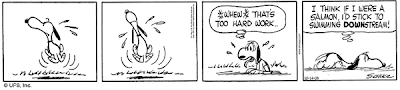 A bad day in the pool can be told by how the water feels. For me, the water becomes the consistency of peanut butter; you're getting a good catch on the strokes, but man, that pull is a complete and utter bee-yotch. Maybe I would have benefited from taking Friday - my normal rest day - off, rather than putting my Speedo Aquabeat MP3 player through its paces. I decided, since we had a non-training day (and a 59-minute hit) to make up for missing Tuesday morning's swim; (refer back to my comments in You Love The Thunder...Not!) disregarding my own dictum...to hit the pool for an hour. I decided to do 60 x 40yds freestyle on the 60. For those of you doing the math, that's 2400 yards of swimming. I averaged between 44 and 47 seconds for each repeat. For those of you who coach swimmers or swim well, you know that's not impressive. When you extrapolate that workout out to a 50yd pool, it was probably 40 x 50yds on the 1:15, averaging between 55 and 59 seconds for each.
Sunday morning's eight-miler was a trudge. No worries; a couple of years back, one of the guys I used to run with always said: 'the day after a hard race, run easy; the day after a good race, run easy.' Naturally, it was more difficult to run easy after a good race; you were stoked over your fitness, blah, blah, blah... But I think every one of us were a little beat from recent efforts, so it wasn't a bad morning...if you look past the ten pounds of used kitty litter in an eight-pound bag feeling in your legs. The one place I always find out how badly beat down (beat up?) I am in the physical sense is the pool. You can fake the track or the road by altering the course to make your effort easier. The pool, however, is another story. Well, I stand corrected. You can fake the pool if you're swimming a solo workout by lengthening the intervals, or in my case, use the entire interval. If you're not training alone and you have a bad day you either pray for them to be hurting worse than you, or hope like hell your lane-mates won't water polo (for those of you who haven't seen water polo, it's a legalized form of the dunk tag you used to play as a kid in the neighborhood pool, with a volleyball added to make it look like a sport) your sorry @$$ when they catch you on the fourth of six 150s or 200s.A bad day in the pool can be told by how the water feels. For me, the water becomes the consistency of peanut butter; you're getting a good catch on the strokes, but man, that pull is a complete and utter bee-yotch. Maybe I would have benefited from taking Friday - my normal rest day - off, rather than putting my Speedo Aquabeat MP3 player through its paces. I decided, since we had a non-training day (and a 59-minute hit) to make up for missing Tuesday morning's swim; (refer back to my comments in You Love The Thunder...Not!) disregarding my own dictum...to hit the pool for an hour. I decided to do 60 x 40yds freestyle on the 60. For those of you doing the math, that's 2400 yards of swimming. I averaged between 44 and 47 seconds for each repeat. For those of you who coach swimmers or swim well, you know that's not impressive. When you extrapolate that workout out to a 50yd pool, it was probably 40 x 50yds on the 1:15, averaging between 55 and 59 seconds for each.
Ah, but it was fun. Now we can get back to the schedule the way it should be. I'll get a rest day somewhere. Probably while I'm flying to Dubai.
Monday, May 19, 2008
Life is Full of Something
 I was all prepared yesterday morning to sit down in front of the toob, turn on MSNBC, and watch the highlights of the mens' Olympic triathlon trials. Lo and behold, what did they have on? The womens' marathon trials. What added insult to injury was the seven minutes (all right, more like three-and-a-half) of commercials right at the top of the hour, then the race from the ten kilometer mark. Yo, dude, what is up with that? Must have been the networks' way of surprising me. I did enjoy watching Deena Kastor kicking butt and taking names at mile 24; throwing her sunglasses off to the side of the road at the last mile for the benefit of the photographers and television cameramen. She's a gutsy runner and deserves a better finish in Beijing than she earned in Athens.
 This is the beginning of the hardest part of the year here, at least for me. The weather conditions on the Gulf Coast usually encourage what I find to be two racing seasons. When I lived in Tampa, there were races through the summer; Wednesday evenings at Al Lopez Park, Friday evenings on Clearwater Beach or St. Petersburg, and a few monthly races up near Brandon. But here, the races come few and far between; a couple in June, one or two in July, and one in August...unless you're willing to 'commute.'
So, the training goes into maintenance mode, and the intensity level gets dropped down a notch. The biggest challenge is holding your motivation when you're dealing with 90 days of 90 degrees and 90 percent humidity. Goal-setting tends to go by the wayside, or lowered to 'get through the summer without dying of heatstroke.'
But it is a good time to start looking ahead to what - and how - you want to be running in September, October, November, and even December. So, the to-do list is empty, and the possibilities are as limited as your imagination. Don't stop getting out and running, but think a little harder about cross-training (swimming, bicycling, elliptical trainer, weight training) to supplement or augment what mileage (or intensity) you might not be getting on the road.
KUDOS:
First, to my friends Steven and Beverly Fair for completing the Ford IM 70.3 at Walt Disney World. Steve, it looks like Beverly has the company bragging rights, since she whipped on both of us.
Second, to Scott Gregory and Beverly Boege for making it through the ING Bay to Breakers 12K last weekend. Scott, the liver will be ready for transplant when you come back.
Tuesday, April 8, 2008
Ask the Coach - April 8, 2008
 Summer is almost here and it's going to be hot. All of us know to drink more fluids and avoid running in the heat of the day. How should the heat effect our mix of intervals and long runs?
 I don't presume every runner knows to drink more fluids; more importantly than this, what fluids to drink. While your kidneys are good at controlling the amount of electrolytes passed in urine, your sweat glands are going to push out electrolytes as well as fluid as part of thermoregulation. This means plain water will do you fine while you're at the workplace, if you have a job where most of your day is spent at the desk. However, plain water can be a little, er, boring to the palate; you're not going to drink what doesn't suit your taste. Sports drinks, such as Gatorade, Powerade, Propel, and so on, are good at making certain you have sufficient hydration; the down side of these drinks are that they have a great deal of high fructose corn syrup, a cheap sweetener, and not so much in sodium, potassium, chloride and other electrolytes, which are the things you need most to be replacing.
Oh, contrary to popular belief, the carbohydrates in most beer are countered by the toxicity of the ethanol. Your liver has to work to process the alcohol and remove it from your system before it can assimilate any carbs. Since alcohol can only be passed through the system by urination, sweat or respiration, like that of caffeine, you'll lose more fluid by drinking alcohol or caffeinated beverages (iced tea, iced coffee, energy drinks) than you would sugary drinks, which take longer to pass through the gut.
You can run during the daytime, but understand that the fluid you lose through cooling your body (sweat) is taken from your blood circulating through your capillaries; that's why you'll see folks looking quite red on a hot day when they've been active. The water loss from your blood as part of the cooling process makes the blood thicker and more difficult for the heart to pump through the circulatory system. Think of it like trying to suck honey through a thin straw, compared to sucking water through the same; it's much harder. Since the blood flows slower through the vessels, it takes more pumps of the heart to move it the same distance it would travel with full fluid volume...oh, did I mention the fact your blood is going to the areas of the body needed most at exercise? That means your leg muscles are probably getting the most blood sent to it, next to the brain. That's a long way to go.
So, hotter and more humid conditions of summertime running mean your perceived effort at a particular pace is going to increase. That's bad news. The good news is there aren't many "important" summer races here. The best thing you can do is continue to run through the year, listen to what your body is telling you, and adjust your effort accordingly. As for track workouts and long runs, I suggest finding a sports drink that replaces the minerals and electrolytes you lose through sweat, and keeping a bottle or two available. You can stash bottles on a long run or get your favorite drink at the local convenience store if carrying a bottle is too much of a problem. If those don't work, then adjust your workout times to take advantage of conditions, or run at places where there are water fountains. Swimming or biking may be a good way to get some exercise this summer since it will be so hot. What's the best mix of swimming, biking and running?
 Swimming or biking may be a good way to get some exercise this summer since it will be so hot. What's the best mix of swimming, biking and running?
 Swimming and bicycling are great cross-training, I like them a great deal because of the reduced impact to the musculoskeletal system. The best blend of cross-training activities depends on your fitness level and amount of time you have available to ride or swim. Borrowing the old phrase "the main thing is to keep the main thing the main thing," there is a limited degree of transfer between swimming, bicycling and running; you need to run if you want to be a good runner. If you bicycle, make certain you wear a CPSC or ANSI-approved bicycle helmet, follow *all* the rules of the road, and (please!) refrain from wearing headphones *in your ears* (there are devices that will allow you to listen to music in your helmet AND hear surrounding traffic). I may want to run a marathon this fall. Is it too early to start training this summer?
I may want to run a marathon this fall. Is it too early to start training this summer? Good for you. A marathon will teach you a great deal about yourself; your perceived limitations, strengths and weaknesses. Training for a marathon, especially a first marathon, takes at least 18, and up to 26 weeks, depending on fitness level and goal. If your plan is to do LaSalle Bank Chicago Marathon, around the first week of October, this would be the time to begin marathon training. Before you mention heat as an obstacle, let me remind you of a painfully obvious fact: Chicago in the first week of October can range in temperature from the high 80s (last year) to the high 30s (about five years ago). You never know what conditions are going to be like on the day. There are good training plans available, several of which have been used by ECRT athletes to run personal best times and qualify for Boston. The biggest challenge is not so much choosing a training plan, but to follow it through and make certain you toe the line on the day as healthy as possible. A personal note: Running a marathon while injured is not a good idea.
Tuesday, March 4, 2008
Nice... Problems To Have
 Every time I hit the road for a race/trip it seems the desk clerk or the concierge assumes everyone who is a runner wants pasta the night before the race. Personally, I'm not in the mood for pasta; I'd rather have Chinese...then I can have rice, and veggies and chicken.
We had some fantastic pasta in the past, I dare admit. One place near Dayton, OH, had some good stuff. But the most memorable thing had to be the abundance of garlic...Chef Emeril Lagasse was asked during one of his shows, 'how do you know when there's too much garlic?' His response almost broke the seatbelt on my couch and risked having me roll on the floor, laughing my @$$ off: 'I don't know. I haven't gotten there yet.' Okay, we were warned about the garlic content of this place's house dressing, so we went with ranch on top of our salad. HOWEVER, the chef must have caught on to our plan to avoid the bulb, because the fried calamari must have been marinated in the stuff. Yes, it was delicious, but (exhale, wrinkle nose) I think I'm still detoxifying five months after the fact.
 ...sounds like someone in need of a Toastmasters intervention.
 My swimming coach and I were chatting after this morning's workout (once I regained consciousness/normal heart rate/normal breathing) about what easily could have been considered the match race for this local running community. Two of the area's strongest runners finally went head-to-head during a 15-mile race at Fort Pickens, on the Gulf Islands National Seashore. One specializes at racing the half-marathon and under, the other races the half-marathon and up. Both are quiet, unassuming, and modest gentlemen; coaching and inspiring many of the area's young adult runners. It's almost funny to see the running community line up behind one or the other when the (inevitable) debate arises each year. The runner who took second place has won his share of marathons. He was the first American male to win the Disney Marathon, and he's won Pensacola's marathon on at least two occasions, I believe. His comment about what happened during the race, 'I still got (sic) a little marathon in me.'
Steve was planning to ask Marathon Matt about his recovery regimen; seems an interesting topic, given the (painfully obvious) fact he raced (okay, ran - his winning time was ten minutes slower than his winning time the previous year) Pensacola two weeks before and Disney several weeks before that.
 I think there's probably two or three points Matt would mention:
1. Train to peak at the right time. Know the races for which you want to be the most fit and the most ready, then walk backward as you're planning your training cycle.
2. Follow the hard/easy principle of training. If you train full-bore all year long the odds are high you will incur an injury.
3. Listen to the times when your body says it needs rest. Complete rest, active rest, and regeneration is as important as tempo runs, interval work and overdistance.
I'm certain the races Matt's run this early spring have been signposts on the way to his ultimate goal; a strong finish on Boylston Street come mid-April. You don't see him racing throughout the year. In fact, a long, steady training progression (with a single-peak period) ensures the highest and longest peak he - and most well-trained athletes - can possibly achieve.
 Fatigue. Starting to see the possible benefits of massage therapists and "bone benders," especially as there are more miles on the ol' odometer. Funny, running will beat you from the behind down (unless you've got old shoes, and then it can beat up you lower back, too)...it takes that swimming and cycling we use for cross-training to beat up the rest of the musculoskeletal system. I don't get it...yet. But I will soon.
Four days so far, and I've been good on my vow to steer clear from french fried potatoes. I'm not certain whether I'll be able to hold off the entire month, but I'm going to try. I think if I see a couple of extra pounds drop off this frame it'll be the motivation to keep at it. It's an interesting paradox; while fat stores in the body are beneficial to swimming (buoyancy) they are useless excess baggage once you get on the bicycle or out on the run. Get too thin and you might be able to climb or ride strongly, but you then lack on the run...and swimming is a nightmare.
So where do we draw the line? My wife says a little more to the right than I say. There's a happy medium all over the place.
 Res Ipsa Loquitur, NSPS.
I'm certain the races Matt's run this early spring have been signposts on the way to his ultimate goal; a strong finish on Boylston Street come mid-April. You don't see him racing throughout the year. In fact, a long, steady training progression (with a single-peak period) ensures the highest and longest peak he - and most well-trained athletes - can possibly achieve.
 Fatigue. Starting to see the possible benefits of massage therapists and "bone benders," especially as there are more miles on the ol' odometer. Funny, running will beat you from the behind down (unless you've got old shoes, and then it can beat up you lower back, too)...it takes that swimming and cycling we use for cross-training to beat up the rest of the musculoskeletal system. I don't get it...yet. But I will soon.
Four days so far, and I've been good on my vow to steer clear from french fried potatoes. I'm not certain whether I'll be able to hold off the entire month, but I'm going to try. I think if I see a couple of extra pounds drop off this frame it'll be the motivation to keep at it. It's an interesting paradox; while fat stores in the body are beneficial to swimming (buoyancy) they are useless excess baggage once you get on the bicycle or out on the run. Get too thin and you might be able to climb or ride strongly, but you then lack on the run...and swimming is a nightmare.
So where do we draw the line? My wife says a little more to the right than I say. There's a happy medium all over the place.
Res Ipsa Loquitur, NSPS.Saturday, January 12, 2008
Time To Put Out The Shingle
So...looking in the local bulletin board and I find this:
I am a relatively new runner (6 mos). I have 3 5k's, 3 10k's, and 2 4 milers under my belt. In the last month though I have been dealing with terrible lower leg pain after a run no matter what the distance is. I motrin up, take hot soaks, ice bag, and use the various cream rubs to no avail. I am hooked on running but am worried this is more than something that a new runner deals with. Any advise (sic) out there?
I am a relatively new runner (6 mos). I have 3 5k's, 3 10k's, and 2 4 milers under my belt. In the last month though I have been dealing with terrible lower leg pain after a run no matter what the distance is. I motrin up, take hot soaks, ice bag, and use the various cream rubs to no avail. I am hooked on running but am worried this is more than something that a new runner deals with. Any advise (sic) out there?
IF I WERE YOUR COACH: Eight races in six-months of running might be normal for a well-trained, well-conditioned elite-level runner. However, I think it's too much, too soon for a person who is in their first six months of regular running.
There are a number of root causes for lower leg pain that come to mind:
1. Previous (undiagnosed) injury
2. Lack of running experience
3. Competitive running
4. Excessive weekly running distance
Your injury is probably due to a breakdown. You've run and raced more than your body has been capable of handling, stress-wise. Without looking at your shoes, your mechanics, or your background I cannot say with clarity what the cause may be.
The good news is that most injuries are curable, if you are willing to be patient (the degree of injury you apparently have suggests a three-to-six-month recovery) and correct the root causes:
1. Find an alternative means of exercise that will build leg strength and maintain cardiovascular fitness without aggravating the present injury.
2. Sit down with an experienced running coach and develop a holistic training and racing plan which includes all of the necessary elements; rest, long aerobic runs, speed work and recovery runs.
3. Visit a knowledgeable running store (such as Running Wild) and have their staff look at your biomechanics and fit you for a running shoe that meets your running needs and your individual biomechanics.
You might want to also spend some time and money visiting your general practitioner to let them make certain there is no (stress-related) fracture to the leg.
There's my two cents. Please feel free to contact me; if I cannot help you I can point you in the direction of other coaches and professionals.
I cannot wait to see my response get slammed. :)
There are a number of root causes for lower leg pain that come to mind:
1. Previous (undiagnosed) injury
2. Lack of running experience
3. Competitive running
4. Excessive weekly running distance
Your injury is probably due to a breakdown. You've run and raced more than your body has been capable of handling, stress-wise. Without looking at your shoes, your mechanics, or your background I cannot say with clarity what the cause may be.
The good news is that most injuries are curable, if you are willing to be patient (the degree of injury you apparently have suggests a three-to-six-month recovery) and correct the root causes:
1. Find an alternative means of exercise that will build leg strength and maintain cardiovascular fitness without aggravating the present injury.
2. Sit down with an experienced running coach and develop a holistic training and racing plan which includes all of the necessary elements; rest, long aerobic runs, speed work and recovery runs.
3. Visit a knowledgeable running store (such as Running Wild) and have their staff look at your biomechanics and fit you for a running shoe that meets your running needs and your individual biomechanics.
You might want to also spend some time and money visiting your general practitioner to let them make certain there is no (stress-related) fracture to the leg.
There's my two cents. Please feel free to contact me; if I cannot help you I can point you in the direction of other coaches and professionals.
I cannot wait to see my response get slammed. :)
Friday, October 26, 2007
Our Own Cross (Training) To Bear
 Here on the Gulf Coast, autumn temperatures and conditions don't show until the end of October, and when they do show they make themselves known quite readily. My northern friends consider me a sissy for pulling out knicker tights when the temperature drops below 60 degrees, but once your blood has thinned out from two decades of sunshine and warm, humid conditions there's no turning back. Even rainy evenings (which during the summer present precious comfort to us until the sun returns and we feel like we are in the world's largest sauna) can be a tad uncomfortable, pretty much because we get those 15-20 mph gusts cutting through the dri-fit gear we've chosen for our run.
 These conditions can motivate you to very strong workouts, like last Thursday's mile repeats. I won't say they were heroic by any stretch of the imagination, but they were pretty darn good. I think my training partner and I would have been 15 (well, maybe 20) seconds per mile slower if not for the ungodly amount of rain dropping on us. Frankly, we both wanted to get that workout over with...even our warm-up was a little on the warm side.
 One of the things that most runners do not think much about is cross-training. Perhaps they do more in the northern climates because they are in snow and snow-related products for months at a time. Down here, we race from September until May, with a little bit of a break over the holidays; for us it's more of a time where training has to be focused because of the lack of daylight. Cross-training does some wonderful things, in my humble opinion. It keeps you from getting burned out over running; that variety is the spice of life thing, you know? You have the opportunity to do some of the lower-intensity training indoors, saving your quality work for those times when it's light enough to get out there and hammer. Perfect for guys like me who haven't completely learned the benefit of easy days. Didn't say I wasn't learning, but it's usually by necessity. And, if you have a spouse, partner, friend or significant other who isn't into running or doesn't run as fast (or runs faster) than you, cross-training can also give you both some quality time, depending on the activity.
When I talk about cross-training, I'm talking exercise activities that can be done indoors, such as spinning, elliptical trainer, treadmill running or swimming. There's also basketball, racquetball, aerobic exercise of all sorts and weight training that can be done, but I'll limit myself to the first four I've mentioned.
Spinning - think of a spectrum of exercise spanning an exercise bicycle and the Tour de France.
Positives: controlled conditions (no traffic), minimal equipment hassles (no flat tires), and the ability to work out at your own intensity level and still be in the vicinity of your fellow exercise enthusiasts. Oh, there's also the motivation of high-energy music (my instructor has played everything from Al Jarreau to ZZ Top in the past two years) and an instructor who tells you what you need to do, such as get up out of the saddle, hands at a particular position on the handlebars, pedal at a certain pace/heart rate intensity.
Negatives: doesn't help your bike-handling skills. Some instructors are less cycling-focused than others; while most Spinning instructors have a certification through Madd Dogg sports, they may (or may not) understand the focus of a cross-training athlete. You also have to find a place with a spinning class (local Y, fitness center, gymnasium, health club), then hope a bike is available. In my case, I like to use my road bike shoes, so I have to find a spinning bike that has Look-compatible cleats, or settle for platform pedals that accept workout shoes and aren't as efficient.
Burn: a 40-minute class will burn between 300 and 400 calories, depending on the intensity.
Elliptical trainer - lets you go through all of the motions of running or cross-country skiing, without the jarring of a treadmill. These are especially good during taper periods before a half-marathon or a marathon, when you absolutely feel the need to put a check in the got a 60-minute workout block of your daily to-do list; they're also great for rehabilitation from injury, say, when you break your arm and can't run for eight weeks.
Positives: most good machines have a variety of programs which allow you to work at a fat-burning or cardiovascular-stressing intensity, as well as hill climbing, interval and random programs. All of the information (distance, pace, calorie burn, heart rate, terrain) is right in front of you, so you are not left in the dark. You can let your legs and lungs feel the burn without beating yourself to death.
Negatives: most gyms don't have enough elliptical trainers, or the ones that are available have broken pulse monitors. A good solution for that problem is to take your own heart rate monitor strap with you to the gym. Also, without a television, music or other diversion, using elliptical trainers can be about as much fun as watching paint dry. When I do use an elliptical I'm always stuck in front of a television that has The Jerry Springer Show, or Fox News (now there's an oxymoron...) on...making my workout even that much more uncomfortable. You don't get the mileage in that you would cover on a treadmill or on the road. Also, if you have knee issues, some programs will trash your knees long before you stress your heart.
Burn: 40 minutes in fat-burning mode, without going too far over the line, will burn between 600 and 700 calories. You could do another 20 minutes, but the antidepressant use may outweigh the calorie burning benefits.
Treadmill - the original, and probably the most commonly used piece of indoor cardiovascular exercise equipment. I don't have to say much about this that you don't already know.
Positives: infinite variations on a theme. The ability to walk, jog or run on these things are a plus. Add the hill, interval, heart rate, and random programs to a good treadmill and you would wonder why any of us would ever go outside. The feedback on most treadmills is pretty much the same as elliptical trainers.
Negatives: doesn't replicate road running as well as most runners would like. Why is it I can run a 5:47 mile on the track and I cannot run a mile on a treadmill at 10.8 miles per hour? The shock absorbency of the treadmill deck varies from model to model, and a good model costs serious money. Also, while treadmills have ways to carry your fluid bottles and your music player, I've only seen one that has a ventilation fan...and even it isn't all that good. Watch me sweat all over a treadmill and you'll understand why I think fans are a great thing. And again, while I don't want to complain, treadmill choice at most gym facilities are like men and parking spaces at the mall: the good ones are all taken, the rest are way out there or damaged.
Burn: running an eight minute mile, you can burn about 500 calories in the space of 40 minutes.
Swimming - the one cross-training activity that I believe really transfers over to running.
Positives: no jarring, no pounding, and (relatively) easy on your muscles and joints. You know when you're improving in the pool, and when all of the techniques are falling into place. The discipline of breathing (inhaling especially) at the right time pays back dividends during that hard second mile of a 5K run. Also, there's not much you need to get into the pool, outside of a swimsuit and a pair of goggles. Everything else; kickboards, pull buoys, fins, caps, and so on...it's all optional.
Negatives: large learning curve. Technically a complex activity, unless you plan to limit yourself to easy breaststroke. Time your breathing wrong and you're likely to end up with a mouth full of pool water rather than air. Certain times of the year, especially in this area of the country (where lightning is a near-daily occurrence) can pull you out of the pool in a flash...pun intended. And most swimming facilities around here are very strict on pulling folks out at the first flash of lightning.
Burn: an hour of good, vigorous swimming can burn up to 600 calories.
So, it's a good time to start thinking about what to do other than just running during this fall and winter. The fitness and strength you can maintain over the dark months will shorten the time it takes for you to get back into form once spring arrives...especially if it keeps you from gaining those five or ten pounds that somehow jump on our bodies between the end of October and the beginning of January.
Kia Kaha. Stay Strong.
Spinning - think of a spectrum of exercise spanning an exercise bicycle and the Tour de France.
Positives: controlled conditions (no traffic), minimal equipment hassles (no flat tires), and the ability to work out at your own intensity level and still be in the vicinity of your fellow exercise enthusiasts. Oh, there's also the motivation of high-energy music (my instructor has played everything from Al Jarreau to ZZ Top in the past two years) and an instructor who tells you what you need to do, such as get up out of the saddle, hands at a particular position on the handlebars, pedal at a certain pace/heart rate intensity.
Negatives: doesn't help your bike-handling skills. Some instructors are less cycling-focused than others; while most Spinning instructors have a certification through Madd Dogg sports, they may (or may not) understand the focus of a cross-training athlete. You also have to find a place with a spinning class (local Y, fitness center, gymnasium, health club), then hope a bike is available. In my case, I like to use my road bike shoes, so I have to find a spinning bike that has Look-compatible cleats, or settle for platform pedals that accept workout shoes and aren't as efficient.
Burn: a 40-minute class will burn between 300 and 400 calories, depending on the intensity.
Elliptical trainer - lets you go through all of the motions of running or cross-country skiing, without the jarring of a treadmill. These are especially good during taper periods before a half-marathon or a marathon, when you absolutely feel the need to put a check in the got a 60-minute workout block of your daily to-do list; they're also great for rehabilitation from injury, say, when you break your arm and can't run for eight weeks.
Positives: most good machines have a variety of programs which allow you to work at a fat-burning or cardiovascular-stressing intensity, as well as hill climbing, interval and random programs. All of the information (distance, pace, calorie burn, heart rate, terrain) is right in front of you, so you are not left in the dark. You can let your legs and lungs feel the burn without beating yourself to death.
Negatives: most gyms don't have enough elliptical trainers, or the ones that are available have broken pulse monitors. A good solution for that problem is to take your own heart rate monitor strap with you to the gym. Also, without a television, music or other diversion, using elliptical trainers can be about as much fun as watching paint dry. When I do use an elliptical I'm always stuck in front of a television that has The Jerry Springer Show, or Fox News (now there's an oxymoron...) on...making my workout even that much more uncomfortable. You don't get the mileage in that you would cover on a treadmill or on the road. Also, if you have knee issues, some programs will trash your knees long before you stress your heart.
Burn: 40 minutes in fat-burning mode, without going too far over the line, will burn between 600 and 700 calories. You could do another 20 minutes, but the antidepressant use may outweigh the calorie burning benefits.
Treadmill - the original, and probably the most commonly used piece of indoor cardiovascular exercise equipment. I don't have to say much about this that you don't already know.
Positives: infinite variations on a theme. The ability to walk, jog or run on these things are a plus. Add the hill, interval, heart rate, and random programs to a good treadmill and you would wonder why any of us would ever go outside. The feedback on most treadmills is pretty much the same as elliptical trainers.
Negatives: doesn't replicate road running as well as most runners would like. Why is it I can run a 5:47 mile on the track and I cannot run a mile on a treadmill at 10.8 miles per hour? The shock absorbency of the treadmill deck varies from model to model, and a good model costs serious money. Also, while treadmills have ways to carry your fluid bottles and your music player, I've only seen one that has a ventilation fan...and even it isn't all that good. Watch me sweat all over a treadmill and you'll understand why I think fans are a great thing. And again, while I don't want to complain, treadmill choice at most gym facilities are like men and parking spaces at the mall: the good ones are all taken, the rest are way out there or damaged.
Burn: running an eight minute mile, you can burn about 500 calories in the space of 40 minutes.
Swimming - the one cross-training activity that I believe really transfers over to running.
Positives: no jarring, no pounding, and (relatively) easy on your muscles and joints. You know when you're improving in the pool, and when all of the techniques are falling into place. The discipline of breathing (inhaling especially) at the right time pays back dividends during that hard second mile of a 5K run. Also, there's not much you need to get into the pool, outside of a swimsuit and a pair of goggles. Everything else; kickboards, pull buoys, fins, caps, and so on...it's all optional.
Negatives: large learning curve. Technically a complex activity, unless you plan to limit yourself to easy breaststroke. Time your breathing wrong and you're likely to end up with a mouth full of pool water rather than air. Certain times of the year, especially in this area of the country (where lightning is a near-daily occurrence) can pull you out of the pool in a flash...pun intended. And most swimming facilities around here are very strict on pulling folks out at the first flash of lightning.
Burn: an hour of good, vigorous swimming can burn up to 600 calories.
So, it's a good time to start thinking about what to do other than just running during this fall and winter. The fitness and strength you can maintain over the dark months will shorten the time it takes for you to get back into form once spring arrives...especially if it keeps you from gaining those five or ten pounds that somehow jump on our bodies between the end of October and the beginning of January.
Kia Kaha. Stay Strong.
Saturday, August 25, 2007
Changing Hats
 A little out of character for me to write on a Saturday. However, I wanted to ensure the few who read my pithy (lisp not intentional) commentaries as they post that I am still alive and have all my body parts in near-optimal working order. Honest. The orthopedic consultant said so. Yep, he says I'm at 95-percent of normal, and the last five percent will come in the next couple of months.
The mental health, however, is always going to be questioned.
It's not often that my real job gets in the way of what I like to do; coach, train, write and ponder the mysteries of the universe. This week, however, is an entirely different story. I've been spending more time interviewing classroom instructors and entering their responses into an on-line database in support of a major, high-level (we're talking admirals here, baby!), high-visibility project which will provide my co-workers and me a vastly-increased sense of job security, regardless of what the Navy does to my organization 14 months from now.
If they do what we think they'll do in October 2008, I'll be changing hats...either from a performance consultant to an analyst/education specialist or from a civil servant to a retired government worker, depending on the amount of incentives provided. I don't suspect a great voluntary retirement incentive to be given to a guy who is five years out from the calculated minimum retirement age-plus-years of federal service thing.
But that's another story.
Being an athlete who also coaches, I place my confidence in several others to have my best interest at heart...especially in the realm of cross-training. If I were strictly running there would be no issue at all; I'd get on the phone with my coach and go through the 'here's what I think about this bit of training, here's how training so far has affected me...got any comments?' kind of conversation. But, I also swim and ride to prepare for triathlon. That means I have to balance the commitment level they want from me with the commitment level I want from my athletes (which in turn is demonstrated by my own commitment). Lots of communication; most of it frank, occurs within 24 hours of the workout.
I can tell my swim coach, with all honesty, 'dude, I am seriously beat up today. I'll push through to this point in the workout, but beyond that point it's time to crawl to the office.' Of course, he does the same with me when he's at the track.
Lately, my regular spinning trainer has moved down the road to another training gig, which means one of the other gym staff has taken over the class. No big deal to me; I'm there to get my workout in and I'll put forth the effort necessary (give or take a few pedal strokes or percentage points of effort) to get out what I've intended. However, there are some newer guys in the gym who don't really want to be there to work hard. They want to punch their 'I did my 45 minutes of physical training today' box on the checklist for their unit and go on from there. I don't particularly like lazy people screwing with my trainer. I don't like any person screwing with my trainer, because then they are expending their energy on dealing with the asshole and not on me, the person who really wants to be there.
I went to talk with her a couple of days later...just to make certain everything was all right. The guys in the class said they had trained with me (that I was their instructor) before, which was a f...ing lie. Well...that has my hackles up now. I almost told her I'd love to take them for a class...better yet, for a little sprint triathlon, just so I could see them drag @$$ through that. That's evil. And right now, I don't particularly care.
The worst thing you can do is lie to your trainer or your coach on how you're feeling. If you feel bad, I mean, really feel bad, then you should take the day off, or cut the workout short and tell the trainer or coach. If you're feeling lazy and you don't want to work out, don't waste your time going into the gym. Take the day off, start up fresh again the next day.
I can tell my swim coach, with all honesty, 'dude, I am seriously beat up today. I'll push through to this point in the workout, but beyond that point it's time to crawl to the office.' Of course, he does the same with me when he's at the track.
Lately, my regular spinning trainer has moved down the road to another training gig, which means one of the other gym staff has taken over the class. No big deal to me; I'm there to get my workout in and I'll put forth the effort necessary (give or take a few pedal strokes or percentage points of effort) to get out what I've intended. However, there are some newer guys in the gym who don't really want to be there to work hard. They want to punch their 'I did my 45 minutes of physical training today' box on the checklist for their unit and go on from there. I don't particularly like lazy people screwing with my trainer. I don't like any person screwing with my trainer, because then they are expending their energy on dealing with the asshole and not on me, the person who really wants to be there.
I went to talk with her a couple of days later...just to make certain everything was all right. The guys in the class said they had trained with me (that I was their instructor) before, which was a f...ing lie. Well...that has my hackles up now. I almost told her I'd love to take them for a class...better yet, for a little sprint triathlon, just so I could see them drag @$$ through that. That's evil. And right now, I don't particularly care.
The worst thing you can do is lie to your trainer or your coach on how you're feeling. If you feel bad, I mean, really feel bad, then you should take the day off, or cut the workout short and tell the trainer or coach. If you're feeling lazy and you don't want to work out, don't waste your time going into the gym. Take the day off, start up fresh again the next day.
Subscribe to:
Posts (Atom)