"Achilles tendonitis..."
I turned in the direction of the voice. Valentino, in a voice which seemed almost a laugh, said again, "Achilles tendonitis!"
"You?" I asked.
"Yeah, me. I suspected that's what was wrong. I could feel it when I got out of bed the past couple of mornings; all the popping noises and such."
"It's a sign we're getting old, man. Our breakfast cereal is supposed to make noise, not our body," I replied.
I'm not into schadenfreude, the concept of having joy at the misfortune of someone else, but it did seem a little bit ironic. Val's also a running coach; he specializes in sprints at the high school and Junior Olympic level. During my autumn of pain, he would shout angrily when I would limp into the office the day after my own track workouts -- workouts which had intensities or distances too much for my fifty-year-old (still-injured) tendons to endure.
So, Val has appointments with the base medical clinic, the physical therapist, base pharmacy and the like. But he's going to keep running because he's stubborn...and he hates cross-training.
When runners think about injuries and their treatment, most of them have heard of the mnemonic RICE: Rest, Ice, Compression, Elevation. While this treatment method works well for the discomfort of soft tissue injuries, it's not a cure, and isn't as effective when we begin to talk about the more common overuse injuries from which runners suffer.
The same mnemonic, RICE, can be used to treat the cause of injuries like achilles tendinosis, plantar fasciitis, iliotibial band syndrome, patellar tendinosis, and the like. Unlike the soft tissue RICE, this RICE stands for: Reflect, Identify, Correct, Evaluate.
Reflect - stop and think: Has there been a sudden change in the run/workout routine? Have I added distance, changed terrain, altered surface, or increased intensity? When did I purchase this pair of running shoes?
Identify - what are the most-likely causes for the damage? In the case of overuse injuries the culprit usually begins with "too:" Too much speed work. Too much added distance. Too little recovery. Too old shoes. Too many hills. Too many crowned or bad surfaces.
Also, take the time to identify what sort of exercise you can do to replace running for the next few weeks; you might lose some cardiovascular fitness during this period, but exercise which does not aggravate the present damage will allow blood to continue to flow to the injured area, continuing the healing process. Anti-inflammatory drugs can be taken to ease swelling but shouldn't be taken to mask pain just so you can go out and run...remember the discomfort/pain is a message that something is injured and needs to heal.
Correct - what can you do to keep this injury from reoccurring? A lot of overuse injuries are the result of a musculoskeletal imbalance or a muscular weakness, leading to compensation by a connecting part of the body which was unable to handle, or recover from, the increased strain.
Evaluate - is there really a need to train at the level which caused the injury in the first place? If the root cause of the injury is strictly to do with poor equipment then I would recommend a gradual return to the training regimen where no pain existed. If terrain, mileage, intensity or surface changes were the cause, then consider very conservative changes or increases, giving the body sufficient time to recover and adjust to the new stress. If the cause is too little recovery, then you'll have to figure out a way to assist the recovery process either by taking a day off, engaging in "active rest," or implementing modalities like self-massage, massage therapy, compression garments, stretching and so on.
So, when it comes to injuries, you still need to remember the RICE mnemonic, but it's a completely different form of RICE. Reflect. Identify. Correct. Evaluate.

So, How Many Hats Do You Wear?

- Michael Bowen
- Pensacola, Florida, United States
- Husband. *Dog Dad.* Instructional Systems Specialist. Runner. (Swim-challenged) Triathlete (on hiatus). USATF LDR Surveyor. USAT (Elite Rules) CRO/2, NTO/1. RRCA Rep., FL (North). Observer Of The Human Condition.
Showing posts with label distance. Show all posts
Showing posts with label distance. Show all posts
Thursday, April 25, 2013


Wednesday, January 30, 2013
(Out of) My Vulcan Mind
Three days after the fact I can safely say I don't ever want to do anything like that again.
Define "that." "That" is short for 'run a distance race in an undertrained state.'
Even the definition of "undertrained" can be kind of nebulous and squishy. To differentiate between the two most common forms, there's "undertrained," as in "haven't done as many long runs, or speed workouts as I would have preferred." That's a more-tolerable and more-desirable state. There have been some of those worried chats before, where I've told one or two of my own (panicky) athletes their one-toke-short-of-the-line state wasn't such a bad thing. That form of undertrained is much better than being overtrained (under-recovered).
Then there's the other "undertrained" state. That's the one that's most simply defined as "insufficient training volume for the target distance," or the "just lay it out there and pray to whatever gods may be that muscle memory saves the day" state.
In some quarters it's also known, politely, as "extracting a race effort from a portion of the runner's nether region."
When athletes I've worked with in the past have told me "I'm thinking about going to do the (insert event name here), but I haven't trained for it..." in the overwhelming majority of cases the next sound they hear from my mouth sounds like a cross between screaming and...
The first 40 minutes went almost like a charm. Only a few seconds off the pace I would have loved to have completed for the entire race. The second 40 minutes went almost according to plan. Reality began to set in at about 1:15, aboutt the time when I normally finish my Sunday morning runs. Trouble was I had somewhere between four and five miles left. With two miles to go I could feel the first twinges in my left calf, which really slowed the flow of progress. A little adjustment, a little self-talk, and a little music had me back on track. I finished in 1:56, and suspect if I had run steady for the second 40-minute piece my finish would have been around the same as my previous half-marathon...eight months ago.
The lesson I hope you take away from this is: There's a range of training volume - distance, intensity, time - which is perfect for each race distance. A runner doing 60 miles a week can get away with running a 5,000-meter road race, and might do it with a 2-to-3 mile warm-up/cool-down. On the other hand, a 20-mile-a-week guy (or gal) who jumps into a half-marathon is asking for trouble...especially if it's their first one. A more-experienced runner might get away with being a little under-prepared, but they're more likely...transiently...out of their Vulcan mind.
Define "that." "That" is short for 'run a distance race in an undertrained state.'
Even the definition of "undertrained" can be kind of nebulous and squishy. To differentiate between the two most common forms, there's "undertrained," as in "haven't done as many long runs, or speed workouts as I would have preferred." That's a more-tolerable and more-desirable state. There have been some of those worried chats before, where I've told one or two of my own (panicky) athletes their one-toke-short-of-the-line state wasn't such a bad thing. That form of undertrained is much better than being overtrained (under-recovered).
Then there's the other "undertrained" state. That's the one that's most simply defined as "insufficient training volume for the target distance," or the "just lay it out there and pray to whatever gods may be that muscle memory saves the day" state.
In some quarters it's also known, politely, as "extracting a race effort from a portion of the runner's nether region."
When athletes I've worked with in the past have told me "I'm thinking about going to do the (insert event name here), but I haven't trained for it..." in the overwhelming majority of cases the next sound they hear from my mouth sounds like a cross between screaming and...
Even I asked myself a couple of months ago that very question, "Bones."
Suzanne had the temerity to suggest last week that I hang back in the same corral with her and Teri, amble along and watch the sights at a pace which would have been about 65 percent of my planned effort. Ah, but I remembered all-too-well trying to hold back and run with Suzanne...at 50-to-60 percent of my ability...about four years ago. Frustrating for her. Painful for me.
Suzanne had the temerity to suggest last week that I hang back in the same corral with her and Teri, amble along and watch the sights at a pace which would have been about 65 percent of my planned effort. Ah, but I remembered all-too-well trying to hold back and run with Suzanne...at 50-to-60 percent of my ability...about four years ago. Frustrating for her. Painful for me.
So, it was time to pull out the proverbial "plan B" for the morning. I had already penciled in the need to do 40-minute workouts (running, spinning, rowing, or lifting) during the week. Why not use this time as a workout in the presence of 20,000 friends...most of whom still owed me at least one beer? The first 40 minutes would be a great time for a moderate-pace run, after which the crowd would probably thin out enough to let me get about 40 minutes of "speed work" in. After that I figured the next 10-to-30 minutes would serve as that "extraction from the nether region" time. If I felt great I'd drop the hammer, and if not I'd smile and let the crowd pull me along to the finish.
The first 40 minutes went almost like a charm. Only a few seconds off the pace I would have loved to have completed for the entire race. The second 40 minutes went almost according to plan. Reality began to set in at about 1:15, aboutt the time when I normally finish my Sunday morning runs. Trouble was I had somewhere between four and five miles left. With two miles to go I could feel the first twinges in my left calf, which really slowed the flow of progress. A little adjustment, a little self-talk, and a little music had me back on track. I finished in 1:56, and suspect if I had run steady for the second 40-minute piece my finish would have been around the same as my previous half-marathon...eight months ago.
The lesson I hope you take away from this is: There's a range of training volume - distance, intensity, time - which is perfect for each race distance. A runner doing 60 miles a week can get away with running a 5,000-meter road race, and might do it with a 2-to-3 mile warm-up/cool-down. On the other hand, a 20-mile-a-week guy (or gal) who jumps into a half-marathon is asking for trouble...especially if it's their first one. A more-experienced runner might get away with being a little under-prepared, but they're more likely...transiently...out of their Vulcan mind.
Wednesday, January 9, 2013
Keep It Simple - Part I
“It can scarcely be denied that the supreme goal of all theory is to make the irreducible basic elements as simple and as few as possible without having to surrender the adequate representation of a single datum of experience.”
Albert Einstein (1879-1955), during a lecture, Oxford, June 1933
When is the last time you walked into your local running emporium to purchase a pair of shoes? In a perfect world, if you’re like me, the duration from arrival-to-purchase is brief; I know (down to three makers/styles) the shoe I need. I don’t need to try them on or do a brief jog in them. Just set the box on the counter and swipe my American Express card. Thanks, and I’ll see you in about ten weeks.
When is the last time you walked into your local running emporium to purchase a pair of shoes? In a perfect world, if you’re like me, the duration from arrival-to-purchase is brief; I know (down to three makers/styles) the shoe I need. I don’t need to try them on or do a brief jog in them. Just set the box on the counter and swipe my American Express card. Thanks, and I’ll see you in about ten weeks.
My $500-per-year running shoe habit probably covers a little less than 1/1000th of a store proprietor’s yearly expenses. My few gizmos, gadgets, and apparel - thank heavens - have longer life spans. The entry-level runner is more likely to be welcomed with open arms into "SHOES 'R' US" than frugal/cheap runners like me. "GAIT-O-RAMA" associates love to see the person who just got finished reading the “five weeks to a faster 5K” or “crush your first marathon” article in the glossy running magazine or on the interlink. There's nothing like seeing the newbie runner drool as they finger their way through the jogger-porn and look with longing at advertisements for the newest electronic training gadget, or hydration system, or symphony-quality earbuds. There are benefits to many of the apparel items, multifunctional watches, post-run recovery gadgets and technological “nice-to-haves,” but Murphy’s Law posits that the higher-ticket item leads to a greater and more irrational dependence. The more dependent the runner becomes on them, the more likely they will either go missing the day before the race - requiring a very expensive replacement during the race expo - or die/malfunction on the day of said race.
(If you have considered participating in a triathlon, I advise you to NOT buy any expensive technological gadget, especially one which plays music or speaks to you on the run. Trust me. You’ll either thank me or the referee who does not have to assess a penalty later. But I digress.)
I’ve killed music players, had pace/distance/heart rate/training tracking gadgets malfunction beyond all recognition (I think the technical term is “FUBAR”), and slunk away like a hound caught piddling on the living room carpet as my wife discovered a portable hydration bladder-turned-petri dish.
Einstein’s goal of achieving simplicity without loss of the necessary holds true, especially for runners. Do you need a fancy wrench set to tighten or loosen a bolt when a pair of Vise-Grip pliers might work as well? It all depends on how many times you plan to do the job. If it’s a one-shot deal - or (like triathletes) we’re trying to find out what we really need early on - the odds are good we can use more-simple tools. Once you figure out what you can live with/without, then we can gradually acquire the stuff which works best for us.
The simplest needs for every runner regardless of the distance or the coach are a training plan, a way to measure distance, a way to figure out how long they have run. There needs to be a place to store all this information, as well as the effort expended and how soon another pair of shoes will be needed. I’ll talk more about the simplest measures of distance, time and effort in the next installment.
Monday, December 10, 2012
A Different "Army-Navy" Game
Since 2005, I've worked the technical side of running events, laying out and measuring road courses and doing grunt work for triathlon events. I used to tout them in a 'matter-of-fact' fashion, but nowadays my signature block says, "extensive list of worthless certifications available upon request." Most of the "worthless certifications" were the result of participating in enough running events to think, after the second beer, then say out loud "I could put on one of these."
One of my favorite Clint Eastwood lines did not come during the most recent election cycle, but during his 1973 movie, "Magnum Force," where he says..."a man's got to know his limitations." After one-too-many afternoons picking up aid station coolers and driving the sag vehicle while the event director was drinking beer with the athletes I went back to the technical support side of the running world. Back to maps, paperwork, phone calls and e-mail from first-year event directors, and looking at the good, the bad, and the ugly of road races.
In the last month I participated in the behind-the-scenes details of two events; a 5K put on by the Chief Petty Officers Association, and a 5K/10K put on by the Special Forces Association. So, this comparison of good, bad and ugly is a different version of last weekend's Army-Navy game.
Army-Navy has always been special for my family. In the football-(sub?)conscious Deep South, team loyalty often has little to do with the school they matriculated (I went to a Division-II school.). The Bowens and their extensions up and down the family tree have almost all been Navy people; my Uncle Billy (Renn) and I the only ones to serve outside of the Sea Service. (My friend Chuck, a retired Navy Chief, reminds me I've served longer as a Navy civilian than Air Force enlisted.)
We've all got a short list of what makes a running event stand out from its contemporaries. My coach, Dale Fox, used to tell stories of runners who would drive to several race locations each Saturday and Sunday morning in the hope of picking up overall hardware...and a hundred bucks. They knew the pecking order, and would look for the vehicles of athletes they could beat, and those they couldn't. When I ask experienced racers the things they use to choose one road race over another, most will mention the course, the pre-and-post-race experience, the awards, and the shirt.
Play-by-play: Army wins toss, elects to receive. Penalties stymie initial Army drive; settle for field goal. Navy takes long grinding drive and scores.
SCORE - ARMY 3 - NAVY 7
Post-race - Entertainment, food and beverages; doesn't have to be a full spread, but you got to keep the runners happy until the results are ready. ARMY: There was some issue with the keg which never was resolved, but there was cold canned beer, as well as water, fruit, barbecue, live music, and free massages for race participants. NAVY: Old bagels, water and fruit. And an iPod with tunes from back when I was in high school. I like Journey, Foreigner and Fleetwood Mac, but I'm certain the younger participants would have preferred newer stuff.
Play-by-play: Army quick-strikes for touchdown, point-after attempt hits right goalpost. Scores a safety on ensuing kickoff.
SCORE: ARMY 11 - NAVY 7
Awards - Age-group and overall awards should be both meaningful and of good-quality. Something you'd post on your "I love me" wall. ARMY: Carved wood SFA7 logos all over the place. Five-year age groups, overall, masters, grandmasters, etc. Someone inhaled a lot of sawdust. NAVY: Ten-year age group (I finish as first runner over age 50 -- heck, age 40 -- and receive first in 50-59 age group) medals; overall male/female, oldest/youngest runners receive painted oars.
Play-by-play: Good field position leads to Army ball control drive, scores touchdown but leaves Navy time for one more short drive. Navy scores field goal to close out first half.
SCORE: ARMY 18 - NAVY 10
Shirt - great race shirts are advertising for future events. Lousy race shirts are car wash fodder. ARMY: Black, short-sleeved cotton-technical blend shirt with SFA7 logo and original (contest-designed) artwork on front, sponsors on back. NAVY: White long-sleeved cotton shirt with small dog-tag logo on front, sponsors on back, several names misspelled.
Play-by-play: Navy receives second-half kickoff. Three-and-outs lead to poor field position for Navy; punt blocked out of end-zone.
SCORE: ARMY 27 - NAVY 10
Cause - Runners will support a race for a cause they can support. ARMY: Scholarships for children of soldiers killed in action. Marketing in social media, on-line registration sites, local running clubs. NAVY: Rewards leading to prosecution of person/persons who shot and killed an active-duty sailor. Marketing nearly nonexistent outside of on-line registration; single flyer seen at base bowling alley day before event.
Play-by-play: Good field position following Navy kick; return to ball control drive and Army touchdown.
SCORE: ARMY 34 - NAVY 10
Intangibles - These are the little things which could fall under the overall race experience, but someone is going to point them out to you the week after as you're busy patting yourself on the back. ARMY: When I go into the Starbucks around the corner (as an event non-participant) and the racers are there in a line for the bathroom.
Barista: "Can I do anything else for you, sir?"
Me: "Get rid of the line in front of the bathroom?"
Public bathrooms could only handle two men/ladies at a time...1,500 people might have been a little too much. NAVY: Porta-johns, about a dozen, for 200 people. I'm certain they were hoping for closer to 600, but that goes back to the marketing thing. ARMY: Race director/staff are/were Special Forces officers and enlisted. These guys know how to plan, adapt, improvise and overcome obstacles. NAVY: Chief Petty Officers, most of whom were/are members of the "three-mile-a-year" club, sans racing experience.
Play-by-play: And the hits keep on coming. Army grinds out one more long drive for a touchdown, but leaves enough time on the clock for Navy to kick a desultory field goal and warm up their lungs to sing "Navy Blue and Gold" first...for the first time in about 11 years.
If you're a race director, or you aspire to be one, perhaps some of these observations will save you a couple of wrongly-spent dollars and a couple of nightmares.
If you call me, however, I won't be available. At least until race day.
Thursday, August 16, 2012
Doubly Humbled
I truly enjoyed my "occupy the couch" time during the Summer Olympics; the end of the Games was seen with mixed feelings (depending on whether you were me or my wife). Some of the best training sessions I've had in the past month have come during those seventeen days of televised antics.
(Who knows? I might even be ready to race by the end of the year.)
I watched Michael Phelps doubly-humbled in what was once called his signature event, the 400-meter individual medley; first barely qualifying eighth, then finishing a distant fourth. Yes, Phelps swam the event many times, a hiatus after 2008 only foreshadowed Ryan Lochte's time to be the big man in the pool, As Michael walked away, looking much like a guy just released from a two-hour calculus class, it was plain to see a parallel to running.
The law of specificity says, in so many words, success at a particular activity requires focus on that particular activity. Weeks of elliptical trainer workouts and spinning classes have (some) cardiovascular and musculoskeletal benefit, but to run quickly in races, one must learn how to run quickly. Naturally, that can only come from running quickly.
Is "quickly" different for distance races beyond 10K? I first would say reactively there is a different form of quickness. But look a little closer at world class marathoners; those runners whose race pace are in the range of 4:40 to 5:00 per mile. That's not their training pace for every single workout.
So why is it many runners who train for a marathon do most, if not all, of their training at the pace they plan to use on the day?
There are a couple of different schools of thought when it comes to run training:
Grind out long runs at a sustainable pace and benefit from the slow but steady increase in speed which comes from enhanced aerobic base. Of course, this "long distance speed" comes at the increased risk of an overuse injury, as well as the loss of the "short distance speed."
How can a runner tell they've lost the short distance speed? That's when they show up at a 5K and run a solid thirty seconds slower than they did the previous year, BUT...they could most likely run the race a second time and duplicate the pace.
Want to keep all those "gears" in the "gearbox," especially if you like running distances other than the marathon? It's going to take some variety in training pace.
For the marathon I believe the training focus is ideally on increasing the pace where the aerobic threshhold ends and the anaerobic threshhold begins, Since the race distance is long(er), focus one workout a week either on cruise intervals of no less than a mile, or tempo runs of up to 20 minutes at approximately 10K race pace, each with brief recoveries.
Every two weeks, just to add a little variety, do some 200-meter or 400-meter efforts at 5K race pace, with 400-to-800-meter recoveries. I wouldn't do 80 of them, like Emil Zatopek once did in a single workout, but perhaps up to three miles worth might do.
So if you want to lower that marathon time, you're going to have to get that lower time down during the training. Slow and steady isn't going to cut it.
(Who knows? I might even be ready to race by the end of the year.)
I watched Michael Phelps doubly-humbled in what was once called his signature event, the 400-meter individual medley; first barely qualifying eighth, then finishing a distant fourth. Yes, Phelps swam the event many times, a hiatus after 2008 only foreshadowed Ryan Lochte's time to be the big man in the pool, As Michael walked away, looking much like a guy just released from a two-hour calculus class, it was plain to see a parallel to running.
The law of specificity says, in so many words, success at a particular activity requires focus on that particular activity. Weeks of elliptical trainer workouts and spinning classes have (some) cardiovascular and musculoskeletal benefit, but to run quickly in races, one must learn how to run quickly. Naturally, that can only come from running quickly.
Is "quickly" different for distance races beyond 10K? I first would say reactively there is a different form of quickness. But look a little closer at world class marathoners; those runners whose race pace are in the range of 4:40 to 5:00 per mile. That's not their training pace for every single workout.
So why is it many runners who train for a marathon do most, if not all, of their training at the pace they plan to use on the day?
There are a couple of different schools of thought when it comes to run training:
Grind out long runs at a sustainable pace and benefit from the slow but steady increase in speed which comes from enhanced aerobic base. Of course, this "long distance speed" comes at the increased risk of an overuse injury, as well as the loss of the "short distance speed."
How can a runner tell they've lost the short distance speed? That's when they show up at a 5K and run a solid thirty seconds slower than they did the previous year, BUT...they could most likely run the race a second time and duplicate the pace.
Want to keep all those "gears" in the "gearbox," especially if you like running distances other than the marathon? It's going to take some variety in training pace.
For the marathon I believe the training focus is ideally on increasing the pace where the aerobic threshhold ends and the anaerobic threshhold begins, Since the race distance is long(er), focus one workout a week either on cruise intervals of no less than a mile, or tempo runs of up to 20 minutes at approximately 10K race pace, each with brief recoveries.
Every two weeks, just to add a little variety, do some 200-meter or 400-meter efforts at 5K race pace, with 400-to-800-meter recoveries. I wouldn't do 80 of them, like Emil Zatopek once did in a single workout, but perhaps up to three miles worth might do.
So if you want to lower that marathon time, you're going to have to get that lower time down during the training. Slow and steady isn't going to cut it.
Saturday, April 28, 2012
Long Run + "Comatose State" = Too Long
My friend Betsy, Suzanne, and I were talking over Monday early morning coffee about time-constrained training, training partnerships and - not surprisingly - the role of the long run in marathon training.
Suzanne marveled that a group of people would meet each weekend at 5:20 in the morning to train. Naturally, we understand that during certain times of the year - like months which don't have an "R" somewhere in them - early morning training runs are not just a good idea, but sane behavior. She also liked the fact that the group would take time to socialize over breakfast something we've encouraged with our training partners.
Betsy mentioned that 5:20 was the latest the group left in the morning; a runner doing a longer effort would start their run as early as 3:00. In the case of runners who want to finish and have breakfast with the rest of the group, doing two hours or less, it makes perfect sense.
However, a four-hour marathon training jaunt only benefits mentally. To do at least one four-hour (or longer) run in the preparation for 26.2(1876) miles - the four-hour run can help the runner to get their head around the thought of running four-to-five hours at a stretch - is one thing. Otherwise, especially in the physiological sense, the recreational runner who does more than one four-hour training run when prepping for the marathon has got to be mental.
There's a point of diminishing returns - physiologically, emotionally and socially - once the run goes beyond two-and-a-half-hours. It's more difficult to recover, and even do a run the following day, when more than 150 minutes of good running has been "deposited in the bank." And 150 minutes at a stretch is the (recommended) 25-percent long run portion of the maximum sane week (10 hours) of training. There are highly esteemed coaches (of Olympic marathoners) who would rather have their athletes spread the training volume across the week rather than do 50-60% of it in one long slog.
Frankly, all I wanted to do after 16-mile training runs (in a sliver over two hours) was take a long hot shower, pull on compression tights and sweats, put my legs up on the couch and watch football all afternoon. Unless you have a VERY understanding spouse, kids or significant other, the prospect of a (beyond-healthy) chunk of YOUR Saturday (or Sunday) morning out spent on the roads doing 18, 20, or 22 miles in close to four hours, followed by "Occupy the Couch" means a large portion of THEIR weekend is pretty much shot to hell.
If you absolutely have to do the 18-to-22 mile run more than one time in the marathon preparation, schedule it so it comes before a "cut-back" week, where the mileage, time or intensity (or all of the above) is intentionally decreased to let the body (and mind) recover.
If you absolutely have to do the 18-to-22 mile run more than one time in the marathon preparation, schedule it so it comes before a "cut-back" week, where the mileage, time or intensity (or all of the above) is intentionally decreased to let the body (and mind) recover.
A physiologically or emotionally-viable alternative for the runner who feels the compulsion to do the "really long run" part of marathon training more than one time can include the option of splitting it into two.
There are several ways the "typical" weekend can be broken up:
1 - Run the first two-and-a-half hours on Friday afternoon, then do the remaining miles on Saturday morning. Sunday morning can either be a rest day, Saturday's run, or a run of 30-to-60 minutes focusing on form and turnover.
2 - Run the first two-and-a-half hours on Saturday morning, with the remaining miles late Saturday afternoon. Sunday morning can either be a rest day or a shorter run of 30-to-60 minutes focusing on form and turnover.
3 - Run the first two-and-a-half hours on Saturday evening, with the remaining miles early Sunday morning. Then do a very short run run of 30 minutes focusing on form and turnover that afternoon.
I don't like the idea of splitting the long run between Sunday morning and Sunday afternoon. There's always something to do with loved ones; taking any more time than what is absolutely necessary away from family is not a decision which will make for successful running.
There are varying schools of thought about what needs to be the maximum long run distance for marathon training. The 30-kilometer recommendation of European coaches and the 20-mile number bandied about by coaches here in the States are nice round "one-size-fits-somebody" numbers. The best maximum distance for marathon training is the one which does not go too far beyond the physiological tipping point, one which allows the runner to get up and do a little something the following day, or at least do a little something with family that day.
3 - Run the first two-and-a-half hours on Saturday evening, with the remaining miles early Sunday morning. Then do a very short run run of 30 minutes focusing on form and turnover that afternoon.
I don't like the idea of splitting the long run between Sunday morning and Sunday afternoon. There's always something to do with loved ones; taking any more time than what is absolutely necessary away from family is not a decision which will make for successful running.
There are varying schools of thought about what needs to be the maximum long run distance for marathon training. The 30-kilometer recommendation of European coaches and the 20-mile number bandied about by coaches here in the States are nice round "one-size-fits-somebody" numbers. The best maximum distance for marathon training is the one which does not go too far beyond the physiological tipping point, one which allows the runner to get up and do a little something the following day, or at least do a little something with family that day.
Monday, December 5, 2011
Resolution? No. More Like Goals.
Back in the days of the old Emerald Coast Racing Team, our group would get together on Thanksgiving morning for a six-to-eight mile easy run. It was a nice way to kick off the season of feasting and sharpen up a little for the last 5K race of the year. Some time in the middle of the run we would chat about goals for the coming year; what marathon or half-marathon we wanted to run, what 5K goal time we wanted to beat in the spring...stuff like that. And even now, years after that group's dissolution, I still like to think about the accomplishments of this year and the challenges of the next, especially in the realm of running.
Not surprisingly, the topic of New Years' resolutions came to the surface while "chatting" with a few friends on a common social media site. Most of the resolutions seemed run-of-the-mill and typical for citizen athletes, with some ambition here and there. And that's a good thing.
I wrote a post about a year ago, titled "Resolved Not To Resolve," in which I swore never to engage in the overambitious, somewhat nebulous and somewhat self-defeating gesture of proclaiming a New Years' resolution. Suzanne, my wife, would probably say she's perfect as she is and wouldn't change a thing about me. The fact love is blind is good. Very good. I often hope, as a coach, friend, writer, co-worker, teacher, and supporter of all things endurance-based, to live a life that makes my fellow man see me the same way my dog sees me.
However, I'm still not going to make a resolution for the coming year, because that would suggest the fact I've failed at one or more things, slacked-off in a particular area, and decided to redouble my efforts to return to a former state of grace. Instead, I'm going to consider them as publicly-declared goals for the coming year. I hope each of you can find inspiration in one or more of the following categories:
1. Find an event, a race distance, or a venue beyond the familiar. Some places are notable for the (over-)abundance of a single event distance, or the same course every month. A friend is directing an event which consists of seven marathons in seven days between Christmas and New Years; she told me all of her participants are coming from outside the immediate area. The 5,000-meters (more or less) is king here.
When Suzanne plans a business trip, she now checks race calendars and hash kennel web sites with the same level of scrutiny as she does hotel accommodations and airline fares. If she can fit in a race, it's all that much more worthwhile. If I can't go she tries to bring me back a race shirt. If there's a really good race she asks me to consider taking time off. This year, for me, the trip race is a half-marathon in Ottawa, Ontario, Canada's capital city.
2. Give back to the community. Running is fun. Running clubs are fun. Running club politics, not so much. But that doesn't mean you can't help fold t-shirts at a packet pick-up for a race, or hand out water at an aid station. There are jobs so far back in the shadows that you may never hear someone complain, but without it the race director ends up with a half-dozen additional gray hairs.
This autumn I've taught a friend to measure courses; he gets a progressive percentage of the proceeds. If the race is for a non-profit we donate a portion of the cost back to the beneficiary (Thank you, Suzanne, for suggesting this!). Our second serious measurement job together was for a non-profit, which led to a race sponsorship, and our company's logo on the event shirt.
The national governing bodies for road racing (USATF) and triathlon (USAT) are always in need of volunteer officials to support their efforts. Nobody who gets into this makes a lot of money, much less a living, but it's - again - one of those jobs which someone has to do to give everyone else the chance to run.
3. Take care of unfinished business. A triathlon in Panama City Beach sent this writer to the emergency department for five hours a couple of years ago. The experience was enough to get into my head (not to mention my wallet) and stay there until the same time I was about 400 yards into a certain lake some five months later.
We all have one race or more that's kicked us in the chops. This year could be the year for payback. What do you have to do to make it happen? What kind of focus is it going to take? Might it involve an investment of time or a small amount of money? What's it worth to you?
4. Bring someone into the fold. I've always considered running to be the most democratic of sports. Even the most biomechanically-inefficient of us can participate, given a pair of shoes which does not damage us. The vast majority of elite runners I've met have been gracious and kind; there are jerks in the community, but no different than in "real life."
As human beings we're all social creatures. While there are people who prefer to train alone, there's still a need to be considered part of a community, even if on the periphery. Most running clubs can be selective, if they wish, about their membership, but I prefer to think the deepest circle of hell is reserved for those (social running groups) who willingly exclude others from their rolls...for no good reason.
(Forgive me, that was a "soapbox" moment.)
It might mean taking a walk with someone who doesn't run much. It could be running farther back in the pack at a 5,000-meter race. Or something drastic and out of the ordinary. Let your imagination, er, run wild. If I can accomplish all four of these goal areas I have no doubt there will be at least a few more happy people in the running community. Perhaps even in the community as a whole. What "big, hairy, audacious" goal have you slated for the new year?
Here's to a safe, mileage-filled, healthy and successful 2012!
Thursday, September 29, 2011
Free Your Run And Your Mind May Follow
There is a point in our commute to work which reminds us what we forgot to take with us from home, if we have forgotten something. The object's criticality determines, at least for me, exactly where this reminder will occur: If it's the identification cards which grant me access to my office and/or my computer I'll remember mere blocks from the front gate. Something less critical like my workout gear, running shoes, lunch, or perhaps money I need to give to someone will come to mind at a point exactly half way there, with no good opportunity to turn around.
Today was a "less critical" day. My Garmin Forerunner 310XT was sitting next to my computer and should have been in my bag this morning when I bolted out the front door. And why did I forget it? Suzanne was checking her bank balances on my computer; it's all her fault.
That's my story and I'm sticking to it.
Actually, I consider the oversight more critical than most persons would.
I use the 310XT and the heart rate monitor to help me track almost every aspect of my workout routine: the duration, distance, type of activity (using Dan Empfield's Slowtwitch aerobic point scale) terrain, route, average HR, training stress score (using Bannister's minutes at percent calculation), shoe used, and current mileage, to name the majority of the factors. All this information is on a spreadsheet, which lets me look at where I am compared to my training goals and limitations. I can see, at a moment's notice, some of the root causes of a training setback, injury, or fatigue issue.
Am I dependent on the 310XT? There have been afternoons I've launched into a three-second piece of purple prose because the battery died or I forgot to bring the receiver unit (while the heart rate monitor strap was securely wrapped around my chest). So, I guess there might be the academic description of dependence there.
I considered completely tossing my planned mid-morning run into the rubbish container...then decided to go out for a run on the same loop without external pace guidance.
Yeah. Let's go by feel, Coach.
I cannot say it was liberating to go out for a run without having all that data available which the 310XT is able to provide. I was able to observe at a few things - the abundance of squirrels on base, for example - which I normally did not pay more than a passing glance because I was trying to either hold my pace back for a fellow runner or trying to keep from pushing the pace too much. The down side of a "no feedback" run was that I only had a time check at the two-thirds point of the run, at the front gate...at which point I had to judge where I was going to end the run. All I had without eating into my lunch break was 60 minutes, which included a shower and change back into my work clothes.
As long as a runner is not time-constrained or data-(over)dependent a "caveman run" can be a refreshing change of pace from the "X-pace for Y-distance" mentality into which many of us have unintentionally slipped.
Just don't expect me to go barefoot.
Today was a "less critical" day. My Garmin Forerunner 310XT was sitting next to my computer and should have been in my bag this morning when I bolted out the front door. And why did I forget it? Suzanne was checking her bank balances on my computer; it's all her fault.
That's my story and I'm sticking to it.
Actually, I consider the oversight more critical than most persons would.
I use the 310XT and the heart rate monitor to help me track almost every aspect of my workout routine: the duration, distance, type of activity (using Dan Empfield's Slowtwitch aerobic point scale) terrain, route, average HR, training stress score (using Bannister's minutes at percent calculation), shoe used, and current mileage, to name the majority of the factors. All this information is on a spreadsheet, which lets me look at where I am compared to my training goals and limitations. I can see, at a moment's notice, some of the root causes of a training setback, injury, or fatigue issue.
Am I dependent on the 310XT? There have been afternoons I've launched into a three-second piece of purple prose because the battery died or I forgot to bring the receiver unit (while the heart rate monitor strap was securely wrapped around my chest). So, I guess there might be the academic description of dependence there.
I considered completely tossing my planned mid-morning run into the rubbish container...then decided to go out for a run on the same loop without external pace guidance.
Yeah. Let's go by feel, Coach.
I cannot say it was liberating to go out for a run without having all that data available which the 310XT is able to provide. I was able to observe at a few things - the abundance of squirrels on base, for example - which I normally did not pay more than a passing glance because I was trying to either hold my pace back for a fellow runner or trying to keep from pushing the pace too much. The down side of a "no feedback" run was that I only had a time check at the two-thirds point of the run, at the front gate...at which point I had to judge where I was going to end the run. All I had without eating into my lunch break was 60 minutes, which included a shower and change back into my work clothes.
As long as a runner is not time-constrained or data-(over)dependent a "caveman run" can be a refreshing change of pace from the "X-pace for Y-distance" mentality into which many of us have unintentionally slipped.
Just don't expect me to go barefoot.
Friday, June 10, 2011
Eating The Elephant

(inspired by today's comic...)
Look at a 16-to-26-week training plan for a marathon, or a half-marathon.
Count the miles, or minutes. Better yet, consider both measures; duration AND distance.
It's daunting to look at a plan in terms of distance, minutes (hours!) and workouts. Especially when you compare training time to the (relative!) brevity of the race distance and duration.
If we try to take the entire thing in at one fell swoop the odds are great we'd "choke" mentally, emotionally, socially, maritally, and maybe...physically!
Now, cover up all but a single week. Even a "long run" week seems more achievable.
Get a little more granular and look at a single day. Training for one day is simple - which might not necessarily mean the same thing as "easy."
But that's all you can deal with; all you should deal with at a time. One day.
(It's the reason I don't provide much granularity announcing my workouts. I don't want to scare anyone off with a workout that appears too difficult. I don't want to tie myself to a particular distance, modality or intensity only to find an athlete is feeling poorly, or the weather conditions suddenly change, or - like recently - the track is being repaired. That kind of stuff.)
Becoming a good or a great runner, becoming a lifetime runner, all boils down to doing what can be done in the space of one day...and replicating it as often as our minds, emotion, life, family and body will bear. We can use those days which won't allow us to replicate to rest, recover, repair and reload.
It's the answer to the riddle: "How do you eat an elephant?"
Thursday, May 26, 2011
15 Miles-a-Week To 26.2 In A Day: Got A Plan?
A reader of the blog post about "smart" mileage increases over time ("Your Ego Is Not Your Amigo"), was kind enough to send me a question last week:
"I have a question regarding your 10-percent increase every three weeks. How would this work if I were training for a marathon? Would I have to do a 20-mile run five times a week? I'm sure that can't be good for your legs. Do you have another training schedule that you recommend for marathons? Like your friend in the article I have also had IT band problems, which I believe was due to increasing my mileage too fast when training for my second marathon. Thanks for any help you can offer."
Most well-laid-out marathon training plans have the longest (easy pace) run of the schedule in the 16-to-20 mile range, or no more than two and-a-half hours in duration. Naturally, runners will go longer than that on race day, but those longer runs occur two or three times during the latter weeks of the training schedule.
I've shamelessly borrowed from a couple of good marathon training plans over the past five or six years:
The first one/s I've recommended were developed by Keith and Kevin Hanson, who coach the Brooks-Hanson's Distance Project. Their beginner and advanced marathon plans are not a far cry from the ones they used to train (2008 Olympian) marathoners Brian Sell and (2011 Boston Marathon womens' runner-up) Desiree Davila. The Hanson's focus is on "something of substance" training; there is no focus on one single day's workout over another during the training week. Keith Hanson has explained the (relatively) low-mileage long run feels longer because of accumulated fatigue during the rest of the training week.
Links to the beginners' and advanced marathon plans can be found at the Hanson's Running web site (http://www.hansons-running.com).
Not everyone who participates in a marathon has a particular finishing time goal...but the majority of runners who do train for a marathon have an idea how they'd like to finish. Most of them, at least the ones willing to admit, would love to run well enough to qualify for Boston. The biggest problem comes when we talk about pace discipline: One of my marathoners wanted to run a 4:00 to qualify for Boston, and probably is strong enough to run a 3:40. In her first attempt at the marathon this last November, she passed me at mile 12 (I was running the half) and went through the half-marathon mark in 1:35-1:40. I didn't want to believe she'd have a bad day, but (being the pessimist I am) I knew it was coming. After finishing my half, I went to the half-mile to go point on the course. My watch ticked off 3:55...no Deena. 3:57...no Deena. 4:00...no Deena.
Finally, she rolled by, cramping legs and all, at 4:03. She finished her first marathon in 4:07, having fought leg cramps from mile 16 onward. I told her, after congratulating her on her age-group win, that we would focus on pacing strategy for Rock n' Roll/Mardi Gras, her next marathon.
The Marathon Nation (http://www.marathonnation.us) training plans, developed by coach Pat McCrann, are based off Jack Daniels' VDOT tables. Plans are boiled down to the essentials; there's no fluff in a MN plan, which is great for time-stressed runners.
Most importantly, McCrann has a very effective approach to race day pacing. He breaks the half or full marathon into approximately 25-percent chunks; the first 25 percent of the race is run about five seconds per mile slower than goal pace. The middle fifty percent increases in pace to a point where the runner averages about five seconds per mile ahead of goal pace, and the last 25 percent is where the runner makes the tactical decision of whether to maintain (should they feel all right, or not so good) or increase the pace (should they feel very good).
I used a blend of my own speedwork, the MN speedwork and the Hanson's distance focus when training Deena. When it came to race day, I sat down with her and broke down the pace she needed to run; a particular time at 10K, a particular time for the half-marathon, another goal split for 30K...after that it was up to her whether she wanted to push the pace or hang on. She ended up hitting the splits almost exactly as I asked, ran a 25-minute personal best and qualified for Boston.
I asked her how she felt on the first 10K, to which she said, "all these people were blowing by me like I was standing still." And the last 10K? "Gosh, Coach, I was passing people left and right."
The right training plan for a distance event will get you to the starting line healthy and ready to run. The right pacing plan for that distance will get you to the finish line...ideally healthy and ready for your next run.
Tuesday, May 24, 2011
One Thing Too Many
 My dental hygienist read me the riot act last autumn after a lack of recovery, poor diet choices and disregard for sound advice had reinforced one another to wreak havoc on my mouth. After that visit, I started taking a low-dose antibiotic regimen and using an ultrasound-enabled toothbrush.
 Months later, I could tell the difference in my dental health; not only were my teeth clean, but I wasn't beating the daylights out of my gumline with a regular brush.
Like all other good things electronic which I use, something decided to go horribly wrong with this piece of equipment. It occurred right about the time I changed brush heads a week ago. I screwed in the new head and hit the switch to start brushing. Instead of the pleasant buzz and vibration of brush against my jaw there was NOTHING. I pulled the brush out of my mouth and stared in disbelief. It was troubleshooting time.
I slowly unscrewed the brush head, which began the buzz and vibration. However, the cap was too loose and would not stay in position. I shut the brush off and grabbed the "old-fashioned" brush to take care of business, thinking a new set of brush heads might solve the problem. Naturally I was disappointed at the thought of spending twice to replace something I thought I got right the first time.
Later that afternoon I took a closer look at the new brush head. When I unscrewed the head from the handle to look at the inner workings...EUREKA! Somehow the (magnetic) contact at the base of the brush head had attracted a small metal washer - how, I will never know - which not only affected the contact between the power source and the brush head, but also kept the brush head from vibrating when the cap was secured.
Quite simply, a little extra something was the cause of my problem.
My wife often plays with new devices and software as part of her job. I usually get to apply the "savant factor," testing whether a guy can learn to use an application by trial-and-error. What always seems to drive me up the wall is how manufacturers add one too many capabilities to a device. It's like adding a mustache on the Mona Lisa, or an extra quatrain to Rudyard Kipling's "If."
Just like there are Swiss Army Knife models which go "one toke over the line," too many good things can quickly transform a gadget from something that does two or three things in an outstanding manner into something which does a whole lot of stuff "half-fast," or something which sounds like "half-fast." Smart phones are a great example of this tipping point. Search and rescue professionals were recently asked about rescuing stranded and unprepared hikers; several of them mentioned the fact hikers tried without success to use smart phone-based GPS(-like) and compass(-like) applications to maintain their bearings.
Does this relate to training plans? You bet, and on many fronts.
Coaches often write plans in isolation. If the individual athlete understands the role of the coach as guide and teacher, they can talk about the potential barriers and obstacles to accomplishing the plan. As John L. Parker, Jr. wrote (about interval workouts) in his classic novel, "Once A Runner:"
"It was one thing to write '20 x 400 meters in 70 seconds with 400
meters recovery jog,' and another thing altogether to run them."
Intensity - too much, usually - can derail the best of training cycles. So can duration/distance workouts, the "need" to run a particular (usually favored!) workout or a race when the body or the calendar (and sometimes even the coach!) advises otherwise.
More often than not, it's one thing too many, rather than one thing too few, which screws up training.
Monday, October 4, 2010
Off (Or On?) A Tangent
I've run road races since 1995, but never really learned about how to run a course until I raced the 2003 Recycler Run in Ft. Walton Beach, FL. It was there Brian McMahon taught me how to run a race course. The Recycler Run course winds through a residential area, but what made this course even more interesting, outside of the live oaks on both sides through the neighborhood, were the gorgeous sweeping turns. There might have been two miles of straight road on the course...in total, but at no more than a two-block stretch at a time.
We had a gorgeous, cool, overcast morning for the race, so it didn't take long for us to get comfortable on course. I was pacing former Pensacola Runners Association president David Harris, who wanted to run 19 minutes for 5,000 meters, so we needed to run about a 6:19 pace. A pack of us were moving at about 6:20 pace, with Brian just a little ahead. We caught up with him & kept a comfortable clip. As we exited a corner, I could feel a little bit of a nudge from Brian, who was off my right shoulder. Brian & I at that time had a history of pulling a little college cross-country physicality (elbows & shoulders) on each other, so this was nothing new. I nudged him back.
He nudged my shoulder again, & said: "Mike, run the tangent." At that point I suddenly realized what he was doing. I always heard the shortest distance between two points was a straight line but to that point in my racing career had never practiced the technique. This had a lot to do with some of the courses I raced in Tampa being straight out-and-back types.
I could see a couple of guys perhaps five seconds ahead of us; at first glimpse they appeared to be drunk & weaving from the left to the right side of the road. Ah, so they were running the tangent. Brian & the rest of us commenced to play "follow the leader" until the turn-around point on the course, then headed back. I not only ran a good race, bringing David painfully close to his goal of a 19-minute 5K, but also learned that day road racing is a thinking person's game.
You can't go into a road race, shut your mind off & expect to run your best. Pacing yourself is one thing, & smart training is another, but you can needlessly waste precious seconds on a road race by not knowing the course & not running the shortest possible distance.
Most people know I measure courses for USA Track and Field certification. It's one reason I don't run a lot of races in Pensacola. If I show up for a local race three things happen: I'm asked whether the course is certified. I'm asked if I measured the course. And, I'm confronted by runners who say the course was long, according to their GPS receiver.
There aren't many races I'll run which are not on a certified course. I want to know the distance is reasonably accurate (which USATF defines as "not short"). This way I can tell how well my training has progressed over time. I've written much about the USATF measurement protocol, so I won't go into detail here. But even I forget about the technical limitations of GPS receivers & the USATF/AIMS (AIMS is the international marathon measurement authority) protocol. When I ran the Rock n' Roll/Mardi Gras Half Marathon last year in New Orleans my GPS mile splits would beep initially about five seconds (eventually a minute) before the measured mile splits. I fussed for a second, & then remembered the additional 5.28 feet/1.609 meters which were added to each mile to make certain I didn't run less than a half marathon.
But a lot of GPS wearers don't take the time to understand the measurement protocols, don't know the limitations of their equipment (up to 25 feet of error at a single point) &, most importantly, do not run the shortest possible distance on the race course.
Rather than take a winding section of road - some sections are more winding than others - let me use a standard 400-meter track as an example:
- The width of one lane of a standard 400-meter running track is 1.25 meters.
- An athletic track lane distance calculator (http://www.brianmac.co.uk/tracklane.htm) shows the distance around a 400-meter track, in lane three (3.75 meters out from the inside rail) is 415.71 meters.
- Multiply the additional distance by 12.5 (the number of laps in a 5,000 meter track race) and the total distance is 5,196.375 meters.
- The width of one lane of a two-lane roadway with a shoulder is approximately 3.75 meters, a little over 12 feet in width. Even when the five added meters for USATF's short course prevention factor is subtracted, that's an additional 191 meters of distance to run if you're one lane of road out from the tangent for the entire race.
Lose your concentration for five seconds if you're running a six-minute per mile pace & you can add a little over 20 meters to the distance run at a 5K.
In closing, even a set of legs, a heart & lungs in the best of shape can be defeated by a brain that's not prepared on race day. Knowing the course & running the tangents can save a runner from running an unnecessary additional three percent of course distance.
Monday, December 15, 2008
You Have Some "Splaining" To Do
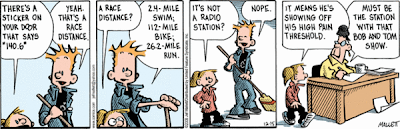 Some numbers are more daunting than others. Take the iron-distance triathlon. Even some of my closest friends have a difficult time wrapping their head around the 140.6-mile (total) distance. After you translate/transform it out to the metric system for the benefit of metric-system-using friends up in Canada, 226 and change (kilometers) sounds even the more insane. To make it sound more round, my metric-speaking friends call it "220."
17 is a more-simple number; that's the number of hours you have to complete the entire event. However, the race organizers make that more complicated by instituting cut-off times for the swim & the bicycle portions. You have to finish the 2.4-miles of open water swimming in 2:20. That means you have to swim 100 yards in a little over three minutes...42 times. I consider myself a poor swimmer, and my distance swim time averages right on the ragged edge of 2:05 for 100 yards.
If you manage to get through that, then you have the privilege of jumping on your bicycle and riding 112 miles, with a cut-off time of somewhere around 10:30 from the start of the race. Oh, the clock doesn't stop after the swim, either.
Let's presume you make it out of the water by the slimmest of margins (sometimes the participants do not), you have to average a little under 14 miles per hour to make the bicycle cut-off. Attaboy.
Now it's time to put your running gear on and do a marathon. Once again, assuming you finish right before the cut-off, it's 6 hours and 30 minutes to travel, under your own power, 26.21875 miles, or 14 minutes & 48 seconds per mile; a rapid stroll...albeit on legs powered by long-depleted energy sources.
Now think about this; there are professionals who are doing this in less than nine hours, and strong amateurs doing it in less than ten. Lots of the finishers could care less about making it in ten; most want to just simply finish.
So, once you run the numbers in a brutally-analytical manner (a friend of mine has completed three Ironman events; we talked about this calculus one night over dinner), where is the challenge? Is it in trying to get through as quickly as possible? Is it in trying to get through it faster than the last time you did it? Or is it in trying to get through it, period? I believe much of it has to do with the mind; having to wrap your head around the concept of distance & of time. Being strong enough to continue forward, yet smart enough to know how fast (or how slow) you need to go in order to make it to the line. Being able to live in the immediate moment & compartmentalize the activity.
So, once you run the numbers in a brutally-analytical manner (a friend of mine has completed three Ironman events; we talked about this calculus one night over dinner), where is the challenge? Is it in trying to get through as quickly as possible? Is it in trying to get through it faster than the last time you did it? Or is it in trying to get through it, period? I believe much of it has to do with the mind; having to wrap your head around the concept of distance & of time. Being strong enough to continue forward, yet smart enough to know how fast (or how slow) you need to go in order to make it to the line. Being able to live in the immediate moment & compartmentalize the activity.
Perhaps Desi Arnaz was right: '...anyone who goes to (do this) needs to have their head examined.'
Thursday, June 26, 2008
Hating Goodbyes
Dinner last night at a Thai restaurant with Christian and Petra, our German friends. Normally we would hold off on dinner and do the New Yorker Deli on Friday evening, but they're now temporarily billeted in the Officers' Quarters on NAS.
The bad news is there's no kitchen.
The good news is there are no dishes.
So, we ended up talking triathlon and training over dinner, trading notes and looking forward to future events. For them it's Ironman Germany in Frankfurt. For me, it's probably going to be either a sprint triathlon or a couple of long races in the autumn. It depends on the work schedule and how busy we are at Chez' Bowen.
Since they're doing IM.de, we'll be able to keep track of them courtesy of IronmanLive. Christian comes back to finish his tour, then goes back to .de. I have the sneaking suspicion they'll remain close (enough) to us in the coming years. I certainly hope so, for a number of good reasons. A life always benefits from diversity:
The more closely your companions and confidants resemble you, the less likely you are to stretch your horizons or consider differing viewpoints. Without the encouragement (or would that be a dare?) of Christian and Petra, I never would have considered doing a half-iron distance triathlon. No, I would not have run the numbers and considered a half-iron triathlon (or a full Ironman triathlon, for that matter!) as an achievable goal.
Christian and Petra also saved me from tuning in to the BBC to get a diverse take on the news; we could always ask what Deutsche Welle, ARD, ZDF, or BRW were saying about American policies and politics. We were able to clue them in on some of the incomprehensibilities of the American political system, usually with much eye-rolling and humor.
Race, religion, culture, sports icons..."third-rail" topics were always fair game, because we knew we could speak in honesty, truth and candor to each other. And for that we have been grateful these past couple of years.
I hate goodbyes. I do poorly with them. Doesn't matter how much you promise to drop an e-mail to each other monthly, or pick up the cell phone (especially if they're on your network!) to stay in touch, it seems small orbits become large ones; large ones become like the orbit of comets that show once every 75 years. Of course, there's Web 2.0 and Skype and all those other things, but it isn't the same as killing three (four? five? I don't recall...) mini-kegs of Heineken on a Saturday, then going out into the front yard to watch the International Space Station whiz by.
Some people bring joy by their arrival, others by their departure. As for Christian and Petra, it's been a joy to be in their presence. Every time I see a triathlete walking a flat-tired bike on a training run I hear the "don't ever go out on a training ride, no matter how short, without a flat kit" lecture.
We will see you soon, my friends. Until then, I'll do my best to hold the tears.
Thursday, September 20, 2007
Hammer Time!
 Tempo run of seven miles yesterday at the beach. The group - which includes most of our team officers, several of our active membership, and not a few of our former members (who I graciously classify on my nicer days as alumni) meets every Wednesday evening at 6:00 to run anywhere from four to six miles, then eat, drink and be merry until they can't stand it any longer...or the management kicks them out.
I've used the treadmill for the majority of the summer because it has been too d@mned hot to get any quality mileage in otherwise...at least while I was healthy enough to run (so maybe there was a good side to breaking my arm!). Two weeks ago I went to the beach to do a six-mile tempo and completely exploded in a blaze of glory at the three-mile point. BRAAP! Back to the treadmill for a couple of more weeks, Coach Mike. I bumped up the pace on the treadmill runs to ~6:44/mile, taking a three-minute cool-down cycle between each mile. Then, I decided to extend the tempo repeat from 1 mile to 1.2 miles, so I got the mileage in five pieces, vice six. That's three less minutes of easier running/jogging/walking, too.
We were talking about the beach loop the other night, and Scott, my assistant and club secretary mentions something in passing about the six-mile loop being only 5.8 miles. I almost asked him, 'says who?' We've never really measured a course out there, and I have little love for GPS wearers and their complete dogmatic trust (dependence?) on that gadget. I have to admit I'm not as violently opposed to them as I was in the past, and I would use one if it were given to me (Note to my loving wife: no, I really do not need a GPS, not unless it does the street navigation, too.) by a company wanting someone to wear-test. Dude, if there's anyone who can destroy a piece of technology with just casual, everyday use, it's me. Ask Nike; that's why they are no longer in the MP3 player market.
I probably could have used one last night, though, to run the tempo run. I have a good idea where the two-mile point on the course is located, so I figured what I would need to add on in time duration (ten minutes) to lengthen the 5.8 mile loop run into a 7-mile tempo run. Hammer ten more minutes (five out, five back), on top of what I guessed would be a 40-to-41-minute run normally and voila! Done.
Well, I went out at a comfortable (7 minute/mile) pace for the first two miles. Who knew I would pick up the pace that much after two? Who knew I would race the sun coming back? Who knew I'd run 49:34 for 7.8 miles!? That's a little bit fast (ya think, Coach?) for a tempo run. That's about 20 seconds faster than my average pace for a half marathon.
However, I tend to run on feel, not on gauges. When I had a Suunto POD and heart rate monitor, I spent a lot of time looking at the data rather than running more by feel. That's the liberty of going by physiological markers, especially after you've done enough training. Translates well into racing and you don't have to worry about if or when the technology bites the big one (like the Suunto did)...Murphy's Law...and it goes wrong after you become dependent on the technology.
 Working that hard makes it interesting the morning after, especially if you're doing any kind of cross-training or you have a real daytime job. When our organization provided employees the option of working flexible work schedules; the kind where you do your 40 hours of weekly work over the course of four days, or your 80 hours of a pay period over the course of nine, I decided immediately it was not for me. Sorry, boss. I'm a creature of habit, and I coach. I have places to be in the early afternoon, and I like having not to worry about taking two hours of annual leave in conjunction with a federal holiday.
Besides, I'd rather do 80 percent of the something my boss and my other 'eight days a pay period' co-workers are doing each day.
Wednesday, September 5, 2007
Changing Courses in the Middle of the Stream

Ever have a training plan or a racing plan drafted out in the smallest detail, then suddenly - wham! - bad strangeness sets in? Often I find that what I've laid out works good for me, seemingly, then I encounter a friend or a teammate who says, 'hey, I'm planning on doing...' Next thing I know I'm sitting in front of a beer or two with my wife, trying to figure out how can I do this and not screw up my plan for that? Naturally, I have a number of choices:
One, I can choose to not do the particular activity with the friend/teammate. I might not have the opportunity to enjoy myself by being in their particular presence, but I definitely haven't screwed up on two fronts.
Two, I can choose the activity my friend is doing rather than my originally-planned 'thing to do.' Done that before and enjoyed the daylights out of it. In fact, I've never had (that I can rightly recall) a bad Plan-B-activity. I guess you can say that the social aspects of the event far outweighed the lost opportunity cost of the discarded event. It's not always perfect, you understand. Sometimes you pay the price for not doing what you know deep down you should be doing. There's a handful of x-rays in an orthopedic consultant's office and a velcro arm sling that can attest silently to this.
Three, I can find a way to do both...if I really want to do it. How many times have I jumped into a race at the absolute last minute and sucked bilge, or run two races on a single day and felt beat up afterward? Well, a couple of times. However, I think it's all in the perspective; if you do a particular event on a lark without any preconceived (unrealistic) expectations you'll probably have more fun than you expected to. And who knows? Sometimes that's when those fleeting personal best efforts come to pass.
I guess the lesson you can take from this commentary is to have a good idea when, where, how many, and how long a distance you intend to race during a season. Do what seems best to you, not to the friend who's trying to talk you into the Murky George 100-Kilometer Slog Through The Bog or something like that. Right now, I'm thinking about whether to take a year off from racing, outside of a half-iron distance triathlon or two. Whether or not the hiatus will sharpen my desire to toe the line once again is at question. Right now, the goal is to make it to the end of December...after that, I can start thinking about my racing future. Hey, it might not hurt to take a year and just be Coach.
Thursday, June 7, 2007
iBummed
 I guess it was as inevitable - Marx would say 'as the collapse of capitalism' - my iPod ate the big one. It's probably a battery issue, which means Apple will take care of it, but not without a price. Who knew it would die, conveniently, over a year after it was purchased by my loving wife?
(In order to show my appreciation, I bought her a white iPod with twice the storage - she doesn't use it too often, but...it was a better deal than my Softride, hindsight being not only perfect but magnified. But that's another story.)

I'm not particularly addicted to my iPod, except immediately before a race or if I'm on the road between point A and point B. I can't use it safely on a long bike ride; swimming is definitely out of the question (although Finis makes a waterproof headphone for those who want to carry their tunes while in the lap pool), and there aren't too many opportunities for me to listen on a solo run, since I don't do that many solo runs. I do like it for those occasional trip to the Y, when I don't want to listen to the early-1980's pop/rock/disco stuff being played over the muzak...okay, it is much better than having to listen to Fox News.
Of course, with the battery dying, I have one of several choices:
- I can send it to Apple, who will put a new battery in and send it back. Not as easy as it seems. Have you ever tried to get a RMA slip through their on-line customer service link? I'd rather shove a sharp stick in my eye. I used to think Nike was monolithic and uncaring...not any longer.
- I can buy a new one. I think Apple's customer service mentality lends itself to this response. They'd rather have you buy a newer, flashier, sexier and more expensive unit with larger memory and more functions that can go wrong in the course of a year. While I'm jealous of my friend Christian's 20GB iPod, with all the videos he has on there, I can't see having...let's see, 1GB equals 133 tunes, so multiply that by 20 and...well, it's close to my entire music collection, and I do NOT need my entire music collection. Come on, why would anyone in their right mind WANT to run to "Sister Mary Elephant" by Cheech and Chong!?
I've complained about my poor relationship with techno-gadgetry...it lets me down by dying at the worst possible time. This is the only time a music player has died without being in the middle of one of my long runs. Thank God. More comments on long runs follow...another Rundown reject. Enjoy!
-=-=-=-=-=-=-=-=-=-=-=-=-=-=-=-=-=-=-=-=-=-=-=-=-=-=-=-=-
THE LONG RUN:
“I used to hurry a lot; I used to worry a lot...” – Randy Meisner (songwriter, member of the Eagles)
If you want to get better at swimming, writing a business letter, or drinking beer, you have to spend time doing the act. No one starts to run and is immediately able to complete a marathon or run a fast 5-kilometer race without the ill-effects of beat-up muscles, sore joints and a pounding heart. We all start at the same point, adapt to the physiological responses and eventually learn to love this activity. The persons who cannot adapt stop running.
IF I WERE YOUR COACH: I would recommend, as part of your training, to run long one day a week. It proves to me an individual really wants to improve as a runner. During a long run, your heart adapts to the work and becomes stronger; strong hearts pump more blood to your other muscles. The small blood vessels (capillaries) increase and become denser, taking the blood to more areas of your body, especially the muscles. The muscles get more oxygen-rich blood, and also develop more and bigger mitochondria, which produce energy. This means the muscles can keep more of the glycogen it has stored, providing you with a ‘larger gas tank.’ Your mind also learns how to work around the discomfort of running over an extended period of time. Believe me, this helps when you begin to have (and you will!) those bad running days.
“…Who can go the distance? We’ll find out in the long run...”
So, what is the ideal distance? Instead, let’s look at time. Remember we all are an experiment of one; what works for the local running stud might put the mid-life, entry-level runner with spouse, corporate job and two children into a mid-life crisis. Some coaches recommend to their athletes that the long run should be no more than 20 percent of a weeks’ workload: If you have eight hours a week for running, then the long run should last around 90 minutes. That’s probably a good rule of thumb for races up to 10 kilometers. If you plan to run longer distances, your percentage might need to be closer to 25 percent. If you’re a new runner thinking about marathons, look into the Hanson’s training program…better yet, start with shorter distance races first.
The marathon is a completely different animal; it feeds on the flesh of the foolish. Trust me. I have the marks (tattoo) to prove it.
“…You know I don't understand why you don't treat yourself better; do the crazy things that you do...”
If you are fortunate, there’ll be someone close to your pace (hopefully an experienced runner) to run with you. That will help with both motivation and pacing. I’ve been on wonderful morning runs where the topic went from how beat up we were at the beginning of the run to all those other things that only can be discussed among the closest friends.
My wife and I do not run together on Sunday morning; we do the same loop, and then discuss training specifics and gossip over breakfast. We don’t run together because our paces are too dissimilar; I injured myself while on vacation in Hawai’i trying to run at her pace. She wonders why her running partners don’t run with her as frequently as they once did. As she started to recall the pace of the run, I noted something she completely overlooked. Lately, she has run with older men who want to take a fast pace early, turning in when she’s in the mood to tack on two more miles. While not always true, the ego and competitive nature of men can turn the most laid-back of runs into a hammer-fest.
I have hammered my Sunday morning runs; I have also run them at a comfortable pace. Quite frankly, I like the comfortably-paced long run a lot more. Some coaches recommend doing your long runs at a minute per mile slower than your marathon (or goal race) pace. My coach, Dale Fox, used to call the necessary pace of the Sunday long run “kinder and gentler.” If I am going out with a friend, we’ll work out the pacing within the first 15 or 20 minutes. If by myself I will take the iPod in order to keep entertained. Running with the iPod presents its own share of challenges.
A couple of Sundays’ back, I was by myself and plugged in to the iPod. I landed on a particular track that I couldn’t help but repeat over and over and over. I ended up running about 30 seconds faster than my marathon goal pace, a personal best time for the loop. However, I was beat up for the remainder of the week. After that, I decided to set up a playlist specifically for the “kinder and gentler” morning runs, saving my 80’s and 90’s rock for the treadmill or the days nearer the end of the training cycle when intensity is the order of the day.
Regardless of whether you choose to run your long run at a more relaxed pace or decide to “scald dogs,” the benefits are the same. When you are thinking about the pace of your long runs, keep in mind that long, slow distance leads to long, slow runners. A little variety in your pace is a good thing every so often; let your later-season long runs be closer to the pace you intend to race and your earlier season runs be “debate club” conversational pace, where you can hold a good conversation with a running partner.
As always, what works for the local running stud might not work for you.
Subscribe to:
Posts (Atom)