The sign at the college campus entrance provided a knee-deep sense of foreboding...which quickly turned hip-to-waist-deep once I saw the tents and pop-up covers. A fund-raising relay event on the track, in 25 words or less, meant no chance for speed work on the track.
If you're doing workouts on your own this isn't a big deal; you just have to go to another track, right?
What if there isn't another track nearby, or the track has a less-than-desirable location/surface? I first had to deal with this "problem" during a two week assignment to Orlando, many years ago. The hotel gym had a "typical inexpensive hotel gym" quality treadmill (translation: great for walking and not much else); and the staff did not know the location of the nearest track. However, there was a long, straight stretch of roadway, about three miles in length, with light poles spaced about fifty yards apart.
Speed workouts don't necessarily require a track; a favorite jogging path, stretch of road or trail will do. The most-popular form of speed work done on paths, roads or trails would have to be fartlek, which is the Swedish for "speed play." The fartlek workout has certain benefits as well as drawbacks: A runner can pretty much push the pace for as long (or not as long) as they feel, they can vary the pace, and they can vary the recovery periods.
However, I'm a bit of a knucklehead about speed work, and in fact, about most of my runs. There has to be a purpose, some sort of plan, behind all of this; otherwise I might as well have my feet up on the couch watching SportsCenter. If there are regularly-spaced landmarks along the way I'll figure it out from the outset and plan something like this:
First two miles - comfortable jog
Next mile - 200 meters, more or less, with 50 meters recovery jog
Next mile - 400 meters, more or less, with 50-to-100 meters recovery jog
Next mile - 200 meters, more or less, with 50 meters recovery jog
The efforts would be anywhere from highly aerobic (a pace I can hold steadily for five kilometers) to eighty-percent of maximal effort.
Now, with the consumer-grade GPS we can probably keep a closer eye on distance efforts and recovery intervals. For those persons who aren't into GPS, another option would be to set a running watch on countdown timer for a thirty-to-sixty second period, set to repeat. Jog easy for fifteen to twenty minutes, then alternate harder and easier efforts during each repeat. The distances are not so much the important quantity as much as the effort and recovery times. Harder efforts, naturally, will most likely require longer recoveries.
So don't let that "Relay for Reality" or the infield soccer camp make you set aside your speed work. Find yourself a place to let your horses run free.

So, How Many Hats Do You Wear?

- Michael Bowen
- Pensacola, Florida, United States
- Husband. *Dog Dad.* Instructional Systems Specialist. Runner. (Swim-challenged) Triathlete (on hiatus). USATF LDR Surveyor. USAT (Elite Rules) CRO/2, NTO/1. RRCA Rep., FL (North). Observer Of The Human Condition.
Showing posts with label gps. Show all posts
Showing posts with label gps. Show all posts
Friday, April 12, 2013


Thursday, January 10, 2013
Keep It Simple, Part II
“It can scarcely be denied that the supreme goal of all theory is to make the irreducible basic elements as simple and as few as possible without having to surrender the adequate representation of a single datum of experience.” Albert Einstein (1879-1955), during a lecture, Oxford, June 1933
Einstein’s goal of achieving simplicity without loss of the necessary holds true, especially for runners. Figure out the amount of data you absolutely need to track progress, after that it's simple to gradually acquire the stuff which works best, or to steer clear of the stuff which won't work at all.
First, let me explain that I’m not slamming brick-and-mortar running specialty stores. If given the choice between a major retail sports store, a locally-owned/operated running specialist and an interlink-based provider I'd much rather deal with the guy who's paying local property taxes and hiring passionate young men and women from my town's high school or local college; someone who really has some skin in the game when it comes to the running community. Usually that's a person who's going to do the right thing. But you can tell when a shopkeeper has become too-mercenary when (new) runners toe the line at a local 5-kilometer race with a four-bottle hydration waist belt.
I have a love-hate relationship with the consumer grade GPS receiver. As a course measurer I love to use the GPS to provide ballpark estimations of where my intermediate splits will fall on the race course, and to get latitude/longitude references in those rare instances when no permanent reference point exists. The hatred comes when runners who have no understanding of the necessary technological limitations of the GPS try to tell me a course is "too long." Upload a run to Google Earth and you'll see some places you never thought you could run. Runners who do most or all of their workouts on a treadmill or a track most likely aren't going to need GPS devices; there are times I would dare to say that for most a GPS is little more than a very expensive running watch. I've also played with running watches which used accelerometers those little pods attach to the running shoe and track how fast and how far you ran, without the need for all those satellites. They're a little expensive and the batteries tend to die at the wrong time, but they're very reliable if all you need is distance and speed. If all your courses are known distances, choose a running watch or a heart rate monitor.
Good ballpark distance figures for runs on sidewalks, roadways, and now even trails can be mapped out on map programs like MapMyRun, GMaps Pedometer, the USA Track and Field "My Running Routes" program, and Google Earth (which requires a little more patience). There are a few disadvantages to these programs: When flat photographs are used to try and measure distance on a rounded surface (our world) there can be varying degrees of inaccuracy; a half-marathon course I measured last year proved this to be true. As a plus, MapMyRun allows runners to track workouts they've run on a particular route, and even gives runners the ability to print out courses...if you purchase a membership. Go on the cheap like me and you best be able to read what can best be called “gibberish.” A race director sent me his MMR files last year and all the street names were “Asflkue Ib.” And worse.
Good ballpark distance figures for runs on sidewalks, roadways, and now even trails can be mapped out on map programs like MapMyRun, GMaps Pedometer, the USA Track and Field "My Running Routes" program, and Google Earth (which requires a little more patience). There are a few disadvantages to these programs: When flat photographs are used to try and measure distance on a rounded surface (our world) there can be varying degrees of inaccuracy; a half-marathon course I measured last year proved this to be true. As a plus, MapMyRun allows runners to track workouts they've run on a particular route, and even gives runners the ability to print out courses...if you purchase a membership. Go on the cheap like me and you best be able to read what can best be called “gibberish.” A race director sent me his MMR files last year and all the street names were “Asflkue Ib.” And worse.
You'd rather not wear a heart rate monitor, you say? My wife is one of the many who would agree with you. Some folks don't like to have that fabric/plastic strap around their chest, especially guys who like to run shirtless (I like data, therefore I run with a shirt). Those persons who still want to check their intensity every so often can purchase a watch which has finger contact plates; place the two fingers of the non-watch wearing hand (of course…) on the plates and the heart rate reading appears in seconds. Runners who use fairly modern treadmills with heart rate equipment attached can most likely forego this and use the handrail plates, which are about as accurate as chest strap monitors.
You Luddites can lay a couple of fingers along your carotid artery on the left side of the neck immediately after the run is completed, or gauge your effort on a scale of one to ten, where one aligns to ”am I awake?” and ten means ”if I take another step my chest will explode!” Some of the really good heart rate monitors will not only break down your workout effort by average heart rate, but by amount of time spent at a particular intensity level. Entire books have been written about training by heart rate, and quickly leaves the beaten path to go into the weeds of the “should I use the ‘220-minus-age’ formula to calculate my heart rate?” question, the “male-versus-female max-heart-rate” debate (which my wife and I have had on many occasions), and so on. Surprisingly enough, physiology researchers found a strong correlation between perceived effort (that “one-to-ten-scale” thing) and percentage of maximum heart rate; a perceived effort of “five” was found to be right around the fifty-percent of maximum heart rate point, and so on.
So now we've talked about the simple "where," "how far," and "how hard" of running. I'll talk in the next installment on what to do with that information.
You Luddites can lay a couple of fingers along your carotid artery on the left side of the neck immediately after the run is completed, or gauge your effort on a scale of one to ten, where one aligns to ”am I awake?” and ten means ”if I take another step my chest will explode!” Some of the really good heart rate monitors will not only break down your workout effort by average heart rate, but by amount of time spent at a particular intensity level. Entire books have been written about training by heart rate, and quickly leaves the beaten path to go into the weeds of the “should I use the ‘220-minus-age’ formula to calculate my heart rate?” question, the “male-versus-female max-heart-rate” debate (which my wife and I have had on many occasions), and so on. Surprisingly enough, physiology researchers found a strong correlation between perceived effort (that “one-to-ten-scale” thing) and percentage of maximum heart rate; a perceived effort of “five” was found to be right around the fifty-percent of maximum heart rate point, and so on.
So now we've talked about the simple "where," "how far," and "how hard" of running. I'll talk in the next installment on what to do with that information.
Wednesday, January 9, 2013
Keep It Simple - Part I
“It can scarcely be denied that the supreme goal of all theory is to make the irreducible basic elements as simple and as few as possible without having to surrender the adequate representation of a single datum of experience.”
Albert Einstein (1879-1955), during a lecture, Oxford, June 1933
When is the last time you walked into your local running emporium to purchase a pair of shoes? In a perfect world, if you’re like me, the duration from arrival-to-purchase is brief; I know (down to three makers/styles) the shoe I need. I don’t need to try them on or do a brief jog in them. Just set the box on the counter and swipe my American Express card. Thanks, and I’ll see you in about ten weeks.
When is the last time you walked into your local running emporium to purchase a pair of shoes? In a perfect world, if you’re like me, the duration from arrival-to-purchase is brief; I know (down to three makers/styles) the shoe I need. I don’t need to try them on or do a brief jog in them. Just set the box on the counter and swipe my American Express card. Thanks, and I’ll see you in about ten weeks.
My $500-per-year running shoe habit probably covers a little less than 1/1000th of a store proprietor’s yearly expenses. My few gizmos, gadgets, and apparel - thank heavens - have longer life spans. The entry-level runner is more likely to be welcomed with open arms into "SHOES 'R' US" than frugal/cheap runners like me. "GAIT-O-RAMA" associates love to see the person who just got finished reading the “five weeks to a faster 5K” or “crush your first marathon” article in the glossy running magazine or on the interlink. There's nothing like seeing the newbie runner drool as they finger their way through the jogger-porn and look with longing at advertisements for the newest electronic training gadget, or hydration system, or symphony-quality earbuds. There are benefits to many of the apparel items, multifunctional watches, post-run recovery gadgets and technological “nice-to-haves,” but Murphy’s Law posits that the higher-ticket item leads to a greater and more irrational dependence. The more dependent the runner becomes on them, the more likely they will either go missing the day before the race - requiring a very expensive replacement during the race expo - or die/malfunction on the day of said race.
(If you have considered participating in a triathlon, I advise you to NOT buy any expensive technological gadget, especially one which plays music or speaks to you on the run. Trust me. You’ll either thank me or the referee who does not have to assess a penalty later. But I digress.)
I’ve killed music players, had pace/distance/heart rate/training tracking gadgets malfunction beyond all recognition (I think the technical term is “FUBAR”), and slunk away like a hound caught piddling on the living room carpet as my wife discovered a portable hydration bladder-turned-petri dish.
Einstein’s goal of achieving simplicity without loss of the necessary holds true, especially for runners. Do you need a fancy wrench set to tighten or loosen a bolt when a pair of Vise-Grip pliers might work as well? It all depends on how many times you plan to do the job. If it’s a one-shot deal - or (like triathletes) we’re trying to find out what we really need early on - the odds are good we can use more-simple tools. Once you figure out what you can live with/without, then we can gradually acquire the stuff which works best for us.
The simplest needs for every runner regardless of the distance or the coach are a training plan, a way to measure distance, a way to figure out how long they have run. There needs to be a place to store all this information, as well as the effort expended and how soon another pair of shoes will be needed. I’ll talk more about the simplest measures of distance, time and effort in the next installment.
Tuesday, May 29, 2012
Undertrained, Yet Not Overwhelmed
Home from the Ottawa (Canada) Race Weekend, where I ran my "target" half-marathon event.
No, it was not a personal best. But in light of my slow healing of the achilles' tendons and an (seemingly) untimely illness during training I went into the event in a way I've often recommended to my own athletes.
Undertrained.
The state of undertraining showed during three jaunts around the Rideau Canal and Queen Elizabeth Boulevard; I could run along at a six-something minute-per-mile clip for a quarter mile, but it took about 45 minutes to get comfortable enough to get there. There were no joyous "check in the box" or "hay in the barn" runs to speak of during the next two days, including a shutdown after fifteen minutes. I knew there was little chance of running close to the last half I ran as part of my triathlon training, but I was going to try.
Naturally, when you are running with over ten-thousand of your closest friends the best place to be is at - or near - the front. This did not happen. In fact, the only way I, or the crowd standing around me on the curb at Confederation Square, were going to get into our assigned corral at the gun was crowd surfing. The female runners were more likely to benefit from this idea; we guys were doomed.
The crowd did not thin out for five kilometers. Seriously. I didn't have much trouble going the pace I planned for, but when it came time to ask myself 'will I be able to step up the pace between now and nine miles?' the answer was a calm 'not today.'
You want to know the nice thing about racing or running a race where the splits are in kilometers?
The splits are in kilometers.
Sure, you can sit there and do all the mental 'eight (kilometers) is five (miles)' gymnastics you want, but it's great to have splits arrive at 62 percent of the time you would normally expect. It's like doing a Rock n' Roll event and getting 42 bands rather than 26...you have more stimulation. And that increase in checkpoints is especially important when you hit the 'dark tea-time of the soul' section of the run. I've learned that every race director has a bit of sadist in them; the most barren, crowd-bereft section of every run course ALWAYS comes at the same time we begin to doubt. The whole gamut of doubt. From "I doubt I can hold this pace until the finish," to "I doubt I can even finish" doubt.
I'm not going to directly attribute the performance I got - which was better than the performance I feared - strictly to increased external feedback. I still looked at my watch when my (mile) split buzzed, and found my splits more or less 30 seconds slower than my "out-of-my-mind" goal pace, but 15-to-30 seconds faster than my average training pace. However, I wasn't fixating on the difference between my GPS and the mile split marker (which I know is approximate) my heart rate data, my pace, my yada, yada, yada the entire time...all the things which can take a runner out of the race they may have mistakenly set themselves up for. And place them in the race they can feel.
Tuesday, December 27, 2011
The Courage to Change, The Wisdom to Know
I looked at the runner's watch face, moments after he finished his marathon. He made his goal of under three hours. But to me something felt very wrong.
Late-December clouds, drizzle, and mist might have affected the ability of his Garmin 310XT (the same model I use to measure, train and race) to communicate clearly with the constellation of satellites; it's happened in the past.
Chuck depended on the 310XT for feedback and pace guidance because he was running solo, without benefit of escort vehicle or bicycle on which to gauge his effort. He told me he tried to do the mathematics throughout the run in order to figure out whether he'd make his goal of seven sub-three-hour marathons in seven days. I could see he was not confident of repeating the feat over the next six days, not without accurate feedback outside of his own physiological data.
I drove home and began to walk through the interrogation points I normally give to a GPS user after a race on a course I've measured:
Was he at the exact start line when the horn went off? Yes.
Did he run the shortest possible distance for the entire run? Outside of six-to-eight stops at the outside edge of the track for fluids, he "bloodhounded" the inside lane line.
Did he stop his unit at the exact finish? Most likely; at the worst he stopped it no more than ten meters past the finish mark.
The issue wasn't that his GPS unit registered a distance that was longer than the standard marathon of 26.21876 miles, or 42.195 kilometers. I knew that was going to happen. It was that the GPS unit registered a distance that was much longer than the standard marathon.
An error rate that approaches five percent definitely exceeds my comfort zone. At that point all I could do is start interrogating myself. I've made a mistake, but WHERE?
Maybe on the mathematical calculations? I've been caught with bad calculations in the past, which can cost a day to two days' worth of work, depending on the race distance. I used to use a hand calculator and word processing document in the past to complete my measurement paperwork but quickly learned the joy of Excel spreadsheets. Once you develop a good spreadsheet formula the paperwork turns into "plug and play."
Also, I've had the pleasure of a second measurer in the past two months, as well as the course certifier, looking at my calculations.
The only thing left was to take a look at my calibration. When I first planned the job I was going to do it in kilometers rather than miles; the track was a 400-meter track, so 42.195 was (so I thought!) going to be more simple than doing feet and miles.
Boy, was I wrong.
Back home, I chewed hard on the data, even going out to take a look at my calibration course. It took only an hour of walking up and down the way for me to realize how badly I screwed up.
I punched up the correct data, went back to speak with the race director, and told her I owed Chuck an apology. She understood it was an integrity issue; it took courage to come out and admit the mistake and to fix it as quickly and efficiently as possible. And I guess she was right. I could have let ego, arrogance and even fear force me to keep my mouth shut.
Small-scale misjudgments - whether as a measurer, a coach, or as a runner - may not drastically affect short-distance races, but can be disastrous when it comes to races like the marathon. Think very carefully about all of the training details, because it's the small one that's most likely going to be the most costly.
Late-December clouds, drizzle, and mist might have affected the ability of his Garmin 310XT (the same model I use to measure, train and race) to communicate clearly with the constellation of satellites; it's happened in the past.
Chuck depended on the 310XT for feedback and pace guidance because he was running solo, without benefit of escort vehicle or bicycle on which to gauge his effort. He told me he tried to do the mathematics throughout the run in order to figure out whether he'd make his goal of seven sub-three-hour marathons in seven days. I could see he was not confident of repeating the feat over the next six days, not without accurate feedback outside of his own physiological data.
I drove home and began to walk through the interrogation points I normally give to a GPS user after a race on a course I've measured:
Was he at the exact start line when the horn went off? Yes.
Did he run the shortest possible distance for the entire run? Outside of six-to-eight stops at the outside edge of the track for fluids, he "bloodhounded" the inside lane line.
Did he stop his unit at the exact finish? Most likely; at the worst he stopped it no more than ten meters past the finish mark.
The issue wasn't that his GPS unit registered a distance that was longer than the standard marathon of 26.21876 miles, or 42.195 kilometers. I knew that was going to happen. It was that the GPS unit registered a distance that was much longer than the standard marathon.
An error rate that approaches five percent definitely exceeds my comfort zone. At that point all I could do is start interrogating myself. I've made a mistake, but WHERE?
Maybe on the mathematical calculations? I've been caught with bad calculations in the past, which can cost a day to two days' worth of work, depending on the race distance. I used to use a hand calculator and word processing document in the past to complete my measurement paperwork but quickly learned the joy of Excel spreadsheets. Once you develop a good spreadsheet formula the paperwork turns into "plug and play."
Also, I've had the pleasure of a second measurer in the past two months, as well as the course certifier, looking at my calculations.
The only thing left was to take a look at my calibration. When I first planned the job I was going to do it in kilometers rather than miles; the track was a 400-meter track, so 42.195 was (so I thought!) going to be more simple than doing feet and miles.
Boy, was I wrong.
Back home, I chewed hard on the data, even going out to take a look at my calibration course. It took only an hour of walking up and down the way for me to realize how badly I screwed up.
I punched up the correct data, went back to speak with the race director, and told her I owed Chuck an apology. She understood it was an integrity issue; it took courage to come out and admit the mistake and to fix it as quickly and efficiently as possible. And I guess she was right. I could have let ego, arrogance and even fear force me to keep my mouth shut.
Small-scale misjudgments - whether as a measurer, a coach, or as a runner - may not drastically affect short-distance races, but can be disastrous when it comes to races like the marathon. Think very carefully about all of the training details, because it's the small one that's most likely going to be the most costly.
Thursday, September 29, 2011
Free Your Run And Your Mind May Follow
There is a point in our commute to work which reminds us what we forgot to take with us from home, if we have forgotten something. The object's criticality determines, at least for me, exactly where this reminder will occur: If it's the identification cards which grant me access to my office and/or my computer I'll remember mere blocks from the front gate. Something less critical like my workout gear, running shoes, lunch, or perhaps money I need to give to someone will come to mind at a point exactly half way there, with no good opportunity to turn around.
Today was a "less critical" day. My Garmin Forerunner 310XT was sitting next to my computer and should have been in my bag this morning when I bolted out the front door. And why did I forget it? Suzanne was checking her bank balances on my computer; it's all her fault.
That's my story and I'm sticking to it.
Actually, I consider the oversight more critical than most persons would.
I use the 310XT and the heart rate monitor to help me track almost every aspect of my workout routine: the duration, distance, type of activity (using Dan Empfield's Slowtwitch aerobic point scale) terrain, route, average HR, training stress score (using Bannister's minutes at percent calculation), shoe used, and current mileage, to name the majority of the factors. All this information is on a spreadsheet, which lets me look at where I am compared to my training goals and limitations. I can see, at a moment's notice, some of the root causes of a training setback, injury, or fatigue issue.
Am I dependent on the 310XT? There have been afternoons I've launched into a three-second piece of purple prose because the battery died or I forgot to bring the receiver unit (while the heart rate monitor strap was securely wrapped around my chest). So, I guess there might be the academic description of dependence there.
I considered completely tossing my planned mid-morning run into the rubbish container...then decided to go out for a run on the same loop without external pace guidance.
Yeah. Let's go by feel, Coach.
I cannot say it was liberating to go out for a run without having all that data available which the 310XT is able to provide. I was able to observe at a few things - the abundance of squirrels on base, for example - which I normally did not pay more than a passing glance because I was trying to either hold my pace back for a fellow runner or trying to keep from pushing the pace too much. The down side of a "no feedback" run was that I only had a time check at the two-thirds point of the run, at the front gate...at which point I had to judge where I was going to end the run. All I had without eating into my lunch break was 60 minutes, which included a shower and change back into my work clothes.
As long as a runner is not time-constrained or data-(over)dependent a "caveman run" can be a refreshing change of pace from the "X-pace for Y-distance" mentality into which many of us have unintentionally slipped.
Just don't expect me to go barefoot.
Today was a "less critical" day. My Garmin Forerunner 310XT was sitting next to my computer and should have been in my bag this morning when I bolted out the front door. And why did I forget it? Suzanne was checking her bank balances on my computer; it's all her fault.
That's my story and I'm sticking to it.
Actually, I consider the oversight more critical than most persons would.
I use the 310XT and the heart rate monitor to help me track almost every aspect of my workout routine: the duration, distance, type of activity (using Dan Empfield's Slowtwitch aerobic point scale) terrain, route, average HR, training stress score (using Bannister's minutes at percent calculation), shoe used, and current mileage, to name the majority of the factors. All this information is on a spreadsheet, which lets me look at where I am compared to my training goals and limitations. I can see, at a moment's notice, some of the root causes of a training setback, injury, or fatigue issue.
Am I dependent on the 310XT? There have been afternoons I've launched into a three-second piece of purple prose because the battery died or I forgot to bring the receiver unit (while the heart rate monitor strap was securely wrapped around my chest). So, I guess there might be the academic description of dependence there.
I considered completely tossing my planned mid-morning run into the rubbish container...then decided to go out for a run on the same loop without external pace guidance.
Yeah. Let's go by feel, Coach.
I cannot say it was liberating to go out for a run without having all that data available which the 310XT is able to provide. I was able to observe at a few things - the abundance of squirrels on base, for example - which I normally did not pay more than a passing glance because I was trying to either hold my pace back for a fellow runner or trying to keep from pushing the pace too much. The down side of a "no feedback" run was that I only had a time check at the two-thirds point of the run, at the front gate...at which point I had to judge where I was going to end the run. All I had without eating into my lunch break was 60 minutes, which included a shower and change back into my work clothes.
As long as a runner is not time-constrained or data-(over)dependent a "caveman run" can be a refreshing change of pace from the "X-pace for Y-distance" mentality into which many of us have unintentionally slipped.
Just don't expect me to go barefoot.
Sunday, May 8, 2011
Just Because You Can Doesn't Mean You Should...
A weekend in a beach town gives many opportunities for a person to see, um, things they might prefer not to. In order to keep this post family-friendly, graphic details will be kept to a minimum. I'm not really talking about tattoo art; who knew Panama City Beach had so many tattoo parlors, or that a tattoo on a certain portion of the body was otherwise called the "Panama City License Plate?" I'm not talking about short shorts (again!), Speedos, or green swim trunks with the little yellow duckies (Agon Swim?), or post-race party observations from the Slowtwitch web site, either.
As you can tell I probably could hold forth for an entire post on one or all of these topics...but it's something a little more mundane.
Ride with a pack of cyclists, especially on a windy day, and you can tell how much more beneficial it is to be suffering with others than to be out there all alone. As long as everybody manages to keep their wheels from crossing one another things are pretty much all right. However, when it comes to triathlon, unless you're of the caliber of those Olympic athletes, the bike ride is an individual affair. Each rider is responsible to take care of themselves and cannot use another rider to shield them from the wind...legally.
Some bike courses, like the ones for Panama City's half-iron and iron-distance triathlon events, have been described in the past as "pancake" flat. Compared to the NOLA 70.3 course I might call them "blueberry-pancake-flat." Yes, there is a bridge over West Bay, but it's the largest "lump" in 56 or 112 miles of Northwest Florida. A "breakfast-quality" bike course doesn't separate the strong riders from the less strong as quickly; this gives Panama City's races the reputation for being a draft-fest. Strong bikers looking for a chance to make a trip to Hawaii have saved up their nickels and dimes for an early-November race...check YouTube for a bike's-eye-view of one section of the ride. Looked like the Tour de France.
The rules for bicycle riding in most triathlons are simple:
1. Ride on the right.
2. Pass on the left.
3. Stay at least two bike lengths back from the bike ahead.
4. If you want to pass, make the pass in 20 seconds, and,
5. If you get passed, drop back two bike lengths before you try to pass them again.
The rules are very simple when you read them to a person. The theoretically-simple becomes the practically-challenging when you tell the person to ride their bicycle this way. Multiply this challenge by several hundred persons on bicycles over a 50-mile stretch of road and the odds are very good someone will temporarily "forget" one or more of the rules.
Perhaps they won't do what they should because they can? Just because you can doesn't mean you should. Because Emanuel Kant's categorical imperative (live your life like your behavior would become a universal law) doesn't work well with nearly a thousand cyclists, there I was, riding on the back of a Harley-Davidson. Nine motorbikes and race officials, including my driver and myself, did our best to make certain all these athletes worked and played fairly together.
The first hour was fairly eventful, as two waves of athletes merged with each other about 15 miles into the ride. Most of the time the sound of that big Harley and those nice, loud exhaust pipes were enough to "remind" athletes of the rules and "encourage" them to follow them to the best of their ability. It's much like how we slow our cars down to a couple of miles above the speed limit when we see a state trooper on the highway.
However, the occasional rider sometimes "misses the memorandum" or didn't remember the rules from the athlete's meeting. Not else a guy can do but count off time, identify the rider and take down information; the head referee will sort it out at the end.
Near the end of the morning, we would approach a pack of riders and began to think of the old Irish ballad, "Danny Boy," '...the pipes, the pipes, are calling...' One rider near the back of the line, perturbed at what he thought was happening up ahead, looked at me and gesticulated with his left hand.
I know, friend. Just because they think they can doesn't mean they should.
Harley-Davidson is, quite often, an effective tool when you need to remind a crowd of bicyclists about the rules. Well, unless you're riding one bike length behind a very attractive cyclist.
Just because you can doesn't mean you should.
It's a lot like road race etiquette and protocol. There are many things which are - while not completely impermissible - are usually not fair to other race participants, and may not endear you to the race director on occasions...things like banditing (even if you don't go through the finish chute), going back up the course after you've finished to pace another racer in, self-seeding too far forward in the pack (especially with jogging strollers). On a personal note, I would even add arguing about the distance of a certified course (The "my GPS says..." argument?) in that short list. Sure, the individual racer can do these things, but it usually makes life a little more difficult for the rest of the community.
Just because you can doesn't mean that you should. Unless you find those duckie Speedos in your size.
Thursday, March 10, 2011
It's A Mode - For The Plane - It's Super, Man...

I wonder how many persons, like me, didn't want to go all the way in on an iPhone because they either didn't care for AT&T's stranglehold on the market (until Verizon joined the fray this year), didn't want to spend lots of money on short-term obsolescence, or - in my case - didn't need THAT MUCH phone? How many of them, I wonder, might have purchased an iPod Touch as an "80-percent solution?" I was sitting at a pizza joint a couple of weeks ago and listened to two older couples talk; one of the gentlemen was talking about his new iPod Touch and all the cool things he could do with his new little gadget.
I couldn't help but smile as he raved about the features. When I first started playing with the iPod Touch (I own a 32GB model) I smiled at the thought of the neat things I could do without having the nasty AT&T data plan...and the nasty AT&T bills which came along with it. I could check most all of my e-mail accounts, keep in contact with the rest of the world on social media sites and use my Skype account to talk, as long as I had the fancy-schmancy iPod earbuds with the microphone/switch, and was in an area with WiFi.
There lies the rub. One of many. Once I learned the few scattered places where I could get WiFi reception in my town, (your town might be different; and hopefully better than mine!) I resigned myself to the comforting thought I had - at the least - a good emergency phone...if I were stranded at the mall or downtown. And if not that I had at least one hell of a big music player.
Even when you have WiFi available, using it can suck the life out of an iPod Touch's battery faster than my wife can kill a pint of Abita Andygator. You will have problems. Big ones. Even an after-market ($75) Mophie juice pack - which can provide up-to-75 percent additional power to a fully charged iPod - isn't going to help if you want to use any run-related applications for the iPod Touch, like iMapMyRun: GPS plus WiFi equals not listening to any tunes while you're running.
And, for most people, isn't that why we carry iPods on a run?
It got to the point where I could see the battery gauge slowly sliding "to the left" while I did training runs or cross-training at the gym. What good was this piece of equipment if all I could do was play "Eye of the Tiger" for 60 minutes or so before it threatened to die on me?
Thank heavens for geeks.
One of the things I never really took a look at were some of the more arcane (and hidden) settings in my iPod. I coulld figure out a few, but I truly was at a loss for what some of the things did...or did not accomplish. Finally, I got so fed up I decided to do a Google search on "extending iPod Touch battery life." Darned if there wasn't several YouTube video clips from geeks for the lumpenproletariat, yes, teaching the great un-washed (at least immediately after a run!) masses what levers to pull and buttons to push so we can keep from having to continually charge or recharge our devices.
Two words will save you, iPod Touch users: Airplane Mode.
The iPhone and the iPod Touch have a setting which (I guess) was designed for the benefit of airline travelers who ostensibly wouldn't need to make phone calls or surf the internet while on board commercial aircraft, but still wanted to be able to play with other applications, or at least iTunes. The Airplane Mode shuts off the GPS functionality and the WiFi antenna on the device; I guess the device still has some sort of stand-by mode for WiFi even when it's off which uses battery power. Turn on Airplane Mode, and voila! The drain on the battery is minimized.
It also doesn't hurt to not use the iPod's graphic equalizer; why we really need something which ideally was taken care of by highly-paid audio engineers in the recording studio is beyond me.
I've noticed that I can now plug my iPod Touch into the after-market adapter cord for my Scion xB and not have to worry about shutting completely down during the course of a day. Even if I use the device for an evening workout at the gym I might only have to recharge once every two or three days. This should make life a lot more simple for me when I'm on the road to our next race; I'll be less worried about having to arm-wrestle my wife in order to recharge the iPod when we hit Mississippi.
Every once in a while we runner-types need to tip our cap in the general direction of the geeks. I'd hate to think what road running would have been like without them...probably less than super, man.
Thursday, January 6, 2011
Three "Really Ought To Have" Gadgets
 This morning, my wife is going to see her dentist, Dr. Roberto Maal. Until about a month ago she had little need to visit him, or any other dentist, for that matter. Suzanne is as mindful of her home care routine as I am when it comes to my training routine. It makes dental hygienists jealous.
However, she was assaulted while walking to her car on a Saturday evening in our downtown. Disoriented & confused, with a scraped-up knee & damaged incisor teeth, she walked nearly three miles (past the police station) to a friend's house. She tried calling my cell phone (which just happened to be sitting in my car) to have me come get her, & ended up spending a very chilly night on her friend's front porch.
I woke up early the next morning to no spouse. Panic immediately followed, especially after hearing the messages which provided no information other than "come get me." I drove into downtown looking for her car, then called her friends in the hope she was with them. One friend, awakened from a sound sleep at six a.m., suddenly realized Suzanne was out on the porch & had been knocking on the window the entire night, trying to get her attention.
Fortunately for us, & thanks to Dr. Maal, the story has an economic & emotional "happy ending." But all too often I read news articles of "horror stories," where solitary (female) joggers or walkers have been mugged, robbed, sexually assaulted, or killed because they were in the wrong place at a bad time.
I've always been a true believer of the running credo "travel light, travel fast." Go into a local running emporium (when I go to the one in my town, I feel this way...) & no doubt you'll see the latest & greatest accessories coming down the pike targeting the entry-level runner. Some are "nice-to-haves." Others are a complete waste of money.
Three items, in my humble opinion, should be in the equipment bag of every runner - and carried along for every run - regardless of ability level. A caveat: If I mention a particular brand it's because I've had experience with their product, not because I receive any compensation.
Identification. There are a number of portable identification & information-sharing devices on the market, ranging from the simple dog-tag or wrist tag to the complex USB-capable data wristband. I haven't tried the newer USB drives, though. I've worn three RoadID devices in the past ten years & prefer their simplicity. The latest models from RoadID provide a web address or toll-free number for emergency personnel to access pertinent user data; even the simple RoadID models are easy to read & can make the difference between a running partner or passer-by knowing who to call in an emergency & a news story about another John Doe hit-and-run.
Carry Pouch. Apparel makers, like RaceReady, have made their mark in the running community by developing clothes for (longer) distance runners who need to carry important "stuff" like gels or electrolytes with them. I have shorts, & even a few running tops, from some of the major athletic wear/shoe companies like Brooks & Mizuno, which have pouches & pockets built in. But an item I first saw a couple of years ago at the Crescent City Classic expo really stands out:
Spibelt, based out of Texas, makes several small personal item carriers. My wife & I purchased one at the last Rock n' Roll event, with the addition of a toggle to secure our race number to the belt. Spibelt is small enough to be hardly noticed in public (much like a traveler's money belt); the pouch - from personal experience - comfortably holds an iPod Touch & a smart phone, plus driver's license, credit card, folding money, & won't flap on the run like a fanny pack. If you can fit it comfortably into a single jeans pocket, you can probably carry it in a Spibelt.
If you want to keep your phone separate from your credit card, there is a two-pouch Spibelt. Both single & two-pouch Spibelts come in a variety of colors (basic black for me, pink camouflage for Suzanne) & have an adjustable elastic belt with a strong Fastex buckle clasp...so it won't come off until you're ready for it to come off.
Cell Phone. In the past I recommended to RRCA clubs to have at least one person on a group run carry a photo-enabled cell phone. The smart phone's gadgetry is almost a "must-have" now; you can download applications which will help you find who has the GPS function turned on, search for information on the nearest public safety provider, & even request turn-by-turn directions in the event of disorientation. The things these phones can do now goes far beyond & thankfully can dovetail into what we could do in the past by just calling the local 911 service.
Even these & other good gadgets are no substitute for the common-sense practices of running with one or more other persons when possible, maintaining situational awareness at all times, & staying out in the great wide open (public) as often as possible. My wife & I learned a painful, mildly expensive lesson, but (fortunately!) we live to run another day.
Friday, October 15, 2010
The Big Plan B
 *BEEP*
That was the low battery warning signal from my (formerly) trusty Garmin 310XT GPS receiver. The sound was immediately followed by a slight buzz, silence as the receiver shut itself off, & an unprintable comment from my mouth. I guess it wouldn't have been such a bad thing if not for the fact I was driving out to run a tempo run with a group on a Wednesday evening.
My wife asked, 'do you have a charger in the car?'
'My charger, unfortunately, is attached to my computer back at the house,' was my reply. As we continued the 20-minute drive I was stewing in my own juices of stupidity. I know I put the receiver on the charger the previous evening, so how could this be? I resigned myself to the thought of going out for what former triathlete (now triathlon coach) Chuck "Chuckie V" Veylupek calls a 'caveman run.' This would be an acceptable compromise. I took a deep breath, let it out, & returned to conversing with my wife about life, the universe, & everything. You know, the kind of stuff married couples talk about when there's nothing else to do...wink, wink, nudge, nudge...
My wife then pulled out her new smart phone to check her voicemail & realized her phone had been off all day. She had a little trouble turning the phone on & assumed the battery was dead. I managed to reset it, & then realized, 'hey, these smart phones have GPS. If I download a run mapping program (like iMapMyRun) I should be able to keep track of the pace I'm supposed to do for this tempo run.' So, with precious few minutes left before the group was scheduled to leave on the run I tried to download the software. However, I couldn't get WiFi or set up the phone in time to download. That's where the ability to "Plan B" a workout is a valuable skill.
When talking about training I repeatedly have borrowed the John Lennon song line: 'life is what happens to you while you're busy making other plans.' This is so true as a runner or as a coach. I can lay out a training schedule in macro for 16, 18, 20 weeks out from a race, but more often than not it's going to get adapted, truncated, or...worst of all...pitched in the wastebasket as life takes hold of the stick & throttle. Even the micro level of an evening's (scheduled) track workout gets adapted; heavy cranes & lighting equipment, soccer matches & "facility fascists" can take up part or all of the track & leave an inexperienced (or unprepared) runner - or coach - wondering what to do as a "Plan B."
While in a two-year internship with the Navy I spent periods of time ranging from two weeks to two months at training commands. The assignments had the obvious drawbacks of living out of a suitcase, with access to hotel treadmills, & so on. But I learned how to adapt my training to the conditions. During a two-week assignment to Orlando I learned that light poles along this nice long stretch of road near my hotel were set at approximately 50 yards. So, all I had to do was count the number of light poles for my interval workouts; run three at 5K pace, walk one to recover, repeat six times, jog eight poles...I'm certain you get the message.
Frank Shorter once was quoted as saying 'hills are speed work in disguise.' So, running up a section of hill or bridge for a period of time (or distance, if you know it!), then jogging easy or walking down can provide a great workout. A 300-yard hill near the track facility where we train has three points marked on it; if a soccer match is going to keep us off the track for most or our entire workout I can always go down the hill. Sometimes the soccer matches are not interrupting; I'll do a set on the hill just to break up the monotony.
Training by perceived effort for a long enough period can help a runner develop a sense of pace; after a while you know what a nine-minute per mile pace feels like, as well as an eight-minute pace, & so forth. The most important thing in understanding pace sense is to know how a particular pace FEELS. I always marveled at my coach's pace sense when we would go out on easy runs during the weekend. I had purchased my first heart rate monitor/foot pod combination & was geeking out checking our pace during one run. He asked me at one point what my heart rate was; I looked at my wrist, then told him, to which he replied, 'yeah, I figured that. We're at the right pace.' Sometimes, it is safer to not ask how they do it. They just do it. I've got a few paces pretty well nailed down after eight years of training by perceived effort, so I can tell how hard I'm working give or take a few seconds now.
But I don't have a good sense of time, with the exception of swimming in a pool. I can tell you exactly how long it takes me to swim 50 or 100 yards, even though it feels like forever, give or take a second. (It must have to do with that love of oxygen.). So when it comes to running a particular period of time at a particular pace I'm doomed if I don't have a watch. So rather than the planned tempo workout of eight minutes at the pace I need to run a half marathon, two minutes easy, eight minutes at threshold, two minutes easy - repeated twice - I had to adapt. I decided to count telephone poles; eight at moderate effort, two easy, eight at hard effort, two easy, repeat until the end.
Adapting a workout to meet life's demands: So simple, even a caveman - or a smart runner - can do it.
Monday, October 4, 2010
Off (Or On?) A Tangent
I've run road races since 1995, but never really learned about how to run a course until I raced the 2003 Recycler Run in Ft. Walton Beach, FL. It was there Brian McMahon taught me how to run a race course. The Recycler Run course winds through a residential area, but what made this course even more interesting, outside of the live oaks on both sides through the neighborhood, were the gorgeous sweeping turns. There might have been two miles of straight road on the course...in total, but at no more than a two-block stretch at a time.
We had a gorgeous, cool, overcast morning for the race, so it didn't take long for us to get comfortable on course. I was pacing former Pensacola Runners Association president David Harris, who wanted to run 19 minutes for 5,000 meters, so we needed to run about a 6:19 pace. A pack of us were moving at about 6:20 pace, with Brian just a little ahead. We caught up with him & kept a comfortable clip. As we exited a corner, I could feel a little bit of a nudge from Brian, who was off my right shoulder. Brian & I at that time had a history of pulling a little college cross-country physicality (elbows & shoulders) on each other, so this was nothing new. I nudged him back.
He nudged my shoulder again, & said: "Mike, run the tangent." At that point I suddenly realized what he was doing. I always heard the shortest distance between two points was a straight line but to that point in my racing career had never practiced the technique. This had a lot to do with some of the courses I raced in Tampa being straight out-and-back types.
I could see a couple of guys perhaps five seconds ahead of us; at first glimpse they appeared to be drunk & weaving from the left to the right side of the road. Ah, so they were running the tangent. Brian & the rest of us commenced to play "follow the leader" until the turn-around point on the course, then headed back. I not only ran a good race, bringing David painfully close to his goal of a 19-minute 5K, but also learned that day road racing is a thinking person's game.
You can't go into a road race, shut your mind off & expect to run your best. Pacing yourself is one thing, & smart training is another, but you can needlessly waste precious seconds on a road race by not knowing the course & not running the shortest possible distance.
Most people know I measure courses for USA Track and Field certification. It's one reason I don't run a lot of races in Pensacola. If I show up for a local race three things happen: I'm asked whether the course is certified. I'm asked if I measured the course. And, I'm confronted by runners who say the course was long, according to their GPS receiver.
There aren't many races I'll run which are not on a certified course. I want to know the distance is reasonably accurate (which USATF defines as "not short"). This way I can tell how well my training has progressed over time. I've written much about the USATF measurement protocol, so I won't go into detail here. But even I forget about the technical limitations of GPS receivers & the USATF/AIMS (AIMS is the international marathon measurement authority) protocol. When I ran the Rock n' Roll/Mardi Gras Half Marathon last year in New Orleans my GPS mile splits would beep initially about five seconds (eventually a minute) before the measured mile splits. I fussed for a second, & then remembered the additional 5.28 feet/1.609 meters which were added to each mile to make certain I didn't run less than a half marathon.
But a lot of GPS wearers don't take the time to understand the measurement protocols, don't know the limitations of their equipment (up to 25 feet of error at a single point) &, most importantly, do not run the shortest possible distance on the race course.
Rather than take a winding section of road - some sections are more winding than others - let me use a standard 400-meter track as an example:
- The width of one lane of a standard 400-meter running track is 1.25 meters.
- An athletic track lane distance calculator (http://www.brianmac.co.uk/tracklane.htm) shows the distance around a 400-meter track, in lane three (3.75 meters out from the inside rail) is 415.71 meters.
- Multiply the additional distance by 12.5 (the number of laps in a 5,000 meter track race) and the total distance is 5,196.375 meters.
- The width of one lane of a two-lane roadway with a shoulder is approximately 3.75 meters, a little over 12 feet in width. Even when the five added meters for USATF's short course prevention factor is subtracted, that's an additional 191 meters of distance to run if you're one lane of road out from the tangent for the entire race.
Lose your concentration for five seconds if you're running a six-minute per mile pace & you can add a little over 20 meters to the distance run at a 5K.
In closing, even a set of legs, a heart & lungs in the best of shape can be defeated by a brain that's not prepared on race day. Knowing the course & running the tangents can save a runner from running an unnecessary additional three percent of course distance.
Thursday, March 25, 2010
Two Runners Go Into A Pizza Joint...
 ...and were in one of those moods you get in after an entertaining week in the world which surrounds us. Yep, only more proof of the existentialist assertion we live in a world gone mad. So, right off the bat my (out-of-town runner) buddy & I are discussing health care, especially the lack of civility which crept into the debate, & definitely has shown in the aftermath of the bill passage. We're both pretty well aligned in the socioeconomic realm, in spite of our divergent belief structure (We've both taken the same side of a religious argument or two in the past couple of years, too - one of His Chosen People & one of His Red-Headed Stepchildren, tag-teaming...who knew?).
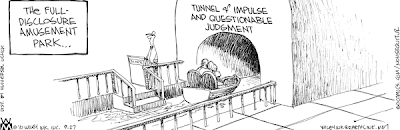
 His solution to a contentious issue relating to womens' health was fairly entertaining; a variation of an old friend's recommendation for people who failed a basic civics examination (My friend was willing to limit to that and revocation of ones' right to participate in the electoral process. I would have added a mandatory two-year C-SPAN and PBS-only cable package in the mix, just to provide remediation somewhere.). Of course, the veterinary term (used in the comic above) was the term we both used as the solution...which when you're dehydrated, glycogen-depleted & fairly well stoopid after a mid-week run...sounded humorous to us & probably offensive as heck to the rest of the public immediately around.
 Ah, but what do they know? Most of 'em were busy on their cell phones, trying to find answers to trivia questions. And perhaps some day the name/s of some of the screaming pundits will be little more than the answer to a trivia question for my grandchildren.
So there's no real variation from settlement to settlement along the Gulf Coast, huh? I would have never thought Port Aransas looked anything like our barrier island. Of course, when I was in Texas I had no desire whatsoever to be near the beach or a large body of water. I was in the Air Force; if I wanted to be near lots of water I would have joined the Navy, right? The irony is that now I've been with the Navy longer than I was with the Air Force...thanks for the reminder, amigo. But he's been working with the Air Force for the past two or three years...high time for him to get back on something big and gray and...
 And then, there was that thing on ESPN last night...saw it briefly...and I have to agree with the cartoon below.
Tuesday, March 23, 2010
Keeping Track Of "Stuff"
 MEMO TO SELF: Make certain to finish Census paperwork. Yes, I know it only consists of ten questions...at least according to the government propaganda (sorry, advertising). But there are so many other things I have to do...and I thought my wife completed one for us the other day. Alas, it was not so. So, in order to spare some part-time government-worker (now there's a double oxymoron!) the potential pain of seeing me in-between workouts, dripping sweat or pool water (Which is more frightening, all: me in race-cut running shorts all sweaty, or me in a Speedo? Personally, I'll take me in the Speedo.), I guess I better take the time to (as in the classic Cheech & Chong routine) zign ze paperz, olt mahn...
 Seriously, who has time to keep track of all the important stuff which needs to be accomplished? It's bad enough I spend up to twelve hours a week running, swimming, bicycling, or elliptical training...add to that the amount of time it takes to get there & back (unless on the indoor trainer), make myself presentable to the rest of the human race (my aging but loving d-a-w-g cares not whether or not I stink; my ageless & loving wife a little less so), & then...keep track of what I did, how long I did it, what shoes I wore, how high my heart rate was on average...you know the drill.
Then my wife wonders why I spend so much time on the computer.
 I'm glad much of the stuff (nearly) automatically downloads from my go-go-Garmin 310XT gadget. So far it has been rather reliable; a couple of hiccups here & there, but after you provide the obligatory thirty second blue-streak-o'-questionable language & reset the booger you're pretty much good to go.
The challenge, however, is to know what all those numbers you're collecting really mean in the grand scheme of things. Does knowing your average heart rate for bike rides over 20 miles provide you any insight into how you're going to perform on race day? Or, does your average run pace on the Wednesday evening run foretell your half-marathon time? It may, & it may not. Sometimes when race day arrives you have to put the unimportant data off to the side & look more closely at the important stuff: How far do I have to go? How much harder can I go? Have I gone too hard already?
 Yes, we can suffer temporary (or permanent) paralysis by analysis because we're too busy crunching numbers to race or train like a Jedi: Trust your feelings, young pad'wan learner. Get too tightly tied up in the minutiae of the training plan; go this duration at that power, then follow it with...aarrgghh. What in heaven's name did we do before heart rate monitors, power meters & other technological training wheels?
There's a place for all this good stuff, as long as you know the physiological feedback which equates to the number: What does an eight-minute mile on the run, or a 1:30 for 100 yards in the swim, or a 20-mile-per-hour speed when you're in big ring/small cog feel like? 'Cause, what do you do on the race day when your battery dies, or the numbers aren't matching up with the ones for which you were hoping?
 At that point you have two choices: panic, or have fun. For most of us this was never meant to be work, & it never should be. In my own case, the day endurance sport begins to look, smell, feel, act or taste like work...that's the time to find something else with which to fill the void in my personal calendar.
Why should being a tri-geek or a runner, or a swimmer be like work? There are times my father has marveled at the stuff I do (writing & all that good stuff), because the best stuff gets done during the moments I manage to shoehorn (or crowbar) out of the middle of my work day. Yes, I do get "stuff" done there...probably because I don't spend as much time keeping track of it.
Monday, December 21, 2009
Easy Days
 Sounds like the kind of place I want to spend some time in this time next year. Ah, but that will depend mostly on the wishes of COMNAVWIFELANT, also known as "Mrs. Java," "Coffee-Mate," or..."she who must be obeyed."
Fortunately for me, this years' endurance challenges smoothly segued into:
1. a reasonable level of training, namely the building of a right solid base, and
2. my wife's wish to run another half-marathon after a year's hiatus from systematic training.
So, I took the challenge of being husband and coach all at the same time...again...and got her back into the run training regimen she had a couple of years ago. Suzanne's strength is the ability to (like the Energizer Bunny) go for a consistent pace over an extended period of time. Brute, blistering speed is not her forte.
The biggest challenge for her, unfortunately, is the fact she is one of the few at her ability level who enjoys doing what I like to assign (to my athletes); moderate-distance training sessions of up to an hour two-or-three times a week, with speed work once-or twice a week. Oh, yes, don't forget the run of at least an hour once a week. That means she spends a lot of time doing her workouts alone. At least I can find someone within 30 seconds/mile pace to run with me...most of the time. However, since the middle of last month I've made a conscious effort to run easy with her at least once a week.
Don't know how many of you have ever tried to run a minute-to-two minutes/mile slower than your average training pace, but it can be a little painful. Especially after 60 minutes. I dreaded the prospect of those first runs at such a sedate pace, remembering vividly the damage I did to myself along Waikiki a couple of years back. All right, I have to admit part of the problem had to do with the fact I was in very old running shoes...and had recently done damage to my achilles at the beach half-marathon.
But once I figured out how to do the right thing - run for a period of time/distance, then turn and run back to my wife - everything went well. As it was, she was never really more than about two blocks back from me over the course of a single mile, so I could gently jog back. It also allowed her to know the exact route which we were going to use for a six-mile run, or an eight-mile run, or what the route for the distance she needed to cover was going to be (GPS plus Google Maps equals a very good estimate of how far you've gone.).
This particular attitude persisted over the last month, with other runners who are a little faster than my wife also benefiting from the small change in my training regimen. As they've come out they've had the opportunity to learn the loop we train on & build their confidence.
So, what has it done to my speed? Well, I ratcheted up the pace the other night on the beach, doing a 6.2-mile loop. The first mile or two were in the 7:30/mile pace, after that the splits started to come down between 5-and-7 seconds a mile, until I was running the last two miles in the high-six minute/mile range. Yes, it hurt. But it was a good hurt. I hadn't been at that particular pace for about two, or maybe three, months. But I also hadn't done any real speed work since September, either.
So, if you want to develop speed you need to learn how to run comfortably at speed. But once you've learned how it feels, you can't be hurt by emphasizing the runs which maintain base fitness.
Wednesday, August 12, 2009
Is It Dark In Here Or Is It Me?

This past weekend was not only an epiphany of sorts about the insanity of excess, but a prelude to moving over to the dark side. I've written in the past about my love/hate relationship with technology; everything from the MP3 player to the heart rate monitor has lasted for an all-too-brief lifespan, mere days beyond the one-year warranty most manufacturers will honor. It's something that keeps me from jumping on the newest bandwagon, whether it's the newest Macintosh/Windows operating system or the smoothest-looking GPS gadget.
It's not just because I'm frugal, but I know the sum-bee is going to DIE AT THE WORST POSSIBLE MOMENT. Like race day.
My Speedo Aquabeat MP3 player decided to act up during the past week. I'm not certain whether it has to do with some of the music files I had becoming corrupted or some of the music files I found which might have had uninvited guests on board. Since I'm a Mac user, most of the viruses (viri?) & malware which malcontents use to terrorize the computing poulace are of little concern. Of course, I loan files to my non-firewall-using PC-owning friends at their own risk. Might have much to do with the recent bad scene. I had to literally reformat the player this weekend, but it seems the same outcome has happened. So, there are probably a handful of bad files on the player.
Then, on Monday, not long after that the strap on my heart rate monitor decided to go toes up. I only use the inexpensive analog strap to communicate with the cardio machines at my local gym, or when I do a spinning class. After inserting a fresh battery I found the same bad thing happening...nothing. It was bound to happen sooner or later.
So, in order to really track all the mileage/yardage I say I do, the efforts I put in, & even have an estimate of where a mile might be on an unfamiliar course, I've stepped over to the dark side. I ordered the Garmin 305XT wrist-mounted GPS, which can be used while swimming. Cool. I'm not so certain how the heart rate strap will work when in water, but that's a different concern altogether.
One of the things which kept me from going to a system like this, where I can track workout data on a PC, was the fact most programs which help determine physiological trends over time were not Macintosh-friendly. I remained a (smug?) Mac afficionado for 15 years, developing the ability to move from Mac to PC with little difficulty. However, in the last year the software I need to develop road race events, triathlons, training schedules & the like have left my G4/OS 10.3.9-equipped Powerbook behind. I thought about moving up to the latest & greatest Mac, even took a good long look at what a local electronics superstore had to offer. My pathological frugality & fear of having the latest/greatest for once in my life made me tell my wife we'd wait a little while longer.
Doggone if my wife didn't have to purchase a laptop for an office intern a couple of weeks later. When the internship ended there was an extra laptop around the office with no real need to keep it. Seemed like a good time to sell the thing off and recoup the expense. Ooh, ooh, pick me...
So as of today I have a new laptop. It doesn't mean the end of the Mac, however. Maybe we'll set it up as a home e-mail/entertainment station so we don't have to mix business with pleasure. I guess I really haven't gone completely over to the dark side. But I'm at the point where it might be good to keep a flashlight handy.
Subscribe to:
Posts (Atom)