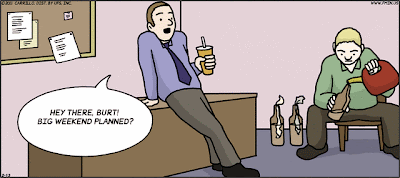
That's a very short-term quick fix. Go out and purchase another pair of shoes. Or two.
So, How Many Hats Do You Wear?
- Michael Bowen
- Pensacola, Florida, United States
- Husband. *Dog Dad.* Instructional Systems Specialist. Runner. (Swim-challenged) Triathlete (on hiatus). USATF LDR Surveyor. USAT (Elite Rules) CRO/2, NTO/1. RRCA Rep., FL (North). Observer Of The Human Condition.
Monday, August 27, 2012
More Than Meets The Sole
That's a very short-term quick fix. Go out and purchase another pair of shoes. Or two.
Wednesday, January 4, 2012
Will Stretching Make Me Faster? Probably Not.
The January 2012 issue of Outside magazine took ten of the biggest fitness myths to the mats. One of them had to do with stretching's effect on running parformance. FSU researchers asked ten male athletes to stretch for 16 minutes, then run for an hour on a treadmill. In a later session, the same crew sat quietly for 16 minutes, then hit the treadmill for the same duration. Without the pre-run stretch, the men covered more distance while expending less energy.
So, I don't feel quite so bad about my inability to stretch. At least I can run.
Ah, you say, but if you did stretch you probably would not have to deal with the nagging little injuries you've had in the past year. Not so fast, my little friend. In several large-scale studies of athletes and military recruits, static stretching did not reduce the incidence of common overuse injuries such as Achilles tendinopathy (one of the issues with which I deal) and knee pain.
In my humble opinion, stretching is a personal matter. I'm not going to tell someone they shouldn't stretch if they feel it helps. When specific muscles are tight or I have run a lot of mileage, I will do a little bit of stretching, usually the calf muscles (which also impacts the achilles’ tendon), the iliotibial band, & the hamstrings, since these are the muscles which become most inflexible because we run.
One thing you will not see me do is throw my leg over the back of a chair, or do what I see most recreational runners do, what I like to call "flamingo imitations." You've seen the person. They're the one who take their foot and pull it directly behind them up to their backside. I'm not certain whether they're working on their knee flexibility or their quadriceps muscle. Neither one really seems all that essential to run performance.
All three muscle group stretches can be done by having a flat surface, something with which to lean against, and a bench or chair. A fifteen-minute warm-up, consisting of a jog and some stretching - at the most - and on to the run.
The calf stretch can be done while leaning against a wall, bleachers, pole, or any solid object. Hold the stretch for 30 to 60 seconds without bouncing, then switch legs.
The iliotibial (IT) band stretch
is done by crossing one leg behind the other 6-9 inches, then leaning toward the rear leg. Again, hold the stretch for 30 to 60 seconds without bounce, then switch legs.
The hamstrings can be stretched by placing the leg up on a bench or support between knee & waist height (there are variations which keep both feet on the ground). Bend slowly forward at the waist until the stretch is felt, hold for 30 to 60 seconds, then switch legs.
Some things you don't want to do:
Never try to stretch a muscle that has not been warmed up. A few minutes of easy jogging (the same amount of time it takes to run about a mile) will raise a muscle’s temperature enough to make it pliable.
Never bounce during a stretch. Just stretch as far as the muscle will allow; stay relaxed & breathe. You don’t get awards for being the most flexible at the race.
Never over-stretch. You really can stretch too much & leave your joints susceptible to injury.
If you really feel the need to do it, stretching does not need to look like a return to dance classes of our youth. As long as you do it in a manner which aligns with your day-to-day functionality you probably won't need to worry about loss of muscle strength, or hurting your joints.
Wednesday, September 7, 2011
The Not-Always-Ten-Percent Rule
Wednesday, August 17, 2011
Irrational Thoughts?
Just because a person has coached athletes for a few years, has learned from hard experience what not to do, and struggles on a regular basis to clearly communicate those lessons to people who ask questions of them does not necessarily mean they have achieved an immunity to the disorder I like to call "abject stupidity."
Somehow I managed to survive a brief exposure to this disorder on my way to my "real" job this morning.
I started to think about training for a marathon.
Those who follow my rambling, sometimes cryptic missives know marathon training nearly turned me into "once a runner" approximately six months ago. It wasn't necessarily marathon training which was the primary cause of my achilles injury as much as a failure to deal with an under-healed achilles tendonitis issue which plagued me for three or four years.
I'm not certain what made me start to think about the marathon. Could it be because the evenings and the early morning hours have become a little more cool? Perhaps the slow approach of autumn and the need to review the training plan of one of my athletes was a subtle hint. Maybe, just maybe, it was that set of 400s we ran during last night's workout.
I wasn't the one spanking the group, though. Jim took Deena and myself to the woodshed most of the workout. He was kind enough to let us out after the third set. But it was nice to float up along Jim's shoulder on the back stretch of the last 400 and be in that middle ground between floating - where you feel the spring in the toe-off - and the feel when you know there's no "extra gear" available.
So a little bit of the speed is returning; 15 seconds a mile here, 20 seconds a mile there. But I must remind myself, like Taco Bell differs from Mexican food, there is a vast difference between being "healthy" and being "fit;" being "able to run" and being "able to race." I am most certainly not out of the woods yet. But I am beginning to see glimpses of the glade.
Injured runners often take too little time off from training, don't allow the body enough time to gradually ramp back up to the level of training they were at when they injured themselves, and don't stay in touch with how their body is feeling during the ramp-up. Fail to exercise caution and restraint when increasing distance, duration, intensity, and especially when races are added, and those "small" injuries which are usually remedied with a weeks' worth of rest or cross-training can transform into "major" issues which drastically affect the overall quality of life.
Feeling no pain is not necessarily the same as feeling better. It is, however, the first step on the road to recovery.
As for this ol' coach, we're almost ready for 5,000-meter road races, and not much more. In the meantime, there's a couple of flat late-autumn and early-spring marathons I'll continue to consider; the operating word is "consider."
I'm not that stupid. Yet.
Wednesday, August 3, 2011
Sock It To Me - The Right Foot Cover For The Job
There was good news and bad news.
The bad news was that the heel pain continued. The good news was the pain was localized at the point where my heel rubbed against the cuff of my training shoe. Why? When I pulled off my shoe a dime-size spot of mesh appeared at the heel of my ten-year-old "favorite pair" of running socks. Right at the cuff. That was the reason for the pain.
There's nothing evil about parting ways with a ten-year-old pair of running socks. It's hard to grow into love with a new - read the word "different" here - piece of clothing, especially if you've grown accustomed to a particular style, cut or material. In this case, the socks were knit wool(-blend) crew style. My friend Scott heard immediately questioned my sanity. Yes, Scott, wearing wool socks in Florida is probably a sign I'm a little mad.
Running socks have come a very long way from the cotton crew socks I used when I started running with regularity in the early 1990s. Definitely far from the up-to-your-calf cotton tube socks I wore in high school.
Naturally, space prohibits from discussing every possible type of sock available. However, if there are sock manufacturers willing to let me road test their wares I won't hesitate to talk a little more about them.
The most popular running socks fall into three different categories: thin, padded and specialty.
Thin socks which come to my mind are made by companies like SockGuy, SaveOurSoles, LN, Gizmo and Air-E-Ator. When Suzanne and I go to an out-of-town race, we'll pick up a matching pair, just to remind our friends we're married. I love these socks for a number of reasons:
First, they work well for a multitude of situations. I can wear them with a pair of dressy shoes; nothing drives my co-workers up the wall like seeing me in a meeting wearing a pair of black socks with a beer mug embroidered on the medial (inner) and lateral (outer) cuffs.
Second, when I do triathlons the thinner socks protect my feet from the seams and edges of my bike shoes and help me to slide into my run shoes very quickly.
Third, I can wear them with a snug pair of cushioned running shoes or racing flats...depending on the distance, or as an inner pair with a low cuff padded sock for a longer distance race.
Last, the multitude of sock colors and embroidery designs - colleges, military services, wise comments, and so on - let me expose my personality on the road.
When it comes to padded socks Thor-Lo comes to mind reflexively. I've varied between the low-cut crew 12 and what Thor-Lo calls the Run-12 and the Run-14, depending on the time of year and availability in the running specialty stores. Thor-Lo knits their socks in three different varieties of thread: CoolMax, Wool, and Acrylic, and in thin or padded styles. I love the padded style, and can never seem to have enough pairs. I've also worn the Ironman-branded sock, which is an acrylic blend, and a little less-padded than the Thor-Los. The Ironman-branded socks, made by Wigwam, are my first choce for longer-distance race days, usually covered up with a SockGuy-type sock.
I received a pair of WrightSocks as part of a grab bag shipment a few years ago. What made those socks special was the fact they had two layers rather than one, which kept my tender(ized) foot and ankle flesh from rubbing against the internal seams of my shoes. Nice socks, but unfortunately, I suffered from the curse of any guy who launders...the favorite socks always lose one member of the pair, after which they - the single sock which remains - are only good for making dog toys.
Why is it the good socks always lose one of the pair, and the bad socks never get lost?
Let's return to the topic of rubbing and the outcomes which result from skin rubbing against seam - blisters -and skin rubbing against skin - blisters, chafing, callouses. I've had calloused skin between my fourth and fifth toes for a long time, which occasionally I'm able to trim down. My wife, noticing this issue, asked whether a pair of socks with split toes would help the problem. I used to look at the Injinji socks as another one of those strange marathoner aberration-slash-fad things; my marathoning alumna used to wear them for every run and swore by their benefits. With "barefoot" running and the Vibram-type split-toed shoe-like devices suddenly appearing on the foot of every bandwagon rider the Injinji socks would make for a great sock inside a pair.
Think about it, barefoot-runners. If you're wearing a "shoe" with no sock, eventually it is going to stink to high heaven UNLESS you have some sort of sock or fabric in there to soak up all that sweat. Naturally, split toed "shoes" would require the use of split toed socks.
So, Suzanne decided to grab me a pair of Injinji socks (rainbow colored!) which I could wear with sandals or while running. After the first five minutes of 'wow, this feels a little bit strange, this feeling of cloth between my toes' feeling, I have to admit they were very comfortable. Even for long runs.
Naturally, there's no "one size fits all" solution for the right pair of socks. Much like running shoes, the right sock for the runner is a match -sometimes made in heaven, sometimes a little farther "south" - between shoe and foot; a blend of personal preference, "checkbook resiliency, and foot type.
Tuesday, August 2, 2011
A Very Scary Place
Christopher Cross, "I Know You Well' (1998)
In the past I've focused on advice and counsel which can be passed to a larger, more general public, especially since a sports editor asked whether he could borrow one or two of my posts.
Weekly exposure in a large-city newspaper leads to a number of outcomes: You end up with new 'friends.' You also gain new 'detractors.' Both are necessary to the aspiring writer. There's nothing like seeing your weak points exposed by a person who wants to "make points" in the public spectrum - they provide an unpaid (but not unappreciated) editorial function in the feedback loop. You go back and think a little more critically about the next topic; you read the first draft a little more critically. You make certain there's more "muscle" than fat. The editor has less material to polish, change or tweak.
This post is (most likely) not going to be sent up the line. Here is where I temporarily revert to that often self-abusive "make-you-go-blind-if-you-keep-writing-like-this" type of writing which to many appears to be the sustenance of bloggers. I feel a need to talk about a "very scary place" I briefly visited this past weekend. Some details will be trimmed to save friends and loved ones from needless exposure.
I like beer. However, I would not say I have a drinking problem. More often than not I am the person who sees the proverbial "line drawn in the sand," over which I dare not step for fear of ruining my personal, financial, or professional well-being. I will have anywhere from zero-to-three beers a day during the work week. There is the rare - perhaps two or three times a year - occasion when I will dance at the line and mock the Fates, after which I go back to my comfortable bed and sleep for a few hours. When I awaken, I chuckle at my good fortune, grab a cup of coffee and march smartly.
This weekend I have to admit I stepped over the line. It wasn't a big step, but it was a step. In the 25-plus years since I drunkenly stumbled out of a bar in my hometown and inflicted $600 worth of damage on my brand-new pick-up truck, I think I can say I've "stepped over the line" perhaps three times. For me, this involves or has involved drinking (probably in this most recent case) the equivalent of a 12-pack of American beer and climbing into or onto a motorized vehicle.
I've seen other people (try to) do this. In a far worse state of inebriation. With facial trauma from the outmanned tag-team match against gravity and disequilibrium that state of drunkenness so stealthily arranged. I've seen a few really good, and graphic examples of why not to drink to that state. Of course, when we are having a great time we don't quite think about those consequences.
I definitely thought about the potential consequences - financial, judicial, professional, medical, and so forth - once we returned (safely) home. The next morning's run turned into a long walk and chat with my wife. She now understands why I prefer to not drink as much as the next party animal. And naturally, my body decided to let me feel the lowest level of the potential consequences through the remainder of the day. A headache would have been acceptable. But no...my stomach taught me a lesson.
Small, 12-ounce opaque drinking cups are your friend. Large, transparent 21-ounce beer mugs are your friend, too...but for a brief period of time. Having the courage to say "I think I've had enough," or to ask whether someone (sober AND of legal driving age) can make certain you get home safely might not make the hangover, headache or gastrointestinal distress any less intense, but it might be much less expensive for you. And the ones who run with - or love - you.
Wednesday, June 1, 2011
Say When?
Yes, even Kenny Moore learned when to say when.
Friday, May 27, 2011
15 Miles-A-Week To 26.2 In A Day: The Marathon Puzzle
Before I start, let's come to a couple of understandings:
Tuesday, April 12, 2011
Your Ego Is Not Your Amigo
He sent me a running question the other day:
"I'm starting to experience some pain on the outside of my right knee after I run. For example, I did eight miles this morning and was fine while running. When I got home, the pain really started kicking in just walking around the house. The pain seems to occur at the point when I step forward with my right foot. Any ideas? It has been happening for a few weeks now and seems to come and go. I did six miles on Monday evening and didn't have any trouble. Thanks for any help. I definitely don't want to mess up my knee."
When I sent my response back to Brett, I initially suspected iliotibial band syndrome because of the location and intermittent nature of the pain. The only other overuse injury I can think of would be patellofemoral syndrome, or "runner's knee", which would have the pain at the lower margin of the knee; the IT band would be at the upper or outer margin of the knee.
Either way, Brett has an overuse injury.
He later revealed to me he went from running five to running ten miles at a time over a four-week span, which came from training with a triathlon training group at their local YMCA. "Guess I was trying a little too hard and too quick to hang with the 'A Group'", was his lament.
When an overuse injury such as IT band syndrome, achilles tendinosis, plantar fasciitis, patellofemoral syndrome comes to pass, most of the root causes are these:
1. Old, worn-out, or improper running shoes. If the runner cannot say how long (in time or miles) they have run in a particular pair of shoes they might have run in them too long. Sometimes an old pair of shoes will give fair warning by "smelling dead," or the runner might suffer from some aches and pains in the ankles, feet, knees or lower back. Naturally, the remedy would be to get into a pair of shoes which best fits the foot type. Most experienced runners know what kind of shoes work best for them. Once in a while a particular model of shoe changes construction or materials, so it doesn't hurt (no pun intended) to have a "short list" of acceptable shoe models. The major running magazines do annual shoe reviews which can make the search more simple, or a running speciality store can point the individual runner to the "short list."
2. Significant changes in training volume, terrain, or surface. A short-term (or even a long-term) business trip or a new training group can wreak havoc on a training cycle. Most good training schedules aren't necessarily (and probably shouldn't be) written in stone. I've discussed with my coach/advisor about synchronizing my workouts with my coaching; some times solitary training sessions are necessary to train at the proper (read: easier) intensity. Look closely at the recent changes, then subtract them for about three weeks. Why three weeks? That's how long it takes for the body to benefit completely from a change in training volume or intensity, or the minimum time it takes for a low-level overuse injury to begin healing.
And when adding distance/duration to a workout, the "ten percent every three weeks" rule of thumb is best. When talking ten percent, the addition of time/distance should be spread across the training week as much as possible. For example:
OLD WEEK - 30 miles/week
- Sunday - 6 miles
- Monday - Rest
- Tuesday - 6 miles
- Wednesday - 6 miles
- Thursday - 6 miles
- Friday - Rest
- Saturday - 6 miles
NEW WEEK - 33 miles/week
- Sunday - 7 miles
- Monday - Rest
- Tuesday - 6.5 miles
- Wednesday - 6.5 miles
- Thursday - 6.5 miles
- Friday - Rest
- Saturday - 6.5 miles
I've met runners who tacked the ten percent on the Sunday run, which in the example above would increase the volume of that day by 50 percent and increase the longest run of the week to more than 20 percent of the week's volume. Neither one of those are a good idea. If there's a time crunch during the week the additional miles could be split between Saturday and Sunday, but even then there would be the risk of adding too much stress too soon.
And, regardless, cambered roads and hill running can wreak havoc on the unprepared runner. Stress injuries abound from too much "new" (surface, distance, or intensity), too soon.
3. Muscle weakness, especially in the calves, gluteus medius, and abdomen. When a runner has weak muscles or muscle imbalance it puts undue strain on the rest of the "drivetrain." I sent Brett a link to a YouTube video (http://www.youtube.com/watch?v=5RC7VH3bEB4) with some exercises to strengthen his glutes and stretch the IT band. Six of ten runners who make these changes can recover from a low-level overuse injury in as little as three weeks, with the remainder recovering in six weeks. There are those cases (this coach included) where recovery can take up to six months; more of a compliance and patience issue than anything else.
Brett sent a reply which ended with:
"I signed up for a ten-miler this coming Sunday. I want to finish it, then my plan is to go back to six miles and see how I do. If I still am having problems, I'll keep backing off until I stop having problems and may look into seeing a physical therapist. Once I figure out where my baseline is, I'll start slowly increasing my distance again, only this time at a reasonable pace."
When it comes to training, and especially when it comes to recovering from an overuse injury: Your ego is not your amigo.
Monday, April 11, 2011
Pre-Race Paranoia, Or The Half-Shell
Monday, January 24, 2011
Sidelined. Not Benched, But Sidelined.
I had a sneaking suspicion something was not "really" right when we started the second of three planned seven-mile loops yesterday afternoon. My right heel and achilles tendon had behaved well through the first loop and we were gliding at a relaxed low-to-mid eight minute-per-mile pace. For Deena, one of my athletes in training for the Rock n' Roll/Mardi Gras Marathon, this pace was right where she needed to be, give or take a few seconds. However, this pace would not do me on the day; I'd need another fifteen to twenty seconds each mile. But pace was the least of my concerns.
My mind and my legs were having one of those James T. Kirk and Montgomery Scott moments which played out in every Star Trek episode or movie I've ever watched. Unfortunately for me the legs were Patrick Doohan, the mind was William Shatner: I'm giving 'er all I got, Kept'n...
About two miles left in the loop, I was deep in the Elisabeth Kubler-Ross stages of dealing with death and dying: Denial. Anger. Bargaining. Depression. Acceptance. Two of three poor half marathon performances in three months were a clear message something was biomechanically amiss, and getting angry about it would not fix the problem.
I figured I would make a bargain with my body and try to finish fourteen miles; if I could do fourteen then tacking on an easy two miles to make the run twenty-six kilometers would be an acceptable compromise.
We stopped briefly at a Circle K. I grabbed a bottle of fluid; Deena took a quick stretch break. As we started again I broke the news. I decided, rather than to back down from the full marathon and run the half in three weeks, repeating the "ten miles of decent running, followed by three miles of character-building" insanity - and insanity, according to Einstein, is doing the same thing over and over with the hope of different results - I would back down immediately to rehabilitation. This vicious cycle of train, injure, recover and reinjure has to stop. And this cycle had to be broken before I repeated the same ten kilometer walk-of-shame I did in Jacksonville...followed by recovering from a high-grade achilles tendon problem.
When you find yourself in a hole, the smartest thing to do is stop digging.
After a hot shower and a cold beer, in front of the television watching the NFC Championship with my greyhound Rubin, I saw Jake Cutler come off the field with a slight limp. Most quarterbacks in his position would have been selfish and said: 'I'm fine, I'm staying in the game,' and continued down the (painful) path of self-destruction. It may seem suicidal for a team who wants to make it to a championship game to put in their third-string quarterback, but I think it was wise of Cutler to know he would only do more damage to himself and to his team's slender chance to win by trying to earn ego points.
Sure, from the outside looking in it seems weak. But Cutler's teammates, the guys who know him best, seem to be in support.
We always look at the "manly-man" approach to training, racing, and endurance sport, but we rarely remember one of the best lines ever spoken by a "manly-man" in the movies:
"A man's got to know his limitations." - Clint Eastwood, as "Harry Callahan," "Magnum Force" (1973)
So, I'll watch from the sidelines for now. Much better than watching on the TV while my season (s a runner) is over.