"These sudden joys have sudden endings. They burn up in victory like fire and gunpowder. . . . Too fast is as bad as too slow."
--"Romeo and Juliet," Act 2, Scene 6 (William Shakespeare, ca. 1597), in modern English.
My loving wife often warns me about what she calls "hobby-horses." She knows I tend to be fixated to the verge of obsession on certain topics. When I served as RRCA state rep for North Florida, headphone use was my "hobby horse." I've had other "hobby horses," too, but the headphone thing was most-notable.
I've talked a lot about treadmill running with people who hate treadmills. Some of them are folks who say TMs are no good for training, others don't like the boredom factor. Since late November, I've done every weekday run, including speed workouts, on a treadmill. True, the TM can be breathtakingly boring, but they let me control many training variables. I can adjust one variable at a time and see how my body reacts, or I can end the workout the instant my tendons are in distress.
The initial 35-minute runs are now 60-minute runs, averaging eight minutes per mile. The good news is I'm near the training volume where I was when I was running six days a week and racing once every three months. But the ache in my back and hips is not so good.
It's not the shoes - the oldest of my three pairs has somewhere between 260-270 miles on them, with the newest pair less than thirty. Could it be the treadmill? The "Gait Guys" wrote an article for Triathlete magazine; they warned readers about how a treadmill can adversely affect a runners' gait.
After reading the research by University of Virginia physical therapist Jeff Dicharry, I called the overwhelming majority of the "Gait Guys" article bupkis. Except for that "downhill" thing.
Like a road or trail surface, the feel and comfort of a treadmill varies by manufacturer, model, and even the machine's installation. Ed W. sees treadmills and elliptical trainers as warm-up, not the workout itself...that means run/tri guys like me are not his gym's typical customers. The treadmills in his cardio area are on solid rubber flooring, and thick rubber matting supports his lobby area TMs. There might be a slight slope in the lobby naturally; all the lobby treadmills seem to have this feeling like one is running slightly downhill.
The "Gait Guys" say the downhill sensation is caused by the "pull" of the belt on the runner's lower extremity, in contrast to the "push" of the lower extremity on the ground surface. They say it affects the gait; Dicharry has proven whatever variations exist (in 40 percent of runners) are so miniscule that to tell the difference it requires equipment which exists in only two sports labs in the country.
So, runners who sense that "downhill" feeling on the TM may benefit from an elevation tweak of 0.5-to-1.0 percent. I've tried both; for me a 0.5-percent adjustment is enough to take away that sensation.
The cause of the hip ache is simple - spin class on the "off" days. The exercise bicycle in the gym cannot be adjusted as readily as a "real" bike, or like a "spinning" bike. Different movement patterns cause musculoskeletal aches and soreness.
Any runner who has ever tried to run a pace that is too slow for their comfort has probably found out too late the error of their ways. I like to tell the tale of running with Suzanne at Honolulu's Ala Moana Park in January 2008; a solid minute-to-two-minutes-per-mile decrease in pace left me hobbling after the third day. A pace that is much slower than a runner's intrinsic efficiency forces major gait adjustment, either in stride length or stride duration. A shorter stride length is not biomechanically injurious; a longer stride duration means a longer period of compression time for the large muscle groups and joints. Drive with your shock absorbers compressed beyond their normal range for an extended period of time is most likely going to shorten their lifespan.
So, perhaps it's possible not only for a runner to go at a pace that is too fast - leading to fatigue, overstriding, a compensated gait pattern, and heel-striking - but also too slow on a treadmill.
How can a runner determine what are good training paces for treadmill runs, without going into a lot of trial and error? There are a couple of really good on-line calculators developed by some of the nations' best running coaches (e.g., McMillan, Daniels) which provide optimal pace ranges for easy runs, recovery jogs, and speed work of varying degrees.
I used my Daniels VDOT training pace for easy/long runs as the starting point for treadmill runs. After a time it appears the easy/long run pace is too slow. So, I will probably start at the "marathon pace," a little closer to 7:30/mile, and adjust downward until I find the least uncomfortable pace which doesn't feel too slow.
That's why the later editions of Running Formula, and McMillan's calculator, have pace ranges, because there will always be a sweet spot at each of the intensities which feel best for the individual runner. While running too fast on the treadmill can injure a runner, too fast is no more injurious than running too slow.

So, How Many Hats Do You Wear?

- Michael Bowen
- Pensacola, Florida, United States
- Husband. *Dog Dad.* Instructional Systems Specialist. Runner. (Swim-challenged) Triathlete (on hiatus). USATF LDR Surveyor. USAT (Elite Rules) CRO/2, NTO/1. RRCA Rep., FL (North). Observer Of The Human Condition.
Showing posts with label calculations. Show all posts
Showing posts with label calculations. Show all posts
Thursday, February 23, 2012


Tuesday, April 7, 2009
Outside Looking In
When I mentioned my 2009 goal of completing an Ironman 70.3 & an Ironman event to my running friends, one of the first questions with which they responded came down to 'so, what time do you think it will take for you to complete the Ironman?' 'Frankly,' I told them, 'all I want to do is finish, but it would be nice to complete it in...'
At that point I stopped, partly because I was trying to calculate what would pass for a good day doing 140.6 miles by taking my crappy day of 70.3 & multiplying times two. But, remembering my hubris, I also told them I'd take the entire 17 hours if I had to, all that mattered was to finish & hear Mike Reilly bellow out the affirmation: "You Are An Ironman!" After that I can have a beer, take the time to determine which set of muscles hurt the least; those muscles will the ones over which tattoo number two will be placed. Hubris hurt me worse during my past two marathons than the tattoo I got to remind me to respect the distance. I'm not counting my first marathon; I knew nothing about running a marathon & it showed on race day. But I survived, & that's what was important on the day:
- I participated in my second marathon against the advice & counsel of my own coach. I spoke very lightly about my chances of qualifying for Boston, based on the (5K/10K racing-focused) training I accomplished that autumn. I did two long (16-mile) runs which left me susceptible to the worst case of flu I had ever experienced...two weeks out from race day. I ran (I think) a 7:00-15/mile pace for the first 13.1 miles, which put me 5-7 minutes ahead of Boston Marathon qualifying pace. The next five miles were where the wheels began to fall off, with the game over moment coming at mile 19. I screwed up the hydration plan & was passed by the 3:20 pace group six miles out from the finish. The 40-mile drive was painful, as well as the ilitibial band friction syndrome I suffered from over the next year. Brought a whole new meaning to the term walk of shame.
- My most recent marathon experience saw smarter training; I followed an adapted Brooks-Hanson's plan & focused on the hydration/nutrition necessary to make the marathon a good day. However, a poor choice of training shoes (when a running store owner/sub-3:00 marathoner tells you he wouldn't run a marathon in the shoes you chose, you made a poor choice) brought on overuse injuries which never really went away come race morning. I followed my heart rate monitor for the first 13.1 miles, hydrated religiously every 15-20 minutes, & had eight minutes to play with at that point, when the training injuries came back to haunt me. My achilles' tendon began to swell because I adjusted my stride to deal with bilateral calf cramps which hobbled me. I lost the eight-minute cushion bymile 20 & had to make a Hobson's Choice of three options:
- - Push the pace to make Boston qualifying time, & risk serious/permanent injury.
- - Walk the last ten kilometers to the finish, & live to fight another day.
- - Drop out, take the did not finish, & live to fight another day.
I say all that to write this Memo to Self: If the marathon is a humbling distance, then triathlon of nearly any distance is even more humbling due to the breadth of disciplines. Performance gains in one discipline often come at the expense of hard-earned gains of one or both of the other two. If the sprint distance hurts X much at the end, the intermediate distance do not hurt X-times-two; the half-iron distance do not hurt X-times-four, & the iron distance sure as hell does not hurt X-times-eight. It's probably more than that.
Multisports.com coaches Paul Huddle & Roch Frey said it best this month in their article in Triathlete magazine, from which I (shamelessly) quote (emphases are mine):
"...Madam Pele....hears & sees everything. She doesn't take kindly to overconfidence & disrespect....Ironman was born in Hawai'i &, therefore, the rules of aloha & kapu extend globally....we encourage all first-time Ironman athletes...to approach their first attempt at the distance with a healthy heaping of humility."
"...The No. 1 goal that every athlete should have when toeing the line for an Ironman is to finish. What are some other goals worth shooting for? Let's list a few: 2. Finish while still standing. 3. Finish while still standing & smiling. 4. Finish while still standing & smiling & in good enough physical condition to bypass the medical tent for food & a massage. 5. Finish while still standing, smiling, bypassing the medical tent & remaining gainfully employed. Finish while still standing, smiling, bypassing the medical tent, remaining gainfully employed & married."
"Look, we're already at No. 6 & there's been no mention of times and/or placing..."
Hardest part about the preparation for Ironman so far isn't so much the distances necessary to be accomplished in training, but partly of getting one's head wrapped around the big, honking numbers of distance & time that will be traversed. I have several friends (male & female) who are Ironmen; several provide sea stories about what they did/do in training, what worked & what failed. But, with very few exceptions, many Ironmen don't tell everyone they've done one. There might be a discreet M-Dot sticker on the back of their car, or they might wear a polo or fleece. Some have the M-Dot tattoo, which may or may not be revealed in the throes of tipping back a few adult beverages. (I still love the explanation to the kids, Jean. For the religious at heart, I would call it an outward manifestation of an inward process.)
At this point in time I feel like a kid in an orphanage or foster care who wants so badly to be accepted into the family. And family is so much a part of the training experience, from what my closest IM friends have said: they serve as domestiques, soigneurs, cheerleaders, psychologists...you name it. That explains the family member boogie down the last few hundred yards with the participant, which to me seems pretty cool. But, like every adoptive child, we're all unique, on the outside looking in. We want to know from the other kids what they did to get into the family.
I don't care how long it takes to get into the family. I just want to be a part.
Monday, December 15, 2008
You Have Some "Splaining" To Do
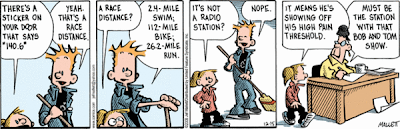 Some numbers are more daunting than others. Take the iron-distance triathlon. Even some of my closest friends have a difficult time wrapping their head around the 140.6-mile (total) distance. After you translate/transform it out to the metric system for the benefit of metric-system-using friends up in Canada, 226 and change (kilometers) sounds even the more insane. To make it sound more round, my metric-speaking friends call it "220."
17 is a more-simple number; that's the number of hours you have to complete the entire event. However, the race organizers make that more complicated by instituting cut-off times for the swim & the bicycle portions. You have to finish the 2.4-miles of open water swimming in 2:20. That means you have to swim 100 yards in a little over three minutes...42 times. I consider myself a poor swimmer, and my distance swim time averages right on the ragged edge of 2:05 for 100 yards.
If you manage to get through that, then you have the privilege of jumping on your bicycle and riding 112 miles, with a cut-off time of somewhere around 10:30 from the start of the race. Oh, the clock doesn't stop after the swim, either.
Let's presume you make it out of the water by the slimmest of margins (sometimes the participants do not), you have to average a little under 14 miles per hour to make the bicycle cut-off. Attaboy.
Now it's time to put your running gear on and do a marathon. Once again, assuming you finish right before the cut-off, it's 6 hours and 30 minutes to travel, under your own power, 26.21875 miles, or 14 minutes & 48 seconds per mile; a rapid stroll...albeit on legs powered by long-depleted energy sources.
Now think about this; there are professionals who are doing this in less than nine hours, and strong amateurs doing it in less than ten. Lots of the finishers could care less about making it in ten; most want to just simply finish.
So, once you run the numbers in a brutally-analytical manner (a friend of mine has completed three Ironman events; we talked about this calculus one night over dinner), where is the challenge? Is it in trying to get through as quickly as possible? Is it in trying to get through it faster than the last time you did it? Or is it in trying to get through it, period? I believe much of it has to do with the mind; having to wrap your head around the concept of distance & of time. Being strong enough to continue forward, yet smart enough to know how fast (or how slow) you need to go in order to make it to the line. Being able to live in the immediate moment & compartmentalize the activity.
So, once you run the numbers in a brutally-analytical manner (a friend of mine has completed three Ironman events; we talked about this calculus one night over dinner), where is the challenge? Is it in trying to get through as quickly as possible? Is it in trying to get through it faster than the last time you did it? Or is it in trying to get through it, period? I believe much of it has to do with the mind; having to wrap your head around the concept of distance & of time. Being strong enough to continue forward, yet smart enough to know how fast (or how slow) you need to go in order to make it to the line. Being able to live in the immediate moment & compartmentalize the activity.
Perhaps Desi Arnaz was right: '...anyone who goes to (do this) needs to have their head examined.'
Wednesday, March 19, 2008
Comfortably Numb
 I vaguely recall a tale of my father's, from a period of time when he was a police officer in a small town in southwest New Mexico. He still is there, living the life of a comfortably-retired civil servant. The term above was not exactly the last words spoken during a cuff and stuff episode outside of a hometown watering hole...there was one more word there.
The chapeau in question above only reinforces something I find rather strange. How is it that athletes in the pool or on the bike can wear Spandex, but if the average Joe Paper Lunch Bag decides to wear the same type attire his masculinity is called into question? How much of that 1980's-big-hair-glam-rock influenced this attitude? I realize it's not a universal thing, only an American thing. My European friends see nothing wrong with Speedos, Lycra bike shorts or tight-fitting attire when working out. As for me, I'd rather have you mocking me behind my back as I'm blasting down the road on my triathlon bike at 20-something miles per hour, rather than meet your seal of approval and have to deal with chafing and other discomfort. So there.
 Find a need and fill it. Sounds like my day job. Unfortunately, the recommended intervention (while worthwhile) seems a little too big. Then again, I remember seeing a Dave Matthews Band video a couple of years ago; the protagonist got up in the morning and went out into the world, giving a hug to everyone he encountered. Looked a little too silly at first. However, after long stretches of short chats with my wife (She tends to buy into this kind of solution set; I tend to raise the b.s. flag after five minutes.) this might be an idea whose time has come.
 There are certain questions that should never be answered. Some calculations should never be made. However, the best one I've heard, for want of a better term, would be best called beer mileage. A friend looked at the calorie content of the typical 12-ounce American beer and figured it to average right around 100 calories, more or less. So, in order to burn off 100 calories, she figured the average person would have to run at least one mile. So, running a ten-kilometer (6.213712 miles) race would burn off the calories taken in by a six-pack of American beer. I guess, if you took this analogy further, you could say a 12-pack would equal a half-marathon's worth of running, and a case of beer would require you to get out and do a marathon. Of course, the catch is doing the mileage before the intake. Yes, you have to earn your beer, friends. You get to be comfortably numb after you do the work.
It doesn't work as well the other way around; drink the beer, then do the distance. I've seen what folks look like trying to run after doing a beer. Twice. One can per quarter mile. Not a pretty sight.
 Find a need and fill it. Sounds like my day job. Unfortunately, the recommended intervention (while worthwhile) seems a little too big. Then again, I remember seeing a Dave Matthews Band video a couple of years ago; the protagonist got up in the morning and went out into the world, giving a hug to everyone he encountered. Looked a little too silly at first. However, after long stretches of short chats with my wife (She tends to buy into this kind of solution set; I tend to raise the b.s. flag after five minutes.) this might be an idea whose time has come. There are certain questions that should never be answered. Some calculations should never be made. However, the best one I've heard, for want of a better term, would be best called beer mileage. A friend looked at the calorie content of the typical 12-ounce American beer and figured it to average right around 100 calories, more or less. So, in order to burn off 100 calories, she figured the average person would have to run at least one mile. So, running a ten-kilometer (6.213712 miles) race would burn off the calories taken in by a six-pack of American beer. I guess, if you took this analogy further, you could say a 12-pack would equal a half-marathon's worth of running, and a case of beer would require you to get out and do a marathon. Of course, the catch is doing the mileage before the intake. Yes, you have to earn your beer, friends. You get to be comfortably numb after you do the work.
It doesn't work as well the other way around; drink the beer, then do the distance. I've seen what folks look like trying to run after doing a beer. Twice. One can per quarter mile. Not a pretty sight.
Subscribe to:
Posts (Atom)