The marathon is the "Rubik's Cube" of running. You can pull one right out of the container that's in perfect condition, and no sooner than you start to screw around with it you end up making things a mess. One that's almost impossible to return back to the original state. A runner who takes up the idea of doing a marathon without at least four years of (preferably injury-free!) training and racing of distances up to the half-marathon is asking to twist the bejeezus out of a brand-new Rubik's Cube.
The hardest part is not doing the training that's necessary to prepare for that day of 26.21876 miles, it's doing the training without becoming injured. Most of the published marathon training plans have long runs of up to 22 miles. Some longer. And most written for a general population. Look at a plan written by coaches in areas where the metric system reigns supreme and you'll find the longest run is 30 kilometers (18.641136 miles). When laid up against the 50-mile or 80-kilometer week, that single long run will take up half of the training mileage (and possibly more than half of the time) spent training. I'm more of a fan of spreading the mileage (50-to-60 miles) out throughout the week, with the longest run of the week around 16 miles, or 26 kilometers, a distance which can be covered by most trained runners in 2.5 hours or less.
Even then, there are runners who don't have large chunks of time to spare in their life. They can manage to squirrel away 8-to-10 hours during the early morning or later evening. Some ask if it's better to get the week's mileage in large chunks, say a long run of 12-to-16 miles on the weekend, and runs of 8-to-10 miles during the rest of the week. While there are some physiological benefits to pushing a 60-to-90 minute run one additional day of the week, the risk of injury increases as the runner goes out for longer duration sessions...especially as you approach that 2.5-hour mark. Add to that the amount of time it takes to recover either at home or at work and running "singles" may be a more-hazardous endeavor than first thought.
And what happens if there's a family visitor or a social function going on that cuts into that (for example) 90-minute planned run on the schedule? My take is that a shorter run of good quality is better than cutting short that planned longer effort and feeling guilty about the whole thing. I like splitting runs, both between morning and evening, and between evening and the following morning. Sure, you're decreasing the amount of time the body has for recovery, often by as much as one-half, but you're also decreasing the amount of time you're out on the run. And if something comes up on the social schedule it's not a complete disaster.
When it comes to the "long run" on the training schedule, not only do I split the run between Saturday afternoon and Sunday morning, I borrow a race execution strategy from a fellow coach, Patrick McCrann. I have the athlete run the Saturday "half" of the long run at the pace they'll run for the first six miles of the marathon. Then, on Sunday morning, I have them run the assigned distance, half at the pace we planned for the middle third of the marathon, half at the goal pace for the final ten kilometers of the race. It's more difficult for the athlete to execute the paces because they've done so much quality work from the previous Tuesday afternoon forward they're pushing five or six miles on legs that have accumulated fatigue...no different than the feeling they'll have on race day. But, they also won't be running as much during the last weeks leading into the race.
During the week, at least on the days when I haven't scheduled a particular intensity, I'm only concerned about the day's duration, which can range anywhere from 45 to 60 minutes. Anything beyond that is gravy. And it's important to recover and rest during those times in between runs; if lawn mowing or an extended house maintenance session is planned during the day it's probably better to get the run out of the way early in the day.
There may be a need for doing one or two runs of two hours during marathon training, but the fatigue accumulated through several days of quality work during the week can mitigate the need for a whole lot of them. There's a solution to the "Rubik's Cube" that is the marathon, the challenge is figuring out what jumbled it all in the first place.

So, How Many Hats Do You Wear?

- Michael Bowen
- Pensacola, Florida, United States
- Husband. *Dog Dad.* Instructional Systems Specialist. Runner. (Swim-challenged) Triathlete (on hiatus). USATF LDR Surveyor. USAT (Elite Rules) CRO/2, NTO/1. RRCA Rep., FL (North). Observer Of The Human Condition.
Showing posts with label time. Show all posts
Showing posts with label time. Show all posts
Thursday, June 6, 2013


Monday, November 22, 2010
Be. Here. Now.
 "The message of rock n' roll? Be. Here. Now." - John Lennon (ca. 1973)
Word of warning, this might be a little too cosmic for the average runner. So, top off your coffee & take a couple of deep breaths before you read on.
Okay, I guess I can continue: So, I was running late, as usual, to work his morning. One of the last things I passed on the way out, after telling my wife & dog I loved them, was a little plastic & stone trophy. This little turkey with backward-turned baseball cap & tennis sneakers was the newest addition to what people employed by my (other) employer call an "I Love Me Wall." If you've run consistently enough for long enough you probably have your fair share of gadgets, ribbons, mugs, glasses & plaques. Some of the road race awards I've earned don't have as much meaning as others do; because of the story behind the race, one or two cheap fourth-place ribbons tacked up over the doorway mean more to me than one or two of my heaviest first masters' male plaques sitting on the corner shelf of my "man-cave".
This turkey is one of those emotionally-significant awards, & not just another tchotchke: It's an age group high point trophy from a masters' swim meet. I had the sneaking suspicion my chances of doing well in my age group were good when I looked at the heat sheets. However, you never can tell until the scores are tallied & the results are posted. Actually, my friend - who was the meet director - told me I was going to win my age group just before my second-to-last event for the day. Was I pleased? If you are as swim-challenged as I, you would say "absolutely!"
My friend Brett Hollowell can explain this same feeling. Eight years ago, almost to the day, we ran a 5,000-meter road race together at Great Lakes Naval Station, just north of Chicago. Several things made the experience memorable: First, it was Brett's first (or perhaps second) 5K road race. Second, it was bitterly cold & overcast. Sleet & snow were falling. These were probably perfect conditions for Waukegan, Illinois, but the temperature was definitely thirty degrees to the south of comfortable for two southern-US-based educators-turned-trainees. When the race was all said & done, I finished high in my age group. It turns out Brett won his age group, much to our mutual delight.
As we drove back to our quarters, Brett grabbed his cell phone to call Meredith, his wife. He started to tell her he won his age group, as he was the only participant his age. I immediately stopped him: "Dude, don't tell her - or anyone - how many people were in your age group. You only tell them you won."
I think it was Steve Jones who said something about the difference between winning a race & running a world record: "To win a race, you only have to beat everybody who shows up on the day. To run a world record, you have to beat everybody who's ever run the race." All too often we downplay our accomplishments as a pre-emptive first strike of humility so others won't make light in an effort to bring forth humiliation. Personally, I think adding asterisks to our own results is wrong-headed. It's as silly as looking at results the day after a race you decide not to run & to say, "heck, I would have finished ahead of...'
If you aren't "here," where ever "here" is at that "now" moment; if you decide to sit & let life pass you by, you don't have the right to complain (like the realtor doing an open house in an otherwise-empty subdivision last Saturday, who called the local constabulary). In the case of the realtor, nobody's coming to visit because everyone decided their "here" was not-here (including Survivor H3, who were two blocks away) now.
Find where your "here" is, no matter what it is, & "be" there. Now.
Sunday, October 17, 2010
How Much Time To Run?

If they can get you asking the wrong questions, they don't have to worry about the answers. "Gravity's Rainbow," Thomas Pynchon (1973)
Sometimes when an athlete comes asking a question, or makes a comment about something lacking in their training, they tend to present the question in the form of their own desired solution. People who love long runs will frame their question so the answer is more likely to be "long runs." People who like intemediate-to-long distance repeats will frame the question, hoping I will answer with their preference. However, there are more important questions which need to be asked when it comes to training.
I like to start by asking the person about the amount of time they can comfortably set aside for run training without drastically affecting their work, their personal life, the interests of their fellow family members. Available time also affects the body's ability to recover from training stress.
Work is the most obvious limitation when we talk about time constraints. Since our town has several military training bases I occasionally work with semi-accomplished post-college runners. Most of these young men & women don't need me to deal with the small details; just provide a few good workouts while they're in student status. Some are good recreational runners who want to stay fit and train for a few races. I usually remind them the life of a military student is well-filled once they start their course of instruction, but I've always made myself available to their needs. As for civilians, some employers are more willing to flex work hours than others - depending on the workplace, the interest of the boss, and the runner's work ethic. But then, sometimes the person works a specific shift or has to open or close the shop. It is what it is.
"Life," John Lennon said, "is what happens to you while you're busy making other plans." There are things which are outside of the box of your control; traffic on the commute home from work, weather conditions, just to name two. There are things which you can plan for within reason, like school activities, religious observance (if you are so inclined), time for bonding with the family. And family, in my humble opinion, trumps (nearly) everything else, save for medical conditions. You, ideally, will be a runner for quite some time, but you will always be a parent, spouse, child, sibling. Your family members will be your first line of support in whatever you do, long after your coach or training partners have gone down the road.
Once the athlete can say how many hours they have available during the week to train, I can multiply by seven to give an "optimal" baseline number of miles/week. The optimal baseline, in my humble opinion, lets me recommend the longest distance the athlete should race as their goal event/s. I've been of the opinion runners can target three-to-six 5K races on a training volume of 25-to-30 miles a week. Training volume for two-to-three 10Ks per training cycle would be somewhere between 30-to-45 miles. Half-marathons or marathons would require anywhere "north" of 45 miles a week.
An important caveat: Just because a person has enough time to train for a race as long as a marathon does not mean they will have the physical ability to train for it. This is the dirty little secret many "Couch-to-Finish Line" programs don't enjoy speaking about. A friend of mine once coached a well-known program, and he saw too many first-year, really, just-off-the-couch, runners injure themselves during the program. I personally believe a runner should, if they are coming off the couch, race no longer than 10K during their first year. I wouldn't recommend anything longer than a half marathon until after at least two years of solid, consistent, injury-free training. It takes that long for the body to assimilate the stressors which come with run training.
So, what do I think needs to be part of a typical week of training?
Rest needs to be placed in the weekly training schedule, at least one day. There are some coaches who recommend a day of rest for every decade of life, starting with the 40s. So a guy like me who has been running for 16 years would probably benefit from 1-to-2 days of rest every week. I usually have at least a day or two days worth of cross-training during the week, but I listen to my body & sleep in or take a complete rest day when I'm feeling a little too beat-up.
Once a week, there should be a long run which takes up 20 percent of a runner's training mileage/time. Running coach Jack Daniels' recommends the long run to be no more than 2.5 hours, even as part of his marathon training protocols. I've always done my long run on Sunday morning, but some coaches, like Patrick McCrann of Marathon Nation, schedules his training plan long runs for Saturday, with a 40-minute run which focuses on skill & form for the next day.
I've tried the easy run on Sunday after a hard Saturday run & think it's pretty nice. That "kinder, gentler" run gives me a chance to run with less-experienced runners at a relaxed pace, socialize, & focus on my form.
During the middle of the week I schedule a "semi-long run" if training for half-marathon or marathon, or do a tempo run to work on race-day speed. This workout is usually sandwiched by a once-a-week speed workout which can be anything from fartlek, track repeats of 200, 300 or 400 meters at efforts ranging from just above aerobic to "See God" pace (that's a pace where if you took one more stride at that pace you would probably see God), or tempo run. The last piece I try to add works on strength. These can be hill repeats/bounding of 150, 200, or 300 yards at varied effort levels, or track repeats of 500-to-2400 meters.
There are important pieces of the training puzzle which need to be put into place, but you should first ask yourself honestly how big the puzzle can be before you begin to set the edges.
Friday, September 24, 2010
The Run - The Smallest Part Of Training
Two evenings. Ninety minutes. As a coach that's how much time a week on the average I have to influence the training of my athletes. I have to trust them to do the right things on the other five days of the week; run a long run, run a semi-long run, run some easy runs, rest, listen to their body, and so on. The training regimen of every athlete, whether elite or amateur, boils down to two states: The Run, and The Recovery.
When you're not running you're recovering. It's that simple. Even if you're busy at your "real job", if you're not running it's recovery time. Simply put, recovery begins the moment you finish the run. Some of the smartest things you can do to aid in the recovery process has to start within the first 30 minutes of the finish.
FUEL:
First things first: let's refill the tank. A blend of carbohydrates & protein (3-to-1 or to 4-to-1 is optimal) will help to repair micro-torn muscles & jump-start the process of glycolysis (simply put, the making of glycogen, the fuel muscles use to burn for energy). You can either take this in solid or liquid form; your body will accept it either way. If you don't like to eat soon after a hard run or a race, then you can use a commercial recovery drink, like (Pacific Health Labs') Accelerade, (Aijinomoto's) Amino Vital, or (Cytosport's) Muscle Milk to get those necessary elements in that 30-minute window. Why 30 minutes? Physiological research finds muscles are more ready to accept those elements during that first 30-minute period. Besides, I can think of few things better after a hot, sweaty long run than a nice cool drink.
Low-fat chocolate milk has been the latest recovery hero; an almost perfect blend of carbohydrates & protein, and without the hassle of measuring and mixing; every little local convenience store (no matter where you are) has 16 ounce or half-liter bottles of the stuff in stock. If you can eat during that half-hour window, low-fat yogurt, a sandwich or pasta with meat sauce will also do the trick. Does it have to be both carbohydrates & protein? While carbohydrate-only refueling is better than no refueling at all, a recent study concluded runners taking carbohydrates & protein together reported less soreness compared to runners who took only carbohydrates.
HYDRATION:
At the finish of my ten-miler this morning I stepped into the porta-potty near my car. I felt like I needed to void my bladder, but all I could void was a small amount of dark yellow urine. Yes, I was definitely dehydrated; probably even before I started the run. The eight-to-ten ounces of water I took in at the halfway point of the run was a weak holding action at best in the struggle to remain hydrated. I wrung out more than that amount from my technical shirt at a mile-and-a-half to go. There are multiple schools of thought on rehydration:
Weight change - weigh yourself naked before & after the run. Rehydrate with the same amount of water or sports drink you lost in weight.
Weight change/150-percent - weigh yourself naked before & after the run. Rehydrate with 150 percent - one-and-a-half times - the amount of water or sports drink you lost in weight.
Weight - weigh yourself . Divide the number (pounds) by two. That number is the amount of water (in ounces) you should take in. This school of thought is good for those no training run days.
Urine color - drink enough water/sports drink to ensure the color of your urine is straw-colored/light yellow. The problem with this method is it's subjectivity; one person might consider their urine to be sufficiently light in color, also, vitamin supplements can color urine a bright yellow.
ALCOHOL:
I run with several friends who consider beer to be a beverage with multiple benefits; post-run carb replenishment, post-run analgesic, lubricant. One out of three is correct. Apart from killing pain (and brain cells!), alcohol affects reaction time, accuracy, balance, eye-hand coordination, & endurance. Even the night-before "barley pop carbo load" can screw up sleep cycles & hurt the next day's performance.
A 12-ounce can of beer has only 14 grams of carbohydrates, as compared to 40 grams in a can of soft drink. Athletes who drink regular beer end up running - to the bathroom - more than those who drink low-alcohol beer or alcohol-free beer. And drinking alcohol forces your liver to focus on breaking down alcohol rather than on glycolysis. So one 12-ounce can of beer can delay your body's recovery & refueling by an hour. When you have real life to accomplish outside of the run or the workout every hour counts.
If you're trying to drop a pound or few (one pound of excess weight can add two seconds per mile to a race performance) calories in alcohol pile on top of regular caloric intake. Alcohol also stimulates the appetite & makes it harder to feel full. So if you like alcohol, limit the drinks to two per day (for men; one for women). And don't forget to swap between one glass of non-alcoholic beverage for every drink.
(SELF-)MASSAGE:
I know several local massage therapists; I train one of them. I'd use their services on a weekly basis if I didn't have a real daytime job. My employer understands my occasional training & coaching-related absences to a certain degree, but I'm not willing to push the envelope on this account. So, outside of the occasional weekend "fit into the schedule" visit, my use of massage as a means of recovery is a do-it-yourself project. Some massage therapists teach self-massage to their clients as a value-added service: A smart LMT will have to work less hard on an athlete who keeps their muscles & tendons happy in between visits. The founder of Trigger Point Performance Therapy considers self-massage like tooth-brushing; you still go to the professional (like a dentist) for a thorough job or an emergency situation. Some popular self-massage items include foam rollers, therapy & sports balls for pinpoint massage, knobs; there are also at least half a dozen books on athletic & therapeutic self-massage. Check with your local health club, therapy spa, massage therapist, or athletic specialty store - not necessarily in that order - for lessons, items & recommendations on what works...and what should be avoided like the plague.
YOGA:
Yoga can be used as a cross-training or therapy tool - the core strengthening, relaxation & flexibility aspects can be used either after or in between workouts; even on those days when you're beat up or injured. There are stretches & positions which will work on the legs, core & balance.
COMPRESSION:
Lastly, compression wear - tops, tights, & socks - can help ensure blood flows from the extremities back to the heart, lungs and digestive system. They provide gentle pressure and support to the muscles, as well as retain warmth, which will allow the muscles to remain supple for a longer period of time. There are several companies which produce compression clothing, at varying levels of affordability, so every runner can take advantage of their benefits. Oh, and while there are many runners who swear by the use of compression sleeves or compression socks while racing or training, the jury is still out on the benefits; so far all they seem to do is make runners look a little geeky.
So, the best way to prepare for the next workout is to aggressively approach the recovery process immediately after the present run is completed.
Tuesday, May 4, 2010
Wasting Our Time Running?
I have a coffee mug...well, actually my wife has a coffee mug she allows me to borrow...which has the face of a lady in her early-to-mid-thirties on it and the phrase: 'today was a complete waste of make-up.' I've taken it on many occasions to my work place, where the sentiment is all-too-notable. Never fails to draw a laugh, especially from my manly-men-slash-ultra-conservative co-workers...not certain yet whether the laugh is one of nervousness at me taking a good long hold of my feminine side or at me having the chutzpah to say right out loud what they are thinking.
But, heaven forbid that when we begin to look at our running we feel that at many times it's a waste. If we're doing the wrong type of training at the the wrong time of the training (or racing) year, however, this could be true. Today's Coach Pat McCrann installment, the second of thirty from his Marathon Nation site, talks about how we can more effectively spend the time we have available to run...doing something which will improve our running.
------------------------------------------------------------------
But, heaven forbid that when we begin to look at our running we feel that at many times it's a waste. If we're doing the wrong type of training at the the wrong time of the training (or racing) year, however, this could be true. Today's Coach Pat McCrann installment, the second of thirty from his Marathon Nation site, talks about how we can more effectively spend the time we have available to run...doing something which will improve our running.
------------------------------------------------------------------
Setting the tone for a great run starts well before you hit the pavement. A great run requires the alignment of many things, some of which are even out of our control. Here's what you can do to set the stage for a great run effort:
* Know Your Workout & Goals -- One of the biggest reasons why folks fall into a running rut is because they have no idea why they are running. Could be they have no plan; could be that their plan is poorly written. Regardless of the cause, this higher level understanding will enable you to place your workout - and your mind - into the proper context (hard intervals or endurance day, etc.).
* All Geared Up -- Have all of the proper gear laid out and ready to go well before you need to run. Nothing saps my energy like wasting 15" looking for a pair of running shorts...as that only means 15" less of running time.
(COACH MIKE'S COMMENT: I LIKE TO FOLLOW THE TRIATHLETE'S DICTUM; TRAVEL LIGHT, TRAVEL FAST. THE LESS GEAR, THE BETTER.)
* Know The Conditions & Terrain -- Simple enough, but many folks pay little to no attention to the weather forecast. In addition to the weather, the type of run I am planning helps to dictate where I want to run (the what first, then the where). Having a few options for each "type" of run can go a long way towards making running fun.
* Know Your Workout & Goals -- One of the biggest reasons why folks fall into a running rut is because they have no idea why they are running. Could be they have no plan; could be that their plan is poorly written. Regardless of the cause, this higher level understanding will enable you to place your workout - and your mind - into the proper context (hard intervals or endurance day, etc.).
* All Geared Up -- Have all of the proper gear laid out and ready to go well before you need to run. Nothing saps my energy like wasting 15" looking for a pair of running shorts...as that only means 15" less of running time.
(COACH MIKE'S COMMENT: I LIKE TO FOLLOW THE TRIATHLETE'S DICTUM; TRAVEL LIGHT, TRAVEL FAST. THE LESS GEAR, THE BETTER.)
* Know The Conditions & Terrain -- Simple enough, but many folks pay little to no attention to the weather forecast. In addition to the weather, the type of run I am planning helps to dictate where I want to run (the what first, then the where). Having a few options for each "type" of run can go a long way towards making running fun.
I start thinking about the average run workout about an hour before I am due to hit the start button on my Garmin. This is when I take the final steps to make sure my body will be ready to run the workout I have scheduled. From eating to stretching, here are my personal steps (in order of execution):
* Turn the Phone Off -- This is the only thing that has the true potential to end a run before it starts.
* Last Meal -- I spend most of my day grazing, which means I frequently make the wrong food choices before my runs (hummus anyone?). To help counteract this habit -- and to prepare my body for the demands of the workout, I make sure I have a solid meal/snack about 1 hour before the run. This is predominantly carbs with a little bit of protein for good measure.
* Water Replacement -- If you are even remotely like me, you drink too much coffee (or tea, or pop). That's not really going to make your run very enjoyable, so about 45 minutes out I make the switch to drinking water only as a means of Critical Task and/or Email Sweep -- With hydration taking place, I have a few minutes to check in on critical work areas to see if there's any big issues still pending. If so, filing that into my head on a long run really helps me review and analyze the issue. I typically return with some really good insights.
* Final Pit Stop -- Of course, we don't want to spend 50% of our run searching for a place to go to the bathroom...
(COACH MIKE'S COMMENT: SOMETIMES RECONAISSANCE ON THE WAY TO THE RUN COURSE START FOR PORTA-POTTIES ARE A HELP. EVEN BETTER ARE PARKS WITH ACTUAL TOILETS!)
* Light Stretching/Yoga -- I wouldn't call it stretching as much as I'd call it loosening up. Just a light routine that targets your hips, lower back, glutes, hamstrings, quads and calves will be great.
* Turn the Phone Off -- This is the only thing that has the true potential to end a run before it starts.
* Last Meal -- I spend most of my day grazing, which means I frequently make the wrong food choices before my runs (hummus anyone?). To help counteract this habit -- and to prepare my body for the demands of the workout, I make sure I have a solid meal/snack about 1 hour before the run. This is predominantly carbs with a little bit of protein for good measure.
* Water Replacement -- If you are even remotely like me, you drink too much coffee (or tea, or pop). That's not really going to make your run very enjoyable, so about 45 minutes out I make the switch to drinking water only as a means of Critical Task and/or Email Sweep -- With hydration taking place, I have a few minutes to check in on critical work areas to see if there's any big issues still pending. If so, filing that into my head on a long run really helps me review and analyze the issue. I typically return with some really good insights.
* Final Pit Stop -- Of course, we don't want to spend 50% of our run searching for a place to go to the bathroom...
(COACH MIKE'S COMMENT: SOMETIMES RECONAISSANCE ON THE WAY TO THE RUN COURSE START FOR PORTA-POTTIES ARE A HELP. EVEN BETTER ARE PARKS WITH ACTUAL TOILETS!)
* Light Stretching/Yoga -- I wouldn't call it stretching as much as I'd call it loosening up. Just a light routine that targets your hips, lower back, glutes, hamstrings, quads and calves will be great.
Proper running is an amazing thing to watch. Catching a glimpse of a great runner is much like watching poetry in motion. Regardless of their speed, a great runner seems to effortlessly glide across the landscape. Spend the last 15" before your run focused entirely on your run. If you have your gear ready and your schedule is clear, you can devote these last few minutes to getting your mind -- and body -- ready to run with greatness. Here are a few images I use to get ready:
* A Horse At Full Gallop -- It's no secret I am a bigger doode, and for some reason the image of a horse flying along at full speed strikes me as both powerful and smooth.
* A Waterbug Skipping Across A Pond -- Watching these little guys on the Nature Channel really stuck with me. Seeing how these creatures were made to skim (literally) across the surface of the water is just awesome. This image helps me remember to stay smooth and focused.
* A Stream Flowing Down A Mountain -- This really helps me when running trails or downhill sections. In particular, how smooth the water is despite the speed and any resistance. This image helps me avoid pounding my way to an uncomfortable workout.
* A Horse At Full Gallop -- It's no secret I am a bigger doode, and for some reason the image of a horse flying along at full speed strikes me as both powerful and smooth.
* A Waterbug Skipping Across A Pond -- Watching these little guys on the Nature Channel really stuck with me. Seeing how these creatures were made to skim (literally) across the surface of the water is just awesome. This image helps me remember to stay smooth and focused.
* A Stream Flowing Down A Mountain -- This really helps me when running trails or downhill sections. In particular, how smooth the water is despite the speed and any resistance. This image helps me avoid pounding my way to an uncomfortable workout.
What about you? What do you do in your last hour? What's your double top secret mental image? Let us know!
Friday, June 26, 2009
Simplify!
 "...We don't train to accomplish any of what these other coaches have tried to coax you into believing. We train to IMPROVE, and to do our best. We train to perform and to win. And while triumph is no doubt defined differently for each of us, it is far easier to comprehend than anything you've heard here... Sure, it's imperative to understand what training does to your body, but it is far more important to know why you are training and what your training is leading you toward, and to have 100% belief in the process. Simplify!" - Chuckie "V" Veylupek (at some nameless coaching conference, way back when)
 Not only local runners use me as their coach. I also coach two or three runners by what I can only describe as remote control or belief coaching. After enough research into what makes a good training plan work (periodization) & a little trial/error on my own (candor), some of my friends have asked me to help them achieve their running/triathlon performance goals. So far it has been effective.
What makes it effective is this: Describing my own workout regimen (these repetitions, at this pace, with this recovery) is enough to boggle their mind, but I've been able to simplify it for their benefit. Without spending a month of three workouts per week trying to learn the language, they've been able to improve & progress forward in their training, strictly because I have simplified it for them.
 I'm not training anyone to improve their VO2max score, training stress score, magic mile or any of that stuff. Simply put, I try to help them be (in the words of Daft Punk) harder, better, faster, stronger. The nice thing is that there's only one measure that will honestly prove that on race day...the clock. The SRM won't do it. The HRM won't do it. And no matter what WKO says when all that GPS stuff is uploaded into your PC, the (four or) six numbers that really count are xx:xx:xx. Outside of (to borrow from Disraeli) numbers, d*mned numbers & statistics, the only other thing that matters is whether they make it across the finish line in one piece. If they make it across in a better time than they hoped for, all other controllable factors being equal, so much the better.
Seems pretty simple to me.
Tuesday, April 21, 2009
The Right Kind of Currency
I came home Sunday morning, after my bi-weekly 8-mile jaunt around Bayou Texar, & proceeded to ditch my dripping wet running shorts, socks & shoes on the shoe rack & hangers in my back yard. As I opened the back storm door, there was a whirrr & a blur of feathers off to the left at about the height of my head. A bird house which hung off one of our loblolly pine trees since we moved into the house five years ago had fallen in one of the hurricanes we had in the year after our arrival. Because of the fall, it's structural integrity wasn't the greatest; the floor was about half attached. We had it sitting on a metal outdoor shelf for a while wondering what to do with it. It still kind of looked cute, so we hung it up near our kitchen window about three months ago, about the same time we started putting up our patio roof.  After the Close Encounter of the Avian Kind, I realized the birdhouse was no longer just a decoration. The bottom of the birdhouse was crammed with pine needles. Obviously, some bird couple has decided to take up residence there. My wife, ever the cautious one, wondered whether we should try to repair the house and re-hang it. However, I'm more than willing to hold off until I know for certain the house has been vacated. Hey, I wouldn't want someone to come in & redecorate (or screw up) my place while I was out, Home & Garden Network be d*mned.
After the Close Encounter of the Avian Kind, I realized the birdhouse was no longer just a decoration. The bottom of the birdhouse was crammed with pine needles. Obviously, some bird couple has decided to take up residence there. My wife, ever the cautious one, wondered whether we should try to repair the house and re-hang it. However, I'm more than willing to hold off until I know for certain the house has been vacated. Hey, I wouldn't want someone to come in & redecorate (or screw up) my place while I was out, Home & Garden Network be d*mned. "Life is a budget." - Patricia Quigley, Ph.D., ARNP, CCRN (during aerobics class, ca. 1993)
 The quote above probably has never been used in a book, or directly attributed, but I definitely have to give credit where credit is due. Dr. Q is probably one of the main reasons I went to college, developed an interest in fitness, and began working as a coach. During the mid-1990s she saw me in various states of fatigue, dehydration & under-nourishment, & rescued me during one of my more acute crash-and-burn exercise moments, which turned me on to the benefits of sports nutrition.
It's also a great quote when I think about fatigue, stress, work, training. Especially when I'm laying out training plans for my athletes. Like the first principle of economics says, we have unlimited desires but limited resources. There's only so much you can do given time constraints, energy limitations, & multiple task demands. Professional athletes are blessed with not only the gifts of efficient energy distribution, but with the opportunities to efficiently reacquire the energies previously distributed. The rest of us citizens juggle that 40-hour (or more) work week, (seemingly unlimited) needs of family & home, & in many cases, determine if we can be involved in other activities.
 By determining how much time do I have to train, runners can make a simple (well, perhaps not so simple) determination of what race distances to focus on. I've seen more than my share of miserable, beat-up marathoners who probably would be happier half-ers...or 10-kilometer runners. Triathletes are even more budget-constrained than the average runner; hard-won performance gains in one of the three disciplines often come at a cost to the other two...regardless of the distance. Lately, I've started to learn you need the right kind of currency to spend in this market.
Ever spend time in a foreign country but didn't have access to their money, and all you had were dollars? Okay, maybe that's not such a good analogy; flip it around. Ever come back from a foreign country to the States, and all you had in your wallet was their folding money? Especially in this town, where people tend to not think about international travel, going into a Starbucks for a latte and trying to pay with 15 UAE dirhams (1 UAE dirham = $.27) is a very bad idea.
'What's this? Monopoly money?'
Your next cup of coffee will be at the Pensacola Police Department, while you're answering a series of questions. Beginning of a very bad day.
While coffee & pastries might work as good fuel for a 40-year-old 5K/10K specialist, it's not quite as effective when the goal is 70.3, or 140.6 miles. I guess you can do it, but it's not good fuel. From all of the people I've ever talked to who have done long-distance triathlon, they have not agreed with the marketing which states America Runs (or Tris) on Dunkin'. Well, Michael Lovato might be an exception.
That same sort of diet (or rest, or beverage...more on that in the future) discipline - or the lack of - is like having a birdhouse with a half-nailed-in floor; it's a matter of when - not if - the bottom will fall out...and you hope you don't have your eggs in there when it does happen. I approach these currency exchanges of a sort with a little bit of fear & trepidation...some 200-plus days out from Ironman Florida.
 So it wasn't too surprising to hear my wife's girlfriend complain about her dietary hassles over the past weeks. She has a love, like I do, for sweet things & junk food. Since my wife is more into savory, salty snacks, the odds of having lots of cookies, cakes, pastries & the like around the house are slim. Not that I don't love pretzels or popcorn, it's just gummi bears are higher on my list of favorite food-like substances which must be avoided like the plague so I can hear Mike Reilly shout my name on November 7, 2009. Blessed be my wife, for she has turned me on to sports nutrition bars, namely CLIF bars.
I tried to explain the benefits of CLIF bars to my wife's girlfriend:
1. There are multiple flavors.
2. They have a cookie-like texture.
3. They are made of mostly-organic stuff.
So it wasn't too surprising to hear my wife's girlfriend complain about her dietary hassles over the past weeks. She has a love, like I do, for sweet things & junk food. Since my wife is more into savory, salty snacks, the odds of having lots of cookies, cakes, pastries & the like around the house are slim. Not that I don't love pretzels or popcorn, it's just gummi bears are higher on my list of favorite food-like substances which must be avoided like the plague so I can hear Mike Reilly shout my name on November 7, 2009. Blessed be my wife, for she has turned me on to sports nutrition bars, namely CLIF bars.I tried to explain the benefits of CLIF bars to my wife's girlfriend:
1. There are multiple flavors.
2. They have a cookie-like texture.
3. They are made of mostly-organic stuff.
4. The large bars are 200 calories; the new mini-bars are 100.
So, with items like CLIF bar, a person in need to be wise with their diet, or lose a couple of pounds...like me, for performance & health reasons...can exchange the unhealthy stuff they love to scarf on at the office (where I can find whatever I am looking for) or at home with what can best be described as an eighty-percent solution. It's not a chocolate chip cookie or a brownie, but it's close enough for government work. The grains, natural fiber, flavor variety & portion control make it the folding money I can use for my own personal fitness & dietary budget.
Monday, December 15, 2008
You Have Some "Splaining" To Do
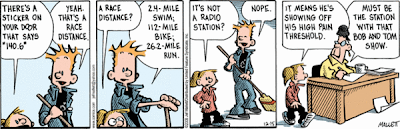 Some numbers are more daunting than others. Take the iron-distance triathlon. Even some of my closest friends have a difficult time wrapping their head around the 140.6-mile (total) distance. After you translate/transform it out to the metric system for the benefit of metric-system-using friends up in Canada, 226 and change (kilometers) sounds even the more insane. To make it sound more round, my metric-speaking friends call it "220."
17 is a more-simple number; that's the number of hours you have to complete the entire event. However, the race organizers make that more complicated by instituting cut-off times for the swim & the bicycle portions. You have to finish the 2.4-miles of open water swimming in 2:20. That means you have to swim 100 yards in a little over three minutes...42 times. I consider myself a poor swimmer, and my distance swim time averages right on the ragged edge of 2:05 for 100 yards.
If you manage to get through that, then you have the privilege of jumping on your bicycle and riding 112 miles, with a cut-off time of somewhere around 10:30 from the start of the race. Oh, the clock doesn't stop after the swim, either.
Let's presume you make it out of the water by the slimmest of margins (sometimes the participants do not), you have to average a little under 14 miles per hour to make the bicycle cut-off. Attaboy.
Now it's time to put your running gear on and do a marathon. Once again, assuming you finish right before the cut-off, it's 6 hours and 30 minutes to travel, under your own power, 26.21875 miles, or 14 minutes & 48 seconds per mile; a rapid stroll...albeit on legs powered by long-depleted energy sources.
Now think about this; there are professionals who are doing this in less than nine hours, and strong amateurs doing it in less than ten. Lots of the finishers could care less about making it in ten; most want to just simply finish.
So, once you run the numbers in a brutally-analytical manner (a friend of mine has completed three Ironman events; we talked about this calculus one night over dinner), where is the challenge? Is it in trying to get through as quickly as possible? Is it in trying to get through it faster than the last time you did it? Or is it in trying to get through it, period? I believe much of it has to do with the mind; having to wrap your head around the concept of distance & of time. Being strong enough to continue forward, yet smart enough to know how fast (or how slow) you need to go in order to make it to the line. Being able to live in the immediate moment & compartmentalize the activity.
So, once you run the numbers in a brutally-analytical manner (a friend of mine has completed three Ironman events; we talked about this calculus one night over dinner), where is the challenge? Is it in trying to get through as quickly as possible? Is it in trying to get through it faster than the last time you did it? Or is it in trying to get through it, period? I believe much of it has to do with the mind; having to wrap your head around the concept of distance & of time. Being strong enough to continue forward, yet smart enough to know how fast (or how slow) you need to go in order to make it to the line. Being able to live in the immediate moment & compartmentalize the activity.
Perhaps Desi Arnaz was right: '...anyone who goes to (do this) needs to have their head examined.'
Subscribe to:
Posts (Atom)