So, How Many Hats Do You Wear?

My photo
Pensacola, Florida, United States
Husband. *Dog Dad.* Instructional Systems Specialist. Runner. (Swim-challenged) Triathlete (on hiatus). USATF LDR Surveyor. USAT (Elite Rules) CRO/2, NTO/1. RRCA Rep., FL (North). Observer Of The Human Condition.
Showing posts with label 5k. Show all posts

Friday, September 28, 2012

Core Workouts? Is That Little "Something-Something" Worth It?

Let’s say you’re a middle-of-the-pack 5K runner.  You probably spend five or six hours a week doing a weekend long run, one or two speed workouts, and the social group/recovery runs.  Maybe you do an hour, perhaps two, of cross-training, which could be swimming, spinning or pumping iron at the local gym.  But you feel compelled to add a little "something-something" to your training regimen which will improve your 5K time, if you only knew what would be the most efficient use of your time. 
Maybe someone suggested you work on your core – the muscles at the abdomen, hips, and back which transform that slinky of our human spine into something a little more resilient.  Is focusing on your core really help you run better?  How do you know if your core is strong?  And what kind of exercises will give me a strong core?
Sato and Mokha (Journal of Strength & Conditioning Research, Vol.23, Ed.1, 2009) placed a group of runners on a six-week core strength training program to see whether their run performance, ground reaction force (how their limbs contacted the running surface), and lower extremity stability would improve.  Both the control and the treatment groups improved their 5K time at the end of the six-week study (which the researchers attributed to several variables), but the group which was placed on the core strength training program had a greater run time improvement, and no perceived change in stride mechanics (from ground reaction force variables) or lower leg stability. 
What differed from previous studies on the benefits of core strength training was the higher training volume (four times rather than two a week in other studies), as well as a two-week progression in set volume; the subjects continually had to adapt to an increased stimulus.  The exercises used in the study included:

Abdominal crunch on a stability ball.  Sit on the ball with your feet flat on the floor at about shoulder-width apart. Place your arms crossed on your chest, or hands behind your head. Walk your feet out a few steps until your lower back is on the ball, then curl your torso up until your shoulders are up off the ball. Hold the position for a moment, then lower and repeat.


Back extension on a stability ball.  Lie prone, with your upper torso draped over the ball, and your fingers and toes on the floor. Extend your spine and lift your head and your chest. Return to the starting position.
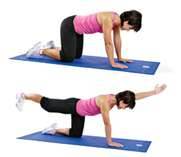

Supine opposite arm/leg raise.  Begin on your hands and knees.  Your hands are directly under your shoulders and your knees are directly under your hips at right angles to the floor.  Make your legs and feet parallel and hip distance apart.  Take a moment to slide your scapula (wing bones) down your back so that your shoulders are away from your ears, your chest is open, and your scapula are settled on your back, not poking up.  Extend your right arm straight in front of you and your left leg straight behind you at the same time. Your arm and leg will be parallel to the floor. This is the pose that reminds some people of a bird dog.

Hip raise on a stability ball.  Start by lying down, arms out, palms facing down. Rest the lower legs on the ball.  Lift the hips upward until the body is straight.  Slowly return to the starting position.


Russian twist on a stability ball.  Lay on ball, with shoulder blades on ball and hips pushed up high off ground.  Place hands together, or hold a single dumbbell.  Keeping your hips up, turn your shoulders to the right so they are perpendicular to the ground.  Twist back to the starting position, then twist to the other side.


I have bad news and good news about core workouts.
First, the bad news:  While core strength training may be an effective training method for improving performance in runners, you might end up with not much more than a strong set of core muscles.  When I reviewed the Outside magazine “Ten Biggest Fitness Myths” article, the question was raised whether whether core-specific training benefits athletic performance at all. In one study, a group of collegiate rowers who ­added an eight-week regimen of core exercises to their regular rowing ­workouts wound up with stronger cores, but their rowing performances remained the same. A group of Division I varsity football players were also tested, and researchers found almost no correlation between a strong core and athletic performance.
The good news is not only that the the law of specificity still works - running not only can help make you a better runner- but new studies show that running does work your midsection. 

Six-pack abs, and a better 5K time.  Gee, what a great idea!

Monday, July 16, 2012

Me Against The Watch

Before I start talking about the main topic, I have to confess this time of year, with a lead-in to another Olympic Games, is a sports junkie's dream.  It has been good for my recovery.  I’ve initiated my own little ‘occupy the couch’ movement with the US Olympic swimming and track/field trials, topped by the Tour de France as the background. 
While many of the participants of the larger ‘occupation’ movements were nebulous in what they desired, I have two goals:  The first goal is to let the lingering tendonitis in my ankles and knees completely heal.  It’s simple:  The only way to recover from an overuse injury is not to overuse what gets injured.  The second goal is to motivate myself into a frenzy of smart training once the Olympics are over.  It’s still going to be infernal, but I have a gym membership and a flexible schedule, so early morning and late evening training is not a problem.
Track and field events, and the Tour de France cycle race, have more in common than the average television spectator might guess, for a number of reasons:  When there are preliminary and semi-final heats at a track meet, the goal of most every athlete is to finish either in a position where they automatically qualify for the next round or in as fast a time as possible to be selected.  Does the athlete necessarily want to finish in first place?  All they need to do is exert just enough energy to qualify, save their energies for the final heat when a win means something. 
During the years when Lance Armstrong won seven Tours de France, he didn’t win every single stage.  He’d win a mountain stage here, and a road stage there; he would finish consistently close enough to the front of the pack every time he was on the road. 
There were races during the Olympic Trials, like the final of the women’s 5,000-meter run and the 3,000-meter steeplechase, where the leading runners not only had to win (or finish in the top three) to qualify, but also had to push the pace of the race in order to make the Olympic qualifying standard.  Some of the athletes collaborated with training partners and co-competitors to ensure a fast pace.  Others felt the need to go “off the front” and do it alone. 
Road stages of the Tour de France (and other cycling races) are a collaborative effort between teams and individual riders, both to push the pace or to hold the pace back…depending on their own best interests.  But there also is what is known in cycling as the race of truth.  Many stage races, including the Tour de France, begin with a short prologue individual time trial and also have one or two longer individual time trials during the course of the event.  The ‘race of truth’ sorts the good from the great athlete.  A rider can win a grand tour without being a great individual rider but there’s no way to win without being a good individual rider.  The time trial exposes every weakness in training, more so than the typical mass-start race.  There’s nobody to hide behind; no teammate to help pick up the pace should they falter. 
For runners, it’s more difficult is it to run a race going off the front alone without a supportive pacer than as part of a pack of individuals with near-identical fitness.
I trained under a coach who (i know) adjusted my training efforts based on recent racing results.  I never did time trials on my own because I ran at a level where I was out of reach of the really good runners and ahead of the slower ones…after the first mile of a race I was usually in “no-man’s land.”  But, when training a runner who is focused on, say, the half-marathon or the marathon, I like to schedule a 5,000-meter time trial on the roads to judge their fitness and make adjustments to their training paces.  It doesn’t necessarily have to be an organized 5K race (although I prefer a certified course), and it might not be until somewhere around six-to-twelve weeks out, but I prefer a course which resembles the terrain or conditions for their target event.
The goal of the time trial is either to run it at a slightly faster pace than the previous time trial, or to run it at the same time, but with a lower perceived effort.  If the athlete’s previous 5K time trial was at a pace where a few seconds of improvement will move them to a higher Daniels’ VDOT score, and subsequently faster training paces, I prefer the “same time at less effort” result.  Just like “heat racing,” the goal is not to light the fuse for a fantastic short race effort six, eight, or ten weeks out from the longer target event, but to develop the runner’s confidence; hiding an “extra gear” inside their head which they can save for race day.  It's the sum total of good runs, rather than a single great workout surrounded by a bunch of crappy ones, which are going to help define a running performance.

Monday, February 6, 2012

Doing Business That Makes Me Smile

“…So why didn’t you run the race this morning?”

Barb, my friend, posted this message on my Facebook wall, which I read minutes after coming home from a two-hour trail trek. Since the questioner is a close friend, dignifying the query with an answer was almost mandatory. “I had a commitment which had to be honored. Suzanne’s not here to support me. Besides that, I’m not in racing shape.”

Barb’s response came back while I was cleaning up: “You could have run the 5K.”

“No. I could not. What needed to be done, needed to be done at 9:00. Besides, I don’t race unless I feel ready to race.”

One of the things an overuse injury does, once a runner can run again, is encourage a focus on quality. Junk mileage, miles for mileage sake, miles to impress ones’ fellow runners; all that egomania gets kicked to the curb. Quality workouts come to the fore. Rest and recovery become important. Races transform into as much of a celebratory event as a test of heart.

After fifty-plus weeks of progress from no running, to twenty minutes, thirty, forty-five, and right at the edge of sixty minutes five or six times a week, I HAVE to keep running fun.

I recently downloaded a copy of Christopher McDougall’s 2009 book, “Born To Run: A Hidden Tribe, Superathletes, and the Greatest Race the World Has Never Seen,” for a number of reasons. I’ve slammed barefoot running as a sort of snake oil fix, and I wanted to read straight from the source material many barefoot running enthusiasts cite as their inspiration. (My suspicion is many barefoot zealots choose to go buffet-style rather than accept the entire menu.) But before I use the broad brush to paint a Picasso-like mural of barefoot true believers, I figured I’d hear the man out. As Bob Dylan once sang: “…don’t criticize what you can’t understand.”

I read through the first hundred pages or so without difficulty. Reading “Born To Run” probably won’t fill you with the compulsion to throw out your Asics Cumulus altogether, or replace them with a pair of Fila Skele-Toes.

Or perhaps it might.

But it’s a very fun read into the mindset of a couple of cultures so different from our own, that of the Tarahumara of Mexico’s Copper Canyon, and that of the ultra-runner.

So, why do people run barefoot? Why do they run ultras? Why do my grandkids love to run and play? What caught my attention in the first hundred pages or so is McDougall’s discussion of famed distance running coach Joe Vigil’s observations of the Tarahumara during the Leadville 100 trail ultramarathon in the 1990s:

“…the real secret of the Tarahumara…(they) remembered that running was mankind's first fine art, our original act of inspired creation….perfecting the art of combining…breath and mind and muscles into fluid self-propulsion over wild terrain.…You had to love running, or you wouldn't live to love anything else. And like everything else we love—everything we sentimentally call our "passions" and "desires"—it's really an encoded ancestral necessity. We were born to run; we were born because we run. We're all Running People, as the Tarahumara have always known.”

If nothing else, what I’ve learned so far from McDougall, from Vigil, from the Tarahumara - and from the guys who spend their Saturday mornings on the wooded trails, miles from the nearest 5K road race, is that running is art. Stephen Stills sang, “I don’t do business that don’t make me smile.” While I understand there are many of my friends who are driven by the pursuit of beer glasses and applause of companions, but if “breath and mind and muscles in fluid self-propulsion” doesn’t bring a smile to our face, we might as well forego the application paperwork and the cotton t-shirt and hand our $25 to the beer vendor.

If it isn’t fun, why do it?

Thursday, September 22, 2011

Blindsided By Beverages

Take a couple of seconds to think about your run routine:

You go out for a run of 30-to-60 minutes, which may or may not include a warm-up or cool-down. You come back to the house, drop your soggy shoes and socks at the door, and amble to the kitchen. Once you hit the kitchen you make a beeline for the refrigerator. You open the door, grab a bottle, can or glass of something cold and wet, and slug it down.

Quick - how many calories did you just take in? Even the most anal-retentive runner, the one who counts every calorie of solid food which crosses their lips, can be blindsided by beverages.

Yes, rehydration is necessary after a bout of running. However, we can - mindlessly - take in more calories over the course of sixty seconds than we burned off in the previous ten minutes. When you start to think about it, it's not all that difficult to see why some runners have difficulty losing those last few pounds. You know the ones - those five pounds which can slow you down by 20 seconds a mile.

That's a minute for a 5K. Closer to ten minutes for a marathon. Ask any marathoner who's come "just that close" to a Boston qualifying time what they would sacrifice for ten minutes. Some might mention a pound of flesh, but it's a little closer to five. Naturally, the issue is one of portion control. When I was the age of my oldest grandchild the largest size soda at the major fast food resturant was the smallest size now; same for the french fries.

And when you look closely at a bottle of the most popular "thirst quencher," you find that the 20-ounce bottle represents not one, but two and-a-half servings. And 130 calories go down the hatch quickly. Very quickly.

I am not saying that sports drinks are bad. What I am saying is that we need to pay close attention to what we eat and drink as part of our training...and I consider recovery as important as any training session on the schedule. There are sports drinks on the market which have more trash than treasure, more empty calories than nutritive value. Some drink manufacturers make claims which can hardly be substantiated and usually come with provisos in small print. Personally, I'm too old to read small print. If I can't read it I probably should not drink it.

When it comes to recovering from the run, I will be the first to say this - slow is best.

Slow down. Read the label. And if you can't read it you probably shouldn't eat or drink what is inside it.

Monday, March 14, 2011

My Sport Is Your Sport's Cross-Training

This last weekend was, I believe, the thirty-first running of the largest 5K prediction run in the U.S., at McGuire's Irish Pub in Pensacola. The last time I ran it I swore I would never do it again. Too many people. However, my wife wanted to go out and enjoy the cameraderie (and a few beers), so I could not refuse. But I think the numbers were a little lower back then. This weekend's run had an official count of 11,057, give or take a couple, and gave me the chance to spend some time with some former athletes, present friends, and see if I could shock a couple of persons. One of my former athletes was definitely shocked, saying I looked larger in the upper torso than in the past...I had to disagree a skosh, though. If you have a well-developed neck and shoulder area, and tend to run in either short-sleeved or sleeveless t-shirts, then appearing in public in either a running-style tank (singlet) or a spaghetti-strapped top is going to make ANY PERSON'S neck and shoulder area look large. Place a long-legged woman in a pair of short shorts and you'll think she has, like Rod Stewart once sang, 'legs right up to her neck.'

It's all in your perspective.

As a guy who likes a nice day in the sun as much as the next 'reformed vampire,' eleven thousand people is sufficient company for three miles and change. But if you're interested in testing your fitness, eleven thousand people for a 5K, without corrals or wave starts, is a few thousand runners to the dark side. When it takes (a rehabilitating runner) 34 minutes to get from the middle of the pack, across the starting line, to the finish, that's way too long, in my case ten minutes too long. That ten minutes was the only time where I could travel in a perfectly straight line; the rest of my run was a demented blend of road race and heavyweight bout: Bob and weave, stick and move... By the time I hit the first mile (since this was a prediction run there were no splits or timing), which went from FOUR LANES down to a single lane of roadway, half-filled with parked vehicles on both sides a quote from "The Big Lebowski," '...let's go bowling,' made perfectly good sense.


Speaking of bowling, I never thought I'd hear someone call running a form of cross training. That is, until I had a bowler come out to train with my group. Joe's mother, Vicki, is a friend of mine. She race-walks marathons, does triathlon, coaches charity runners and occasionally writes about her race day experiences, so we have a bit in common. I always wondered whether the bowling thing was an act of rebellion or something. I guess if I was a kid who's mother was "the balloon lady" at marathons - basically, the harbinger of doom - I'd find a sport which didn't have much to do with running, either.


So, we were chattering during the warm-up, and Deena, my marathoner, asked Joe what he did as cross training. Joe's response was, 'well, I'm a bowler, so I guess running is my cross training.'


It's all in your perspective.


Joe was recently accepted to a college which has a serious intercollegiate bowling program, which I guess to the average guy (including this coach!) seems like a multifaceted contradiction. But then again it's not that far a stretch from road running in the southeastern US, where beer drinking before 9 a.m. on Saturday appears the norm.

I guess the difference between a serious intercollegiate program (in Joe's case, Wichita State University) and a less-than-serious one is the implementation of a fitness test for prospective athletes. Yes, you have to love it. Joe is in great shape; he took everything I would normally dish out at the track to an unknown athlete and enjoyed it. I worried during one repeat, until he told me he was grooving to the music over the nearby softball field's public address system.

I've seen T-shirts which said "my sport is your sport's punishment." But I've never looked at running from the point of view (save for the occasional anaerobic athlete who disdainfully calls it "cardio") of someone who is slinging 15-pound composites a hundred times a weekend. I'll keep running, thanks. Bowling shoes are too darned ugly. At least for me. Perhaps young Joe thinks differently.

It's all in your perspective.

Monday, February 28, 2011

Bruised In A New Place

"There is a certain relief in change, even though it be from bad to worse! As I have often found in traveling...that it is often a comfort to shift one's position, and be bruised in a new place." - Washington Irving

The season has begun to change, and just in the nick of time for this ol' coach/runner. Tampa winters, all 14 of them, I could tolerate; there might (or might not!) be a week of nasty cold weather around the turn of the year, and February could have its moments here and there. But February is a short month and we could always look with longing to nice conditions in March.

Pensacola, on the other hand, has been a completely different story. How could a city which was more northerly be more hot, more humid and more...well...blah, during the summer? And, to top that all off, predictable in its climatic unpredictability in those months which possess an "R"?

It has been nice to get back on the streets, even if it's for twenty minutes at a time right now. I did go for a sixty-minute walk yesterday morning while my wife ran on the same course. I marveled at the blooms and buds, shoots and flowers which began to make their presence known as I strolled past some of the front yards in the neighborhood just a half mile from my home. It began to make me think life was going to be all right.

Then, I remembered it was the last days of February. March was not far behind.

March, here in the "Redneck Riviera," does not enter or depart like either a lion or a lamb. It's like a - lab - as in labrador retreiver. Smart enough to figure out how you're going to react, friendly enough while you're around, but if you fail to keep an eye on them then say farewell to those really nice shoes you just got on sale. March here doesn't go in one way and out in another...it comes in, makes a mess, then asks you (while you're comfortable in front of the tube)to let it back out. Ah, but we love it and wouldn't want it any other way. Especially the weekend around St. Patrick's Day, when we have the largest 5,000-meter prediction run in the country.

My wife and I went to brunch the other morning, after our morning efforts, with one of our closest friends, Charley and Sheila. We marveled at the conditions and wondered whether they would persist until the first week of May, when our summertime conditions show in full force. I then said, "Don't get too excited about this nice weather, because you know it's all going to hit the fan during the weekend of McGuire's. It will either be fantastic on the day and horrible immediately after, or it will be really nasty cold." Charley then laughed at the fact I would remember years past and the temperature tendencies; 80 degrees one day, 35 the next.

Forecast schizophrenia.

To plan for the McGuire's 5K, we pull out the racing attire we want to wear, the stuff we were forced to wear at the '07 Crescent City Classic, and then the oldest running gear we have, on which we won't mind having nasty green beer poured or spilled by someone else. Place all those items in a laundry basket (or "the bag" I wrote about a couple of weeks ago), shake them up and pluck out the first items which keep us from being busted for indecent exposure.

But getting back to the blooms, the weather and all...I started to think about what was going to happen to those pretty buds, blossoms and flowers which were starting to spring and would be meteorologically-blindsided by the middle of the month. They probably reacted to something in nature in the way plants react when everything seems to be all right. I looked at each of those gorgeous blooming trees and all I could think was: 'you fool, you fool...'

Those trees and I had a lot in common last Monday morning, after I did 4.5 miles, the first lick of running after three weeks without a step. Everything reverted back to something like normal. And then, reality set in around Tuesday evening. That chunk of running was a shock to my system, one which left me hobbling for the remainder of the week. Not only were there muscles I hadn't offended in a long time which were now very upset at me, but they took their cues from the unhappy people in Egypt; if protest could topple a 40-year rule, it certainly could hobble a (nearly) 50-year-old man. Every step going down stairwells at work caused my legs to fire uncontrollably. There were moments where my leg buckled as I was teaching my seminar late in the week. I hadn't felt this bad since my marathon walk-of-shame in 2007.

I had, as the Irving quote above suggests, felt the relief of change; the transition from sidelined runner to slow runner. Naturally, the bruises and discomfort had come, not so much in new places, but in places common to new runners. Nothing that time, patience, self-massage, hydration and non-steroidal anti-inflammatories could not alleviate.

Ah, the ache of being a born-again runner.

Monday, November 22, 2010

Be. Here. Now.

"The message of rock n' roll? Be. Here. Now." - John Lennon (ca. 1973)

Word of warning, this might be a little too cosmic for the average runner. So, top off your coffee & take a couple of deep breaths before you read on.

Okay, I guess I can continue: So, I was running late, as usual, to work his morning. One of the last things I passed on the way out, after telling my wife & dog I loved them, was a little plastic & stone trophy. This little turkey with backward-turned baseball cap & tennis sneakers was the newest addition to what people employed by my (other) employer call an "I Love Me Wall." If you've run consistently enough for long enough you probably have your fair share of gadgets, ribbons, mugs, glasses & plaques. Some of the road race awards I've earned don't have as much meaning as others do; because of the story behind the race, one or two cheap fourth-place ribbons tacked up over the doorway mean more to me than one or two of my heaviest first masters' male plaques sitting on the corner shelf of my "man-cave".

This turkey is one of those emotionally-significant awards, & not just another tchotchke: It's an age group high point trophy from a masters' swim meet. I had the sneaking suspicion my chances of doing well in my age group were good when I looked at the heat sheets. However, you never can tell until the scores are tallied & the results are posted. Actually, my friend - who was the meet director - told me I was going to win my age group just before my second-to-last event for the day. Was I pleased? If you are as swim-challenged as I, you would say "absolutely!"

My friend Brett Hollowell can explain this same feeling. Eight years ago, almost to the day, we ran a 5,000-meter road race together at Great Lakes Naval Station, just north of Chicago. Several things made the experience memorable: First, it was Brett's first (or perhaps second) 5K road race. Second, it was bitterly cold & overcast. Sleet & snow were falling. These were probably perfect conditions for Waukegan, Illinois, but the temperature was definitely thirty degrees to the south of comfortable for two southern-US-based educators-turned-trainees. When the race was all said & done, I finished high in my age group. It turns out Brett won his age group, much to our mutual delight.

As we drove back to our quarters, Brett grabbed his cell phone to call Meredith, his wife. He started to tell her he won his age group, as he was the only participant his age. I immediately stopped him: "Dude, don't tell her - or anyone - how many people were in your age group. You only tell them you won."

I think it was Steve Jones who said something about the difference between winning a race & running a world record: "To win a race, you only have to beat everybody who shows up on the day. To run a world record, you have to beat everybody who's ever run the race." All too often we downplay our accomplishments as a pre-emptive first strike of humility so others won't make light in an effort to bring forth humiliation. Personally, I think adding asterisks to our own results is wrong-headed. It's as silly as looking at results the day after a race you decide not to run & to say, "heck, I would have finished ahead of...'

If you aren't "here," where ever "here" is at that "now" moment; if you decide to sit & let life pass you by, you don't have the right to complain (like the realtor doing an open house in an otherwise-empty subdivision last Saturday, who called the local constabulary). In the case of the realtor, nobody's coming to visit because everyone decided their "here" was not-here (including Survivor H3, who were two blocks away) now.

Find where your "here" is, no matter what it is, & "be" there. Now.

Monday, October 18, 2010

One Toe Over The Line...


I went out and ran my first 5K road race in many months a couple of weeks ago. I needed to run a test 5K to assess my fitness level & adjust some of the training intensities, & the weather was just beginning to feel less like Florida. 'Why not?' I said to myself. I didn't perform anywhere near as well as I hoped, but it proved some things I already knew:

A four-week training vacation at the beginning of the summer is never a good idea.

Ten excess pounds does add an extra minute of time to an estimated 5K race performance.

Change...and inertia...can coexist.

Over a cup of coffee & breakfast with my wife & Walter, a local running friend, I took a thirty-minute analysis of what needed to be adjusted in my training & began to make a few small repairs (some of which are in earlier blog posts).

While running a tempo workout the other Wednesday, I passed an old friend. He caught up with me at the bar where we meet after the run & complimented me on how well I had been running lately. Randy loves racing 5K events; he'll not hesitate to jump in his truck & drive an hour so he can run for 25 minutes, then drink light beer for two hours.

From Labor Day to Thanksgiving, here in the Panhandle, there can be anywhere from one up to to three 5K races for a nearly unbroken string of weekends. It then eases off a little into the holiday season & kicks back into swing just after New Years' Day. Randy asked me where I planned to race this weekend. I had to tell him, 'nowhere, my friend.' Not that I don't like racing 5Ks.

When I first started racing, a 5K road race could leave me napping in the recliner for the remainder of the day. As I've matured...all right, aged...I've become more functional. Slower in my walk, but more functional.

About five or six years ago we had a large group of guys & gals who would meet to run at 6:00 a.m. on Sundays. The first mile usually would be kinder & gentler; most of the group were still waking up during that time. Inevitably the pace would pick up a little by the first incline. You could sometimes tell who had raced the day before. One of the guys, a fellow by the name of Gary, once told me it was not good training to race the day after a race. He used to tell me, "Mike, the day after a good race I like to go easy. The day after a bad race I like to go easy." Gary's "easy" the day after a race was often tougher than his race pace. Looking back at that statement & the source; it was one of those "things that make you go 'hmmm...'"

Once the guys (and the occasional chick!) forgot we left our bib numbers on the coffee table the previous afternoon & would begin to string out the group, my coach would have to remind me to not get "happy feet." It was a historical inevitability the front-running pace would eventually slack off. The group always reformed before the water stop at 40 minutes into the run.

Racing, when done right, is painful business. Even if you don't have a number on your chest.

What is it about pinning a bib number & toeing a line with a herd of runners that makes otherwise sane persons suddenly become brain-dead about how hard they need to run? I've often warned my athletes an "easy effort" on race day is almost impossible unless they're truly disciplined. Too many good potential 10K, half-marathon or marathon performances have been spit-canned by jumping into a 5K "just for fun."

The occasional race is a good thing. It serves as a social outlet, sharpens up a runner's skills, & lets them know exactly where they stand in the grand old pecking order of runners. But sometimes too much of a good thing can be harmful. My friend Betsy decided to run four...or five...marathons in a year about two years ago. When she asked what I thought about her running the fifth one that year I had to take a very deep breath and stifle the urge to shriek in horror: "Are you out of your mind!?"

There are several rules of thumb which ought to be followed, more or less, when it comes to recovery or hard training after a race:

1. A day of non-impact exercise or rest - I prefer rest - for every hour of racing.

2. A day of easy training efforts for every mile raced.

If you have developed a good base of training & love to do half-marathon distance races, you can probably segue into a 12-week cycle after a week or so. Marathoners can probably segue into a new 12-to-16 week cycle after two to three weeks.

As always - like Jiminy Cricket - let your conscience & your body be your guide.

Because it will tell you when you aren't following the rules.