"I want to improve my 5K time." "My race times aren't improving." "Why do I keep getting beaten at races?" This statement was said by no runner. Ever.
I am surprised at the number of times I hear something along these lines, as well as the occasional "weight issue" and "how can I improve my triathlon performance" queries. Those are questions which are really "tell me the secret to successful running" questions. When I tell them the uncomfortable truth; the fact they race too much and train too little, it's my way of informing them there's only one secret to being a successful runner: "Choose your parents wisely." There are no miracles in running, and only one secret. The successful runner chooses their target races wisely. They train wisely leading up to the race date, and they return to training when their body is ready.
Depending on the training focus - race distances, specific times of the year - and the individual athlete's economies (physical and fiscal) a well-trained runner can sustain peak racing performance for four to six weeks. A longer, more-controlled training year with a single peak period will reveal a longer peak, a two peak focus or longer distance target races are closer to four weeks. I know persons who participate in half-marathon and marathon events on a weekly basis; most do little more than the event as their weekly volume, and often at paces which more closely resemble quick walks. Regardless of the pace, damage happens. I often wondered why I could trot 5,000 meters on a Saturday morning at eight-minute pace and grade papers or study with no ill effect, but a 5K road race run six minutes faster would find me asleep in the recliner for two hours. Damage happens in training runs, but more acutely so when we race.
Double a race distance, and the muscular and molecular damage which comes from racing is not just doubled; it's doubled, plus "interest." A marathon isn't only eight and a half times the distance of a five-thousand meter race, it's ten times the damage. So the recovery rules-of thumb - complete rest for each hour of racing, easy run training for each mile of racing - aligns well for the 24-minute 5K runner and the four-hour marathoner; followed wisely, all other things being equal, both can start another 18-to-24-weeks of training as long as the base training has been done.
But many recreational runners fail to ensure they've developed a good, solid base. They don't consider long, steady runs which develop muscle, brain and heart to be necessary. Speedwork, including short repeats and tempo runs of 20 minutes, aren't that important to them. Everything is run at the same pace, with little variation from day to day. To continue to do the same thing from week-to-week, without variation and expect anything else but the same performances, searching in vain for the secret, is the runner's way of living a lie.
"I want to live a lie." This statement was said by no serious runner. Ever.

So, How Many Hats Do You Wear?

- Michael Bowen
- Pensacola, Florida, United States
- Husband. *Dog Dad.* Instructional Systems Specialist. Runner. (Swim-challenged) Triathlete (on hiatus). USATF LDR Surveyor. USAT (Elite Rules) CRO/2, NTO/1. RRCA Rep., FL (North). Observer Of The Human Condition.
Showing posts with label improvement. Show all posts
Showing posts with label improvement. Show all posts
Saturday, March 2, 2013


Friday, September 28, 2012
Core Workouts? Is That Little "Something-Something" Worth It?
Let’s say you’re a middle-of-the-pack 5K runner. You probably spend five or six hours a week doing a weekend long run, one or two speed workouts, and the social group/recovery runs. Maybe you do an hour, perhaps two, of cross-training, which could be swimming, spinning or pumping iron at the local gym. But you feel compelled to add a little "something-something" to your training regimen which will improve your 5K time, if you only knew what would be the most efficient use of your time.
Maybe someone suggested you work on your core – the muscles at the abdomen, hips, and back which transform that slinky of our human spine into something a little more resilient. Is focusing on your core really help you run better? How do you know if your core is strong? And what kind of exercises will give me a strong core?
Sato and Mokha (Journal of Strength & Conditioning Research, Vol.23, Ed.1, 2009) placed a group of runners on a six-week core strength training program to see whether their run performance, ground reaction force (how their limbs contacted the running surface), and lower extremity stability would improve. Both the control and the treatment groups improved their 5K time at the end of the six-week study (which the researchers attributed to several variables), but the group which was placed on the core strength training program had a greater run time improvement, and no perceived change in stride mechanics (from ground reaction force variables) or lower leg stability.
What differed from previous studies on the benefits of core strength training was the higher training volume (four times rather than two a week in other studies), as well as a two-week progression in set volume; the subjects continually had to adapt to an increased stimulus. The exercises used in the study included:

Abdominal crunch on a stability ball. Sit on the ball with your feet flat on the floor at about shoulder-width apart. Place your arms crossed on your chest, or hands behind your head. Walk your feet out a few steps until your lower back is on the ball, then curl your torso up until your shoulders are up off the ball. Hold the position for a moment, then lower and repeat.

Back extension on a stability ball. Lie prone, with your upper torso draped over the ball, and your fingers and toes on the floor. Extend your spine and lift your head and your chest. Return to the starting position.
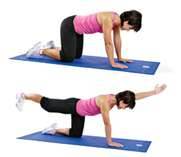
Supine opposite arm/leg raise. Begin on your hands and knees. Your hands are directly under your shoulders and your knees are directly under your hips at right angles to the floor. Make your legs and feet parallel and hip distance apart. Take a moment to slide your scapula (wing bones) down your back so that your shoulders are away from your ears, your chest is open, and your scapula are settled on your back, not poking up. Extend your right arm straight in front of you and your left leg straight behind you at the same time. Your arm and leg will be parallel to the floor. This is the pose that reminds some people of a bird dog.

Hip raise on a stability ball. Start by lying down, arms out, palms facing down. Rest the lower legs on the ball. Lift the hips upward until the body is straight. Slowly return to the starting position.

Russian twist on a stability ball. Lay on ball, with shoulder blades on ball and hips pushed up high off ground. Place hands together, or hold a single dumbbell. Keeping your hips up, turn your shoulders to the right so they are perpendicular to the ground. Twist back to the starting position, then twist to the other side.
I have bad news and good news about core workouts.
First, the bad news: While core strength training may be an effective training method for improving performance in runners, you might end up with not much more than a strong set of core muscles. When I reviewed the Outside magazine “Ten Biggest Fitness Myths” article, the question was raised whether whether core-specific training benefits athletic performance at all. In one study, a group of collegiate rowers who added an eight-week regimen of core exercises to their regular rowing workouts wound up with stronger cores, but their rowing performances remained the same. A group of Division I varsity football players were also tested, and researchers found almost no correlation between a strong core and athletic performance.
The good news is not only that the the law of specificity still works - running not only can help make you a better runner- but new studies show that running does work your midsection.
Six-pack abs, and a better 5K time. Gee, what a great idea!
Wednesday, December 29, 2010
Resolved to Not Resolve
"Whatever you do will be insignificant, but it is very important that you do it." - Mohandas K. "Mahatma" Gandhi, Indian political and spiritual leader (1869-1948)
What a royal pain in the butt.
We persist in making resolutions: Tell them to our friends once we're over-served on New Years' Eve, then hit the roads & gymnasiums throughout January (much to the chagrin of the year-round exerciser). The worst part of resolution-making, especially to the resolution-hearer (or the year-round exerciser), is knowing most resolutions are dead & gone by the end of February, traditionally buried in an empty Russell Stover chocolate box.
I'm glad I'm not alone in this sentiment. And, as always, great minds think alike. My friend & coaching sanity check person Pat McCrann went into a little deeper detail with his blog in Marathon Nation (http://www.marathonnation.us/long-run/top-four-ways-to-make-new-years-running-resolutions-that-stick), & with his Fueling the Endurance Lifestyle (www.patrickjohnmccrann.com/lifestyle/inverted-goal-chasing-choose-to-be-a-fear-dom-fighter) blog, posted 29 December. Fortunately, he didn't steal my thunder so much as provide a congruent perspective.
I'm not saying there aren't things we can improve in our lives; far from it. But the desire to improve something has to be joined with a specific plan of action. If I say (heaven knows I won't!) "I want to run more this year," or "I want to be a better runner this year," what am I going to do?
Hold myself accountable to a group of people: I can join with a local training group, or a running club affiliated with a national running organization, like the Road Runners Club of America (http://www.rrca.org/). Some RRCA clubs not only have social runs, but training groups & programs administered by certified, experienced running coaches. As a (USA Track and Field) certified coach, I've worked with (and serve as sanity check to) several RRCA coaches; the overwhelming majority of them are distance-runner savvy & passionate about their craft.
Accountability doesn't have to be face-to-face: A dozen runners who used to talk in the Runners' World Letters & Opinions forum slowly evolved into an ad-hoc e-mail network. As time progressed the group moved from e-mail to the social media, & meet up in ones-and-twos when business interests or holidays permit. Some of my closest running friendships have developed in the same way. I have a six-month membership with Marathon Nation, which includes access to on-line forums & a weekly chat session. It's great to have a platform from which to sound your accomplishments or voice your concerns. You only have to find the "neighborhood" which fits your specific needs.  Get a different, fresh, perspective on running: Change can be a good thing. This can be a change in distance from long-to-short races, from competitive road races to "fat-ass" unscored events, road-to-trail runs, or (something Suzanne & I have done) add a certain level of frivolity. Hare & hounds runs & hash house harrier groups, "groups with a running problem," vary in focus from "family-friendly" to "beyond-PG-13" in their approach. Just like any social organization, the personalities in these groups vary in looseness, as well as pace; iron-distance triathletes can be cheek-by-jowl with walk/run fans. A sense of humor, & perhaps an older pair of shoes, are the best credentials to bring with you.
A bit of surprise doesn't hurt, either: Runners can easily get into a rut of doing the same run/course/intensity on a particular day. I downloaded a workout application, RunRoulette, onto my iPod Touch earlier in the autumn. If I ever get too bored with a workout cycle I can punch the application & get one of forty possible runs in five different categories: Endurance, Hills, Mystery, Speed Work, & Tempo. The Lite version is free - less expensive than a fitness club membership the resolutionist will use for a month.
So, this coming year, resolve to NOT make a resolution. Instead, do things...or do them a little differently...or do them with a few others.
Thursday, November 18, 2010
A "Whys" Man Once Told Me...
 One of my athletes ran her first marathon this past weekend. She had a fantastic front half of the race, but ran into some trouble (muscle cramps) during the second half & missed her goal to qualify for Boston by seven minutes. We were both disappointed for her, but we knew a qualifying performance was in her future once we got past a few obstacles.
 Most coaches talk easily about the physical aftermath of runs & races. They usually are quick to recommend what to do to rebuild the body's systems, replenish fuel stores & recover strength after their charge has crossed the finish line. A precious few will approach the mental or systemic areas with their athletes; the ones who do often work in a mature two-way relationship with an experienced athlete.

Three of these deficit areas - feedback & expectations, processes & environment, and incentives & consequences - are (mostly) external to the athlete and are, in many cases, a simpler fix.
The other three areas - motives & preferences, ability, and skill & knowledge - are almost completely internal to the athlete.
Most coaches of adult, post-scholastic amateur runners don't have to worry much about the internal deficits; if a coach gets to those root causes it's much like the old light bulb joke:
Q. How many psychologists does it take to change a light bulb?
A. One. But the light bulb has to really want to change. So, I tell folks to take time within the first hours after the race, usually when they have time to quietly think about things. I ask them to write down what went well and what could have been improved in the race performance. Once those problem areas are identified, then it's time to do what is known in Performance Improvement circles as the "five whys." Here's an example:
Problem: I finished my half-marathon 15 minutes later than I hoped.
Why (#1:) did you finish your half-marathon 15 minutes later than you hoped?
I had to walk much of the last two miles.
Why (#2:) did you have to walk much of the last two miles?
Because my right achilles' tendon swelled up.
Why (#3:) did your right achilles' tendon swell up?
Because the course conditions, specifically the hills & concrete pavement, strained my achilles.
Why (#4:) did the course conditions strain your achilles?
Because I didn't allow my achilles' enough time to heal from the last injury.
Why (#5:) didn't you allow your achilles enough time to heal?
Because I thought I could get fit in time for this event.
Why (#6:) did you feel the need to rush getting fit for this event?
Because I was using it to prepare for a spring marathon.
 Once a performance issue can be boiled down to the simplest reasons (usually at the third or fourth "why,"), you can look at the root causes & figure if they are external or internal. So, if I take the "whys" & align them to the causes - I've placed a question you can ask yourself to consider where the answer or deficit falls - I can then start to think of potential solutions.
Feedback & Expectations:
Did I know what was expected of me? Could I tell how well I was doing?
Processes & Environment:
Did I have the conditions and tools to do what was expected of me?
1. Hilly conditions and concrete roadways aggravated achilles condition.
Incentives & Consequences:
Did I stand to gain anything by succeeding - or by failing - at this activity?
Motives & Preferences:
Did I decide to do this activity for the right reason/s?
1. Attempted fall half-marathon rather than early year half, then spring marathon.
2. Unwilling to back off training because of injury.
Ability:
Did I have a chance to succeed, even if all the factors were in my favor?
Skills:
Did I know how to do the activity?
"It is tempting, if the only tool you have is a hammer, to treat everything as if it were a nail." - Abraham Maslow, The Psychology of Science (1966)

So, then I can look at the big root causes & say, "okay, here's what I think you need to do." The one thing you don't want to do is start thinking of the solution before you get to the genuine root cause. More often than not when a person - coach or athlete - does this sort of exercise they look at the issue in light of their preferred answer. For example, a friend of mine loves Pilates, so everything in his mind can be remedied with a modicum of Pilates training. If I were to present an issue to my friend, the gym proprietor, he would likely recommend training his gym provides.
Because the achilles' tendon issue is aggravated by hard surfaces, hills & hard training, I can recommend easy running on softer surfaces as much as possible, minimize hard speed work on the track, minimize or discontinue hill repeats, recommend adding heel lifts to shoes, & work on strengthening the achilles with some stretching & light resistance training. . .and to be patient. There's some unfinished business to be taken care of in New Orleans next February.
Thursday, September 2, 2010
Necessity Is The Mother Of Adaptation
 Some of the athletes I work with remotely have their own special set of constraints, having much to do with maternity or Mother Nature, both of which are a force stronger than E.F. Hutton. The good news for me when I begin to lay out a training plan for them is they usually have a treadmill for running purposes close by. The only place treadmills are used as a clothes valet, as far as I can tell, is Florida.
The difficult part, however, is how to figure the proper training intensity. I can spend thirty minutes in an e-mail discussing what some call Coach Mike-speak, a variant ot terms used by my former coach, Dale Fox, his coach (1964 Olympic 5,000 meter Gold Medalist) Bob Schul, & his coach, Mihalyi Igloi...which works great when the individual athlete is on the track with me over the course of five or six weeks, because they'll catch the understanding eventually. But when dealing with remote coaching situations I can get a good effort approximation from some other really good coaches; Jack Daniels or Greg McMillan. Daniels' run intensity calculations are easily figured out through a table in the front end of his seminal work, Daniels' Running Formula (which I consider one of the three absolute must have running books), or you can find calculators and reference charts on many different web sites on the Internet (http://www.coacheseducation.com/endur/jack-daniels-nov-00.htm has what I would call Daniels In A Nutshell). I've encountered a fantastic spreadsheet you can use (http://www.electricblues.com/html/runpro.html) to determine the training effect of a particular workout, given the heart rate & run duration, but I recommend it for calculation's sake. McMillan also has a web-based chart, located at http://www.mcmillanrunning.com/ which aligns closely to Daniels'. I'm more familiar with Daniels, so I'll use his terminology to talk about run intensities here.
To determine your VDOT score, which Daniels explains is an estimate of a runner's VO2max at velocity, you'll need the results of your races (1,500 meters, mile, 3,000 meters, 2-mile, 5,000 meters, 10,000 meters, 15,000 meters, half-marathon or marathon) from the past year or so; if you have a variety, so much the better. Find your time for the particular race on a Daniels VDOT Values Table, then look at the number under the VDOT column. A list of best performances over more than one race distance will provide a more-accurate calculation; if you race more long events, focus on the findings based on those results and not so much on the shorter races. I'm one to err on the side of a lower VDOT score, personally, as your body can adapt to a training intensity that is a little too low better than it can an intensity which is too high. Once you have a VDOT score, a second table shows the training intensities based on that particular score for distances from 200 meters up to the easy/long run for the week, depending on the intensity level. For example, the athlete I talked about when I wrote about heart rate monitors has a VDOT score of 44 based on her recent 5K racing. She's training for a marathon in November - given the right conditions, a VDOT of 44 equals a 3:32 marathon performance prediction, but that's another story. Based on that performance I recommended she run her easy runs & her weekly long run at a sliver over nine minutes per mile. Her runs to prepare her for the pace she'll need to run in the marathon would be a little over eight minutes per mile, & the pace I recommended for tempo runs on the track is a little slower than a 7:30 mile.
 Once the runner knows their specific paces, they can use one or more of a few good 60-minute workouts for the treadmill-bound runner. I recommend one long run, one tempo & one repeat workout per week, with easy runs filling the remainder of the time available. If the athlete finds the workouts a little difficult based on perceived exertion or heart rate, we adjust the pace/s downward or extend the recovery period a little:
Progressive Tempo - 30 minutes at Easy/Long pace, increase speed by .1 mph every four minutes until Marathon Pace is reached. (Runners training for half-marathon or shorter races can continue on to Threshold pace.)
Daniels' run intensity calculations are easily figured out through a table in the front end of his seminal work, Daniels' Running Formula (which I consider one of the three absolute must have running books), or you can find calculators and reference charts on many different web sites on the Internet (http://www.coacheseducation.com/endur/jack-daniels-nov-00.htm has what I would call Daniels In A Nutshell). I've encountered a fantastic spreadsheet you can use (http://www.electricblues.com/html/runpro.html) to determine the training effect of a particular workout, given the heart rate & run duration, but I recommend it for calculation's sake. McMillan also has a web-based chart, located at http://www.mcmillanrunning.com/ which aligns closely to Daniels'. I'm more familiar with Daniels, so I'll use his terminology to talk about run intensities here.To determine your VDOT score, which Daniels explains is an estimate of a runner's VO2max at velocity, you'll need the results of your races (1,500 meters, mile, 3,000 meters, 2-mile, 5,000 meters, 10,000 meters, 15,000 meters, half-marathon or marathon) from the past year or so; if you have a variety, so much the better. Find your time for the particular race on a Daniels VDOT Values Table, then look at the number under the VDOT column. A list of best performances over more than one race distance will provide a more-accurate calculation; if you race more long events, focus on the findings based on those results and not so much on the shorter races. I'm one to err on the side of a lower VDOT score, personally, as your body can adapt to a training intensity that is a little too low better than it can an intensity which is too high.
Once you have a VDOT score, a second table shows the training intensities based on that particular score for distances from 200 meters up to the easy/long run for the week, depending on the intensity level. For example, the athlete I talked about when I wrote about heart rate monitors has a VDOT score of 44 based on her recent 5K racing. She's training for a marathon in November - given the right conditions, a VDOT of 44 equals a 3:32 marathon performance prediction, but that's another story. Based on that performance I recommended she run her easy runs & her weekly long run at a sliver over nine minutes per mile. Her runs to prepare her for the pace she'll need to run in the marathon would be a little over eight minutes per mile, & the pace I recommended for tempo runs on the track is a little slower than a 7:30 mile. Once the runner knows their specific paces, they can use one or more of a few good 60-minute workouts for the treadmill-bound runner. I recommend one long run, one tempo & one repeat workout per week, with easy runs filling the remainder of the time available. If the athlete finds the workouts a little difficult based on perceived exertion or heart rate, we adjust the pace/s downward or extend the recovery period a little:Progressive Tempo - 30 minutes at Easy/Long pace, increase speed by .1 mph every four minutes until Marathon Pace is reached. (Runners training for half-marathon or shorter races can continue on to Threshold pace.)
Marathon Tempo - 2 miles at Easy/Long pace, increase speed by .1 mph every two minutes until Marathon Pace is reached. (Runners training for half-marathon or shorter races can continue on to Threshold pace.)
Long Repeats (improve lactate threshold) - 2 miles at Easy/Long pace, increase to Threshold pace for up to five minutes, followed by Easy/Long pace (recovery) for up to two minutes.
Long Repeats (improve lactate threshold) - 2 miles at Easy/Long pace, increase to Threshold pace for up to five minutes, followed by Easy/Long pace (recovery) for up to two minutes.
Medium Repeats (improve velocity at VO2max) - 2 miles at Easy/Long pace, increase to Interval pace for up to three minutes, broken up by Easy/Long pace (recovery) for up to two minutes.
Short Repeats (improve economy and speed) - 2 miles at Easy/Long pace, increase to Rep pace for 30 seconds to one minute, broken up by Easy/Long pace (recovery) for up to two minutes.
Short Repeats (improve economy and speed) - 2 miles at Easy/Long pace, increase to Rep pace for 30 seconds to one minute, broken up by Easy/Long pace (recovery) for up to two minutes.

How do you know when you're ready to move the intensities higher? Daniels says race performances are the test of when you're ready to move up...under no circumstances does he recommend trying to beat the training intensities for specific efforts.
While many persons will say a treadmill (simulation) workout is not as good as getting out on the road or the track, I consider it an "eighty-percent solution" for those days when the weather conditions are less than optimal or the runner has a limited amount of time available to train.
Tuesday, June 15, 2010
Once A Coach, Always A Coach – OR – Sometimes, Sport Ain’t Pretty
Some time back I began to read the occasional blog posting from Brett "Doc" Sutton, an Australian coach who has guided a number of athletes to success in the world of swimming, as well as ITU and long distance triathlon. At this point in the 2010 season a number of his TeamTBB athletes have been setting the triathlon world aflame.
One of the first blog posts I read from Doc was entertaining, but difficult to follow, because he (as many of his athletes will tell) has an atrocious writing style. So, I took it upon myself to edit it for public consumption. I think Doc will be pleased, or at least minimally miffed, at the fact I hadn't chopped it up too much...I felt spelling and minor word cobbling would suffice. Enjoy!
Ol’ Doc has been getting a bit frayed around the edges lately, so his ever-suffering wife bought him a set of golf clubs. Seems she had heard him say that back in the old days his doctor used to prescribe hitting golf balls rather than punching bags when the anxiety level started to rise.
Ol’ Doc has been getting a bit frayed around the edges lately, so his ever-suffering wife bought him a set of golf clubs. Seems she had heard him say that back in the old days his doctor used to prescribe hitting golf balls rather than punching bags when the anxiety level started to rise.
Recently his team was on fire, namely the daily “fires” athletes and coaches deal with to make the magic happen on race day. Putting out those fires was starting to take its toll on Doc. So after a little track set, his wife suggested he take the new golf clubs to the driving range and test them out, while she took the kids to the lake. She told him, ‘don’t think about coaching for the rest of the day.’
So Doc went off, bag in hand, down to the driving range. He bought his bucket of balls and proceeded to deal with the anxieties of coaching a’ la Tiger. Right beside him was a group of folks ranging from their mid 40s to about 80 years of age. They were all decked out in their new golf attire, with their beautiful clubs and the immaculately dressed golf pro who was giving the group a lesson. The pro had the group stretching and doing all these drills, and it appeared like they were having fun.
Doc proceeded to put his bucket of balls down, took a club out of the bag, and started to hit the balls. Being a professional in another ball-sport, He never considered hitting a ball that isn’t moving to be much of a problem. After about 20 strokes he found the ball to be moving off the tee quite well, but his anxiety wasn’t subsiding one bit.While his shots were going more or less in the proper direction, the golf students next to him were sending their balls, er, sideways. They had become a danger not only to themselves, but to everyone nearby.
After a 9-iron slice missed Doc’s temple by about an inch (which pleased an elderly lady in the group; she finally hit a ball that was not a “worm burner,”) he decided checking a few e-mails was the better part of being pole-axed by an octogenarian would-be Nancy Lopez. What’s a 20-to-30-minute delay on such a nice day? He knew he’d end up taking care of coaching business, but at least he was exercising his obsession at the golf club rather than at the track.
Doc proceeded to put his bucket of balls down, took a club out of the bag, and started to hit the balls. Being a professional in another ball-sport, He never considered hitting a ball that isn’t moving to be much of a problem. After about 20 strokes he found the ball to be moving off the tee quite well, but his anxiety wasn’t subsiding one bit.While his shots were going more or less in the proper direction, the golf students next to him were sending their balls, er, sideways. They had become a danger not only to themselves, but to everyone nearby.
After a 9-iron slice missed Doc’s temple by about an inch (which pleased an elderly lady in the group; she finally hit a ball that was not a “worm burner,”) he decided checking a few e-mails was the better part of being pole-axed by an octogenarian would-be Nancy Lopez. What’s a 20-to-30-minute delay on such a nice day? He knew he’d end up taking care of coaching business, but at least he was exercising his obsession at the golf club rather than at the track.
As he answered the last of the e-mails, Doc realized this group was booked for an hour lesson. So, with mortal fear he returned to whacking a few balls, but with his eye constantly on the group, just in case. The pro teacher had provided this group with all the correct golf form tips money could buy; but these middle-aged hackers were lucky to be able to strike the ball, much less the broad side of a barn. They all had back swings as big as John Daly, turning their hips exactly like Tiger, and were still fortunate to get the ball 15 yards downrange. Most of the shots were “worm burners,” except when they tried the 9-iron; those were the moments Doc feared emasculation.
He kept thinking to himself, ‘what is this bloke doing with these people?’ He had long gone past the point of being upset for no particular reason. But the anxiety and frustration the foursome was experiencing as an outcome of trying so hard to emulate the technique of the world’s best golfers, as espoused by their instructor, was quickly becoming pandemic. Even with the language barrier, Doc knew the French word ‘merde’ was not ‘I love that shot.’ Time to answer a little more e-mail, thought Doc, to avoid their frustration becoming his. When the old pensioner let out the English version of the earlier French interjection, Doc said nothing, but sat there and kept boiling on how these people were being coached.
The elderly woman came and sat on the bench five minutes later, to light up a cigarette. Now her – and Doc’s - anxiety had gone out of control. He said, ‘that will kill you,’ in English. He knew she understood only too well. She bounced back with, ‘not before the golf does.’
He kept thinking to himself, ‘what is this bloke doing with these people?’ He had long gone past the point of being upset for no particular reason. But the anxiety and frustration the foursome was experiencing as an outcome of trying so hard to emulate the technique of the world’s best golfers, as espoused by their instructor, was quickly becoming pandemic. Even with the language barrier, Doc knew the French word ‘merde’ was not ‘I love that shot.’ Time to answer a little more e-mail, thought Doc, to avoid their frustration becoming his. When the old pensioner let out the English version of the earlier French interjection, Doc said nothing, but sat there and kept boiling on how these people were being coached.
The elderly woman came and sat on the bench five minutes later, to light up a cigarette. Now her – and Doc’s - anxiety had gone out of control. He said, ‘that will kill you,’ in English. He knew she understood only too well. She bounced back with, ‘not before the golf does.’
Doc learned during their conversation the woman’s husband wanted her to learn to play golf and improve her health; he bought her new clubs and 30 golf lessons. She was so embarrassed to not be able to hit the ball. At her age, she felt it was silly trying to learn something difficult, just for fun.
She then waxed on, ‘Look at you. You walk up, don’t stretch, don’t warm up, you don’t practice. You wear lambskin boots for golf shoes, and you just “bang, bang, bang.” The balls fire out like its nothing. How much have you practiced to do that?’ Doc said he had picked up the clubs two or three times in the last ten years.
While this dowager might have had a $3,000 set of clubs and Nike equipment, she was a Yorkshire “angler”; her biggest catch was the husband with the Swiss bank account. They might have been in Montreaux, she in her 70’s, prim and proper, but she still told Doc he was full of it.
While this dowager might have had a $3,000 set of clubs and Nike equipment, she was a Yorkshire “angler”; her biggest catch was the husband with the Swiss bank account. They might have been in Montreaux, she in her 70’s, prim and proper, but she still told Doc he was full of it.
However, he was serious: ‘If you really want to hit the ball time after time and enjoy it, I can help you.’ She said, ‘Oh, now you’re a pro golfer too?’ Doc explained while he wasn’t a pro at golf, he could have her hitting ten fifty-yard shots in succession within 30 minutes. ‘When he leaves with his band of merry payers, go buy another lot of balls. But you have got to do as I tell you; forget all that clap trap the instructor said.’
‘Did you see me try to hit that ball or you just blind? That was my 28th lesson and I have yet to hit one that far and more than three in the row that went anywhere.’ Doc said, ‘well, you got one off the ground which nearly took me out.’
‘So what’s the point? Do you want to be better than you’re doing now, or just look good?’ She said, ‘Yes, of course.’
‘So what’s the point? Do you want to be better than you’re doing now, or just look good?’ She said, ‘Yes, of course.’
‘Well make your mind up; I have to be back at the lake in 45 minutes.’
So, over she went and bought the balls. The first ten minutes passed with Doc instructing, ‘do you want to hit it or look like a golfer that air swings all the time?’
‘I learned a terrific lesson a lot of years ago when I went to a golf tournament to watch my brother-in-law hack about. I watched a 69-year-old lining up; my brother-in-law filled me in: “This guy is the local legend. He can hardly walk now, so he never finishes the second round of the tournament, but he won it three times; twice before the war and one time afterward. He never became a pro as the war wrecked him and his lungs.” Of course I followed him instead of the brother-in-law, and it was the best 18 holes I ever walked. Now, that is another story, but it taught me plenty about hitting a golf ball.’ So Doc told the lady of this old guy and what the old guy showed him, then she started to really listen, not like before. She must have thought there was some English common sense in that.
‘I learned a terrific lesson a lot of years ago when I went to a golf tournament to watch my brother-in-law hack about. I watched a 69-year-old lining up; my brother-in-law filled me in: “This guy is the local legend. He can hardly walk now, so he never finishes the second round of the tournament, but he won it three times; twice before the war and one time afterward. He never became a pro as the war wrecked him and his lungs.” Of course I followed him instead of the brother-in-law, and it was the best 18 holes I ever walked. Now, that is another story, but it taught me plenty about hitting a golf ball.’ So Doc told the lady of this old guy and what the old guy showed him, then she started to really listen, not like before. She must have thought there was some English common sense in that.
So, they got rid of the John Daly backswing, told Tiger Woods to piss off, and decided the follow-through was over-rated. That ten minutes was hopefully the turning point in Amy loving to play golf as in the previous ten minutes; not only did Amy hit ten straight balls but at least half of them went beyond the 50 mark.
She was astonished, but when she went to go, Doc said ‘hang on. It was all ten past that mark. Get your wallet out, old girl, and get some more balls.’ Some traits die hard. ‘We are going to nail this before we leave here.’ She hit two more lots of ten, and the last lot went past the 50-yard sign every time. They grounded in the "Amy Swipe," as it was christened: a technique that revolutionary needed to have a name. Amy was having a ball whacking the balls every time, like a Swiss watch. The old girl had a bit of talent; the “Amy Swipe” was a thing of beauty. The back swing was not higher than her hips - sorry, john. Her hip turn - well we lost that, sorry, Tiger, and her follow-through stopped also at the hip but she hit 30 balls. She never missed one and over half went 50 yards or more, all in a straight line.
They packed up, and she said, ‘I just paid that guy - or my husband did - 1450 Swiss francs for 30 lessons and I still could not hit the ball. What can I get you, Doc?’
‘Well, I am pretty thirsty. How about a can of Coke?’
‘Well, I am pretty thirsty. How about a can of Coke?’
‘Done.’
There are a couple of morals to the story:
First, beauty is in the eye of the beholder!
Second, do you want to look good, or do you want to be better?
I think that sums it up.
As for the anxiety, well, Doc returned to the lake, and his wife said ‘You look much happier. See what happens when you take just a little time off from coaching? I am proud of you!’
Doc said, ‘me too, me too.’
Monday, January 4, 2010
Resolution Versus Resolve
 res-o-lu-tion -n. - 1. a formal expression of opinion or intention made, usually after voting, by a formal organization, a legislature, a club, or other group. 2. a resolve or determination: to make a firm resolution to do something. 3. the act of resolving or determining upon an action or course of action, method, procedure, etc. 4. the mental state or quality of being resolved or resolute; firmness of purpose.
 Naturally, with the passing of the old Gregorian calendar year & the start of the new one comes a well-worn & often useless activity. More often than not this activity consists of two steps: Whine like a seven-year-old school girl about the failure, shortcoming, or character flaw which boiled to the surface in the past year. Make some cockamamie - & often unattainable - promise to transform failure into success, shortcoming into strength, & character flaw into character-reinforcing trait...oh, & all within the scope of the next 365 days.
 After hearing too many of my old contemporaries go through this song-and-dance I resolved to do two things in years past: Rather than make any resolutions at the new year, I would engage in continuous improvement. When confronted by a person making a resolution without a reasonable goal...or a plan of action to reach it...I would challenge them to either develop & execute a realistic plan to achieve a reasonable goal or call them on their obvious lack of seriousness.
It makes me a little unpopular at holiday parties & races, to say the least.
 My wife & I were sitting in a dining establishment on the beach the other day, talking about what we would like to achieve in the new year. She spent the previous Friday evening socializing with her closest friend, celebrating one of those milestone birthdays, & had partaken of a little more of the fermented, grain-derived beverages than she would have preferred...at least when seen in the light of the "elephantine" feeling she had during her Sunday morning long run. When your Friday evening beer intake slows you down all the way to midday Sunday, I guess you could say that is enough beer.
I'm not going to get all self-righteous here & say I don't like beer. In fact, I love beer. I'm in firm agreement with Benjamin Franklin and the Warsteiner brewery: Beer is proof that God loves us & wants us to be happy. Oh, and, life is too short to drink cheap beer.
 My coach's coach, Bob Schul, never liked his athletes drinking beer. Bob was of the opinion beer made for slower running; of course, when you're a slow runner in the first place, what's the big deal? But as I've read more medical-based research in the past year, in running, triathlon & swimming magazines, it has finally sunk in through my thick skull that beer might be proof of the Almighty's compassion toward humanity, but can do a number on a human being's recovery from workouts. Who knew alcohol could slow the production of human growth hormone & delay workout recovery? And when you get to be my age, approaching a milestone birthday faster than I care to admit, recovery takes just a little longer.
But you're not going to see me do a complete & utter cut-back to no beer whatsoever. Ben Franklin might not have been into running, cycling or swimming fast, but he knew a good deal about human nature. Face it...life is short & we are dead a long time. So, if there's going to be beer passing my lips, it will pass my lips less often, & it will be of higher quality.
 So for me, while 2009 was a year of trial & error, 2010 is more likely going to be a year of returning a little closer to the tried & true. Longer, easier stuff on the easy days; shorter, intense stuff on the hard days. Recovery as often as practicable. Cross-training as often as possible. And fun as often as I can get away with it. Because...if it isn't fun, then why the hell am I doing it?
Wednesday, September 16, 2009
Ask Coach: Pre-Workout Snacking
 What is a good pre-workout snack? I tried some Raisinets before a recent workout, but wanted to get your opinion.
Take this as a do-as-I-say-not-as-I-do; nutrition is one of my weaker areas, & something which I constantly strive to improve. I think something a little less “simple sugary” – a banana or a slice of whole-grain or rye (see the article below!) toast with peanut butter & jelly (or honey!) – will stave off hunger, provide beneficial fats/protein, & not die out on you at 7 p.m.
Through the spring & early summer I had a serious fling with the mini Clif Bars, they have 100 calories per bar, & are loaded with fiber & good (natural) nuts, grains/soy, fruit. But they were so good I probably took in too many calories - a couple of hundred calories of snacking a day is fine; a couple of hundred calories of snacking three or four times a day on top of meals can do some damage. I probably took in more calories than I thought I was burning in my workouts.
Without looking at the nutritional data – if you’re looking at nutritional data to justify your snack, it’s probably not worth putting in your body, anyway - there are natural sugars in the raisins, caffeine in the chocolate…and God knows what other chemicals from the processing. So, two out of three are not bad; better than Little Debbie cakes. There was a time I would scarf on one or two of them (Oatmeal, Devils’ Food, Raisin…all evil!) a couple of hours before a track workout. Most of the time I found the short-term sugar rush was NOT worth the crash which occurred on the last set of the workout.
While I'm in the mood to talk about hunger suppression and bread, I saw this article the other day (Isaksson H, Fredriksson H, Andersson R, Olsson J and Åman P (2009), Effect of rye bread breakfasts on subjective hunger and satiety: a randomized controlled trial. Nutrition Journal 2009, 8:39, August) and thought it rather interesting:
Without looking at the nutritional data – if you’re looking at nutritional data to justify your snack, it’s probably not worth putting in your body, anyway - there are natural sugars in the raisins, caffeine in the chocolate…and God knows what other chemicals from the processing. So, two out of three are not bad; better than Little Debbie cakes. There was a time I would scarf on one or two of them (Oatmeal, Devils’ Food, Raisin…all evil!) a couple of hours before a track workout. Most of the time I found the short-term sugar rush was NOT worth the crash which occurred on the last set of the workout.
While I'm in the mood to talk about hunger suppression and bread, I saw this article the other day (Isaksson H, Fredriksson H, Andersson R, Olsson J and Åman P (2009), Effect of rye bread breakfasts on subjective hunger and satiety: a randomized controlled trial. Nutrition Journal 2009, 8:39, August) and thought it rather interesting:
Several studies report that dietary fiber promotes the feeling of satiety & suppresses hunger. However, results for cereal fiber from rye are essentially lacking. The researchers investigated subjective appetite during eight hours after intake of iso-caloric rye bread breakfasts varying in rye dietary fiber composition & content.
The first part of the study compared the satiating effect of iso-caloric bread breakfasts including different milling fractions of rye (bran, intermediate fraction (B4) & sifted flour). The second part investigated the dose-response effect of rye bran & intermediate rye fraction, each providing 5 or 8 grams of dietary fiber per iso-caloric bread breakfast. Both study parts used a wheat bread breakfast as reference & a randomised, within-subject comparison design. Appetite (hunger, satiety & desire to eat) was rated regularly from just before breakfast at 8:00 a.m. until 4:00 p.m. Amount, type & timing of food & drink intake were standardized during the study period.
The milling fractions study showed each of the rye breakfasts resulted in a suppressed appetite during the time period before lunch (8:30 a.m.-12:00 p.m.) compared with the wheat reference bread breakfast. At a comparison between the rye bread breakfasts the one with rye bran induced the strongest effect on satiety. In the afternoon the effect from all three rye bread breakfasts could still be seen as a decreased hunger & desire to eat compared to the wheat reference bread breakfast.
The first part of the study compared the satiating effect of iso-caloric bread breakfasts including different milling fractions of rye (bran, intermediate fraction (B4) & sifted flour). The second part investigated the dose-response effect of rye bran & intermediate rye fraction, each providing 5 or 8 grams of dietary fiber per iso-caloric bread breakfast. Both study parts used a wheat bread breakfast as reference & a randomised, within-subject comparison design. Appetite (hunger, satiety & desire to eat) was rated regularly from just before breakfast at 8:00 a.m. until 4:00 p.m. Amount, type & timing of food & drink intake were standardized during the study period.
The milling fractions study showed each of the rye breakfasts resulted in a suppressed appetite during the time period before lunch (8:30 a.m.-12:00 p.m.) compared with the wheat reference bread breakfast. At a comparison between the rye bread breakfasts the one with rye bran induced the strongest effect on satiety. In the afternoon the effect from all three rye bread breakfasts could still be seen as a decreased hunger & desire to eat compared to the wheat reference bread breakfast.
In the dose-response study both levels of rye bran & the lower level of intermediate rye fraction resulted in an increased satiety before lunch compared with the wheat reference bread breakfast. Neither the variation in composition between the milling fractions nor the different doses resulted in significant differences in any of the appetite ratings when compared with one another.
The results show rye bread can be used to decrease hunger feelings both before & after lunch when included in a breakfast meal. Rye bran induces a stronger effect on satiety than the other two rye fractions used when served in iso-caloric portions.
The results show rye bread can be used to decrease hunger feelings both before & after lunch when included in a breakfast meal. Rye bran induces a stronger effect on satiety than the other two rye fractions used when served in iso-caloric portions.
Thursday, March 19, 2009
How Do I PR?
If you're a relatively new runner personal best times come in large portions of time. As time progresses & your new-found fitness starts to plateau to the level where you will stay (hopefully) unless injury strikes, those personal bests come at a higher price & in smaller increments; a second here & there. Doesn't make the later personal bests any less sweet.

Consistent, systematic training will help you to maintain fitness, combat boredom & burnout, & reduce the risk of injury. You probably can chant - whether or not you follow my advice - my thoughts about training by now:
- Develop a consistent pattern of workouts, which should include long runs of at least one hour once a week, speed work on the road or track once or twice a week, tempo running once a week, & easy runs during the remainder.
- Train all year, with an easy week per month & an easy month per year.
- Rest, as well as cross-training with an elliptical trainer, bicycle, swimming, or light weight training, is underrated.
- Listen to your body.
- Wear the right equipment.
- Learn to pace yourself without being dependent on the watch or the GPS. But do you train like you want to race? Do you think about drafting, passing, tactics, running tangents, starting & finishing pace, & overall strategy for your goal event when you train? Who do you want to be near or ahead of at the end of the first mile, the second mile, & so on? What is your plan for the entire race; what will you do different on a hilly course than a flat course? What are you going to do if things go bad?
Every workout, every run you do must have a purpose. Every repeat you do on the track needs to be done at the right intensity. Your attitude, & how you perform your road runs & speed work directly correlate to how you will perform on race day.
How did I know? I was familiar with the others & their tendency to go hard the first one-third & hang on for dear life at the end. Guess what? It happened exactly the way I figured. Two of the four slowly came back to us with a mile to go; another was reeled in with half a mile left, & we ended up dropping one of them at that point. There was no panic, & no valiant efforts, just a patient, steady, smart (training!) run.
Thursday, June 19, 2008
Feedback, Continued
 Someone suggested last week (through the survey/grapevine) I needed to be less ego-driven and more nurturing, less short-tempered. It was a response I kind of shrugged off; consider the source as someone who didn't want to hear me tell them what I felt they needed to do (one of those things a coach - and a person who is in charge - does).
I did get a little reinforcement of the perception the other afternoon: One of my athletes tries to come out once a week and works hard when at the track. They mentioned I got a little cranky during a workout the previous week. Of course, I was surprised at the honesty in bringing the issue to my attention. I quickly explained myself and told them I would make an honest effort to not be so short-tempered.
 It was easy to figure out the root cause of the cranky moods. When I'm trying to run my own workout and organize/supervise...or, better yet, coach other runners at the same time I can get a little short, sweet and to the point. When you're training, it's all about me is the mantra; how much sleep do I need to recover, how much time do I need to set aside for this long run, this cross-training, this therapeutic modality (massage and stretching for those of you who hate those fancy words), and so on. It makes spouses, employers, and family members lose their even keel...especially when they are the ones who always have to adjust their (overcommitted) schedules to fit those of the runner.
In performance improvement, we are often told to ask the why question four or five times in order to get down to the real root cause of the problem.
Problem: Coach Mike is cranky.
Why is Mike cranky? Because he feels his workouts (at the same time as his athletes) are interrupted to deal with stuff.
Why are Mike's workouts interrupted? Because Mike is running his at the same time as his athletes.
Why is Mike running at the same time? Because Mike has a work project that keeps him from running earlier in the afternoon. Mike also has an athlete who runs workouts by himself and needs to control his pace a little better.
So, one issue meets one root cause, or two. Coach Mike's real job (which cannot be changed all that much) compresses his schedule. Coach Mike has an athlete who is running faster than he needs to be at this time of the year.
 Normally, I wouldn't gripe too much, save for the painfully obvious fact running hard during the heat of the Florida summer is going to do a number on your body. I could let this athlete drive himself into the ground, or I could suggest from the sidelines that he back off. When recommending an easing back on the throttle, I get the I only went (blank) seconds faster on this 400 than the last one response. Of course, then I have to mention another painfully obvious fact; multiply those (blank) seconds on that 400 by four and figure the difference per mile. Bouncing around with (blank x four)-second variations per mile of running is not the way to become a good runner.
I tend to set high (and often, unrealistically high) expectations for myself. I have always done this, not to mention projecting those high expectations onto those around me. In educational theory, it's a well-proven fact teachers who set and communicate high expectations for their students find the students will meet those expectations more often than not. So, while it may seem to the outsider I do not care to the persons who don't want to vault over the bar I set, the exact opposite is true. I care a great deal about every athlete who expresses the desire to improve and makes the honest, consistent and continuous effort to improve.
It's all I can ask from any athlete. It's all I'm entitled to ask from any athlete.
Subscribe to:
Posts (Atom)