I had one of those days at work last week that simply cried out for a run as a form of physical release. But my schedule had two lovely words, "rest day," marked down. And this wasn't one of those "active rest" days, either. This was a "no workout for you, sir..." kind of "rest day."
But what was I to do about the otherwise seemingly-rational mental side of me? Darn it, my brain was all in for the idea of doing four or five miles, even if it wasn't going to do my tendons a bit of good. I wrestled with all of the possible alternatives. I could row or hit the elliptical trainer but I knew I'd either push harder than my ankles would find prudent, or I'd hear the siren song of the treadmill calling me to do "just a few miles."
So, rather than lash myself like Homer's Odysseus, not to a mast, but rather to my dog for a second 600-meter stroll around the park in front of my house...yeah, that would certainly take the edge off of going for a workout...I lay down for a 60-minute nap, waking not long after my wife returned home from her day at work.
There are several things the obsessive-compulsive runner can do to help themselves on those rare days when they decide to leave the calendar blank. Trust me obsessive-compulsives: The world will NOT come to an end, etc., should there be a blank space in your training calendar.
Some folks might recommend doing a stretching routine; I'm afraid that unless the routine is along the lines of what physical therapist Phil Wharton recommends to runners, an active isolated approach, that the tendency would be to over-stretch. Massage would also be great; what better than to take a half-hour or an hour of your life and place it into the hands of someone else? There can be too much of a good thing, and I'm not certain I could deal with even the expense of a gentle massage more than once a week...probably closer to maybe once every couple of weeks, right around pay day would be better.
What's the nice thing about napping? My wife, Suzanne, would consider it one of the least-expensive of guilty pleasures. It's the first therapeutic modality I go to when I'm feeling ill or beat-down. Nothing like an extra hour or two of good horizontal time per week, if you can stand it.
The Mayo Clinic says that a healthy adult will be more relaxed, less fatigued, more alert, and in a better mood as a result of a conservative nap routine. Oh, and let's not forget better memory (did I just say THAT?), less confusion, quicker reaction times, and fewer mistakes on the job. Okay, I'm not so certain my employer will tolerate a mid-day siesta, but we'll continue to push for it.
The naps need to be pretty brief, though - perhaps 30 minutes...an hour at most. I've hit the rack with the plan of going night-night for no more than an hour...next thing I knew it was way past dark. So much for the benefits of a good nap; now I'm staggering around in the kitchen looking for the dog's food. And, next thing I know, I'm sitting up watching Japanese anime cartoons at two in the morning because I got too much rest earlier in the day. So, a little dab'll do you.
Mayo' researchers say the best time for a nap is usually midafternoon, around 2 or 3 p.m. This is the time of day when you might experience post-lunch sleepiness or a lower level of alertness. I've known people who could sleep almost anywhere, and at any time. But a quiet, dark place with a comfortable room temperature and few distractions is best. I've learned to love my new smartphone because of its alarm functions; there's a "smart alarm" which begins to play soothing music at a low volume for a desired period of time (5-to-15 minutes), after which the alarm goes off. I use a gentle alarm noise, too, so that I'm not too shocked. A friend of mine has decided to purchase a wireless sleep and activity tracker, known as "Fitbit," that looks not only at how much sleep you're getting, but also the quality. We know that disrupted sleep patterns and inhibited recovery can be a reinforcing cycle, but that topic might have to be approached at a later date.
Don't forget to give yourself a few minutes after you get back up to, well, get back up. Especially important for those folks who need to respond quickly to stuff once the nap is over.
Naturally, the trial-and-error approach is always best to figure out whether you need a regular "eyeball light leak check" added to your training schedule, and how much. If you're in the midst of an increase in training volume (mileage, intensity, duration) your body might want a little additional rest as part of the adaptation process.

So, How Many Hats Do You Wear?

- Michael Bowen
- Pensacola, Florida, United States
- Husband. *Dog Dad.* Instructional Systems Specialist. Runner. (Swim-challenged) Triathlete (on hiatus). USATF LDR Surveyor. USAT (Elite Rules) CRO/2, NTO/1. RRCA Rep., FL (North). Observer Of The Human Condition.
Showing posts with label research. Show all posts
Showing posts with label research. Show all posts
Friday, May 24, 2013


Tuesday, February 5, 2013
Refrigerator Door Expectations
Once upon a time there was a young man. He possessed a keen mind, loved to read, and was - in the words of his maternal grandmother - a bit of a chatterbox. Unfortunately, his handwriting skills were less-than-stellar. He could not make the letters look exactly like the ones stapled over the chalkboard; his third grade teacher did not less about his reading comprehension or his verbal ability, she cared only about his penmanship. She insulted his writing efforts once in front of his classmates, which had the exact opposite effect of her intentions. He completely gave up on all of his scholastic efforts for the remainder of the year, doing just enough to get by.
The same young man adapted over time, learning to use a typewriter and used neat block lettering for all of his handwriting efforts. Surprisingly, he decided to become a teacher, and learned early on in his education studies about the work of Robert Rosenthal. Rosenthal was a professor at Harvard University, who asked in the mid-1960s if the expectations of outside influencers - like teachers, parents, and so forth - could mean the difference between positive and negative outcomes in the household, school, workplace. Setting a reasonably-high standard, believing the standard could be made, and communicating that belief in many different ways? Rosenthal learned that teachers who believed their students could achieve had students who could - and did - achieve. And yes, teachers who doubted a student could succeed were more likely to see that student struggle or fail.
The same young man adapted over time, learning to use a typewriter and used neat block lettering for all of his handwriting efforts. Surprisingly, he decided to become a teacher, and learned early on in his education studies about the work of Robert Rosenthal. Rosenthal was a professor at Harvard University, who asked in the mid-1960s if the expectations of outside influencers - like teachers, parents, and so forth - could mean the difference between positive and negative outcomes in the household, school, workplace. Setting a reasonably-high standard, believing the standard could be made, and communicating that belief in many different ways? Rosenthal learned that teachers who believed their students could achieve had students who could - and did - achieve. And yes, teachers who doubted a student could succeed were more likely to see that student struggle or fail.
I have a full-page sheet of paper on my refrigerator door with the training plan for the first 22 weeks of the calendar year laid out. Days where I run, days where I cross-train, rest days and the goal duration to spend during each day's workout session or sessions; all of the information is in black and white. Since I'm still in the process of building strength, endurance and overall fitness and not focused on a particular race distance, the workouts are straightforward base-building. Six weeks into the 22, the calendar shows more positive markings; workouts accomplished, intensities met, sometimes even both. Every filled block is a step in what I hope is the right direction, travel toward the desired goal.
The calendar on the fridge, with its "big picture" notations, are the macro version of my little daily workout spreadsheet. I don't post mileage or anything quantitative; there are only three types of marks on the calendar, corresponding to a qualitative standard - really good, good, or not-so-good. One mark reminds me I met both the intensity and duration goals for the day, if I met the duration but not the intensity I place a different mark on the calendar. If by some reason I didn't work out at all - unless I am sick or traveling - I mark the date with a big, fat "X." Naturally, that's a "not-so-good" day.
So far, there have only been four of those "X" days. And a few days where I didn't get the duration or intensity I hoped, because of outside issues. But I have to admit I've met or exceeded expectations more often than not. I don't need to scour through the spreadsheet to tell myself things are improving. And if I feel a little too lazy and start to think about cracking open a beer rather than going for a run, all I have to do is take a look at the "big picture" on the refrigerator door.
Friday, September 28, 2012
Core Workouts? Is That Little "Something-Something" Worth It?
Let’s say you’re a middle-of-the-pack 5K runner. You probably spend five or six hours a week doing a weekend long run, one or two speed workouts, and the social group/recovery runs. Maybe you do an hour, perhaps two, of cross-training, which could be swimming, spinning or pumping iron at the local gym. But you feel compelled to add a little "something-something" to your training regimen which will improve your 5K time, if you only knew what would be the most efficient use of your time.
Maybe someone suggested you work on your core – the muscles at the abdomen, hips, and back which transform that slinky of our human spine into something a little more resilient. Is focusing on your core really help you run better? How do you know if your core is strong? And what kind of exercises will give me a strong core?
Sato and Mokha (Journal of Strength & Conditioning Research, Vol.23, Ed.1, 2009) placed a group of runners on a six-week core strength training program to see whether their run performance, ground reaction force (how their limbs contacted the running surface), and lower extremity stability would improve. Both the control and the treatment groups improved their 5K time at the end of the six-week study (which the researchers attributed to several variables), but the group which was placed on the core strength training program had a greater run time improvement, and no perceived change in stride mechanics (from ground reaction force variables) or lower leg stability.
What differed from previous studies on the benefits of core strength training was the higher training volume (four times rather than two a week in other studies), as well as a two-week progression in set volume; the subjects continually had to adapt to an increased stimulus. The exercises used in the study included:

Abdominal crunch on a stability ball. Sit on the ball with your feet flat on the floor at about shoulder-width apart. Place your arms crossed on your chest, or hands behind your head. Walk your feet out a few steps until your lower back is on the ball, then curl your torso up until your shoulders are up off the ball. Hold the position for a moment, then lower and repeat.

Back extension on a stability ball. Lie prone, with your upper torso draped over the ball, and your fingers and toes on the floor. Extend your spine and lift your head and your chest. Return to the starting position.
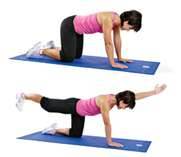
Supine opposite arm/leg raise. Begin on your hands and knees. Your hands are directly under your shoulders and your knees are directly under your hips at right angles to the floor. Make your legs and feet parallel and hip distance apart. Take a moment to slide your scapula (wing bones) down your back so that your shoulders are away from your ears, your chest is open, and your scapula are settled on your back, not poking up. Extend your right arm straight in front of you and your left leg straight behind you at the same time. Your arm and leg will be parallel to the floor. This is the pose that reminds some people of a bird dog.

Hip raise on a stability ball. Start by lying down, arms out, palms facing down. Rest the lower legs on the ball. Lift the hips upward until the body is straight. Slowly return to the starting position.

Russian twist on a stability ball. Lay on ball, with shoulder blades on ball and hips pushed up high off ground. Place hands together, or hold a single dumbbell. Keeping your hips up, turn your shoulders to the right so they are perpendicular to the ground. Twist back to the starting position, then twist to the other side.
I have bad news and good news about core workouts.
First, the bad news: While core strength training may be an effective training method for improving performance in runners, you might end up with not much more than a strong set of core muscles. When I reviewed the Outside magazine “Ten Biggest Fitness Myths” article, the question was raised whether whether core-specific training benefits athletic performance at all. In one study, a group of collegiate rowers who added an eight-week regimen of core exercises to their regular rowing workouts wound up with stronger cores, but their rowing performances remained the same. A group of Division I varsity football players were also tested, and researchers found almost no correlation between a strong core and athletic performance.
The good news is not only that the the law of specificity still works - running not only can help make you a better runner- but new studies show that running does work your midsection.
Six-pack abs, and a better 5K time. Gee, what a great idea!
Tuesday, August 21, 2012
Free Your Ears And Your Run Will Follow
My (wife’s) iPod crashed last week...right before a workout. It wasn't a ‘good news, bad news’ situation. It was more like a ‘good news, bad news, really bad news’ thing.
Good news: I had many of my favorite music files tucked away in my smart phone.
Bad news: The iPod required a reset to factory specifications.
Really bad news: My computer was stolen a couple of weeks back; not only did I lose three years’ worth of training data, blog posts, articles, research and photos, but nearly two thousand MP3 files and podcasts, which were not in my iTunes account. Thus, many of my favorite songs in that “sweet spot” tempo of 80-to-90 beats per minute would either need to be reinstalled from source CDs, or were gone forever.
I’ve written on many occasions how fickle technology can be toward the running athlete. The more dependent we become on the technology to tell us what we think we need to know, or to make us happy during the run, the more earth-shattering it seems when everything “goes south.”
My views on using personal music players vary from ambivalence and pragmatism to pity, depending on the shirt I’m wearing at the moment:
If I’m in running attire at a race the view is closer to ambivalence.
If I’m in a red or zebra-striped polo shirt I’m busy reaching for my notepad. (My friends know what I mean.)
I don’t run on the roads with a music player, but I’ll sing to myself when I run outside. I tell my wife, for much the same reason I train on a treadmill, I want to control as many of the variables as possible.
One of the reasons people run with a music player is to dissociate, or to drown out the “stop already” messages the muscles, lungs and heart send to the brain throughout the course of a race. Other runners use music players to reinforce run tempo (one reason they are prohibited in triathlon). But there’s more that happens between the ears and the earphones of the individual runner when music is involved.
We have an internal clock which controls how well we move in the forward direction; run rhythm, stride length, run speed, and so on. When fatigue sets in we need to grasp for some sort of cue to align with the “clock” in our head and normalize ourselves: music, lines in the road/on the track, telephone poles, etc. The tempo of the music in the player may…or may not…be aligned with the "right" tempo for the individual runner. Unless you’re a complete obsessive-compulsive it is highly unlikely your music is set aside in beat-per-minute playlists. (In the interest of public disclosure, I do notate my BPM on my tracks.)
That most likely means you are thinking more about what’s going into your head than what you’re putting out via your legs.
Do you sing in the shower? Do you sing while cooking? Or folding clothes?
And if you do, do you ALWAYS sing at the EXACT tempo at which the song was performed?
If you answered ‘no’ to the last question you may not need a music player to improve your running. You can most likely sing your way to a better run performance.
Satoh and Kuzuhara (2008) assessed the time and steps of subjects walking along straight and curved paths while mentally singing a familiar song. They were asked to listen to the song, clap hands while listening, sing the song, clap while singing the song, sing while walking in place, walk while singing, then walk while singing to themselves. Analysis of the gait (degree of arm swing, the height of the knees and the smoothness of turn) was performed by a trained observer.
The patients reported feeling improvements in foot progression, ease of arm swing, knee raise and turning and fixation of walking speed. Qualitative evaluation of walking indicated higher knee lift, larger arm swings, smoother turns and less inconsistency in gait. There was a significant improvement in the time and steps while walking a straight path and turning. The researchers believed improvement would be more dramatic in the event of worse gait disturbance. The study participants were able to use mental singing to recover normal pacing when pace was disturbed.
Athletes who moderate their run mechanics by the use of music will most likely benefit from simply singing to themselves during the run rather than placing their safety at risk by using a music player.
Tuesday, January 24, 2012
Cramps - I Believe in Santa Claus
The question of cramping came up in a chat session with some running enthusiasts the other day, and pickle juice was mentioned as a possible solution to the problem. I guess I would have laughed a little more loudly if I hadn't read the same thing in a recent edition of Outside magazine.
Most runners or athletes have had a muscle cramp at one time or another, and we can all agree they are no fun. Somehow we manage to endure the pain and try to go on. And everyone has an opinion on what to do in order to keep the cramp from happening. I've heard people attribute cramps to dehydration, electrolyte imbalance, glycogen shortage and a host of other possibilities. I have a couple of suspicions myself, one of which involves the chairs at the Village Inn restaurants.
I kid you not.
It doesn't matter if I've run an easy five miles, or completed a hard speed workout, or gone to the pool for a masters' swim. Within five minutes of sitting down for a meal at the Village Inn it's guaranteed I will have a massive cramp in one or both of my hamstrings. And we're not talking the 'ouch, that's a cramp,' cramps. I'm talking about the type of cramp which is able to literally pitch a guy off the side of the chair and on to the floor. The type of cramp which makes grown men cry like seven year-olds who have just been told Santa Claus is fiction.
So now I sit at a booth. And I still believe in Santa Claus.
The Outside magazine piece took on several commonly-held beliefs about exercise and physical activity. When it came to the subject of cramps, runners have been told by the running cognoscenti they were caused by dehydration. Other smart people said the cramps were caused by a lack of electrolytes. Some even hold on to the belief that a lack of fuel (glycogen) is the cause.
I'm one of those who considers the fuel theory of cramping to be a strong possibility. It stems a great deal from what I've read of the Central Governor Model for Exercise, originally written about in the 1920s by Nobel laureate Archibald Hill and expanded on by physician, physiologist, marathoner and ultra-marathoner Dr. Timothy Noakes about ten years ago. Noakes' theory says, basically, our brain pretty much calculates a safe level of exertion based on past exercise experiences, metabolic state, and the intended duration of the exercise activity.
For those of you who might remember the old Star Trek series, exercise is like having the Enterprise getting hit with photon torpedoes and taking on damage. And, naturally, Captain Kirk would tell Mr. Scott in engineering to shut down everything except for life support. Okay, I'm glad we kept life support up. Duh.
Noakes writes that our central governor is going to hold back fuel (glycogen) to keep the heart, brain, and lungs alive, shutting down the fuel source to muscle fibers here and muscle fibers there. That's the reason fatigue sets in, our stride gets choppy and our range of motion decreases. Once more fuel comes to play, or the exercise bout ends, the brain recognizes the threat is over and returns (eventually) to normal function - homeostasis.
This old coach's take? The cramp either comes along because of too many muscle fibers being shut down, or from some sort of nerve-related thing (in my own personal case with the Village Inn chairs, pressure).
So why does ten milliliters - less than three ounces - of pickle juice seem to take care of cramping? Some think it has to do with a quick burst of electrolytes. Others think the tart, salty taste of brine causes a disruption in the nervous system...confuses the nerves.
A fitness enthusiast (who just happens to sell an electrolyte balancing beverage) believes the cramp comes as a result of an electrolyte imbalance. Sodium contracts muscle cells and potassium relaxes them. Calcium signals the sodium ion channel to open to begin the contraction cycle. Magnesium then encourages potassium to rush in which relaxes the cell. When a cramp happens, it’s the elements in charge of the relaxing half of the cycle, magnesium and potassium, that are missing.
Pickle juice is predominantly vinegar, which is another form of acetic acid. Acetic acid is used to treat individuals with high blood sodium levels. So, in the mind of this person, lower the sodium level in comparison to the potassium, and you may not begin the cramp.
But Schwellnus, Nicol, Laubscher, and Noakes found in 2004 there were no significant differences between two groups of ultramarathoners - those who cramped up during a race, and those who did not - for pre-race or post-race body weight, percent change in body weight, blood volume, plasma volume, or red cell volume. The immediate post-race serum sodium concentration was significantly lower in the cramp group than in the group which did not suffer from cramping. The immediate post-race serum magnesium concentration was significantly higher in the group of runners who suffered from cramping. There also were no major differences in hydration status in runners who suffered from cramps after participating in an ultra-distance race.
The cause of exercise-associated muscle cramps is probably a little closer to our brains and our nervous system than we care to admit. We might be able to drink it away with pickle juice, but all of the preventatives are more myth than truth.
I believe in fuel, and I still believe in Santa.
Most runners or athletes have had a muscle cramp at one time or another, and we can all agree they are no fun. Somehow we manage to endure the pain and try to go on. And everyone has an opinion on what to do in order to keep the cramp from happening. I've heard people attribute cramps to dehydration, electrolyte imbalance, glycogen shortage and a host of other possibilities. I have a couple of suspicions myself, one of which involves the chairs at the Village Inn restaurants.
I kid you not.
It doesn't matter if I've run an easy five miles, or completed a hard speed workout, or gone to the pool for a masters' swim. Within five minutes of sitting down for a meal at the Village Inn it's guaranteed I will have a massive cramp in one or both of my hamstrings. And we're not talking the 'ouch, that's a cramp,' cramps. I'm talking about the type of cramp which is able to literally pitch a guy off the side of the chair and on to the floor. The type of cramp which makes grown men cry like seven year-olds who have just been told Santa Claus is fiction.
So now I sit at a booth. And I still believe in Santa Claus.
The Outside magazine piece took on several commonly-held beliefs about exercise and physical activity. When it came to the subject of cramps, runners have been told by the running cognoscenti they were caused by dehydration. Other smart people said the cramps were caused by a lack of electrolytes. Some even hold on to the belief that a lack of fuel (glycogen) is the cause.
I'm one of those who considers the fuel theory of cramping to be a strong possibility. It stems a great deal from what I've read of the Central Governor Model for Exercise, originally written about in the 1920s by Nobel laureate Archibald Hill and expanded on by physician, physiologist, marathoner and ultra-marathoner Dr. Timothy Noakes about ten years ago. Noakes' theory says, basically, our brain pretty much calculates a safe level of exertion based on past exercise experiences, metabolic state, and the intended duration of the exercise activity.
For those of you who might remember the old Star Trek series, exercise is like having the Enterprise getting hit with photon torpedoes and taking on damage. And, naturally, Captain Kirk would tell Mr. Scott in engineering to shut down everything except for life support. Okay, I'm glad we kept life support up. Duh.
Noakes writes that our central governor is going to hold back fuel (glycogen) to keep the heart, brain, and lungs alive, shutting down the fuel source to muscle fibers here and muscle fibers there. That's the reason fatigue sets in, our stride gets choppy and our range of motion decreases. Once more fuel comes to play, or the exercise bout ends, the brain recognizes the threat is over and returns (eventually) to normal function - homeostasis.
This old coach's take? The cramp either comes along because of too many muscle fibers being shut down, or from some sort of nerve-related thing (in my own personal case with the Village Inn chairs, pressure).
So why does ten milliliters - less than three ounces - of pickle juice seem to take care of cramping? Some think it has to do with a quick burst of electrolytes. Others think the tart, salty taste of brine causes a disruption in the nervous system...confuses the nerves.
A fitness enthusiast (who just happens to sell an electrolyte balancing beverage) believes the cramp comes as a result of an electrolyte imbalance. Sodium contracts muscle cells and potassium relaxes them. Calcium signals the sodium ion channel to open to begin the contraction cycle. Magnesium then encourages potassium to rush in which relaxes the cell. When a cramp happens, it’s the elements in charge of the relaxing half of the cycle, magnesium and potassium, that are missing.
Pickle juice is predominantly vinegar, which is another form of acetic acid. Acetic acid is used to treat individuals with high blood sodium levels. So, in the mind of this person, lower the sodium level in comparison to the potassium, and you may not begin the cramp.
But Schwellnus, Nicol, Laubscher, and Noakes found in 2004 there were no significant differences between two groups of ultramarathoners - those who cramped up during a race, and those who did not - for pre-race or post-race body weight, percent change in body weight, blood volume, plasma volume, or red cell volume. The immediate post-race serum sodium concentration was significantly lower in the cramp group than in the group which did not suffer from cramping. The immediate post-race serum magnesium concentration was significantly higher in the group of runners who suffered from cramping. There also were no major differences in hydration status in runners who suffered from cramps after participating in an ultra-distance race.
The cause of exercise-associated muscle cramps is probably a little closer to our brains and our nervous system than we care to admit. We might be able to drink it away with pickle juice, but all of the preventatives are more myth than truth.
I believe in fuel, and I still believe in Santa.
Monday, January 9, 2012
A Bad Day, And A Revelation
This week marks, more or less, the 52nd week since my most painful two weekends of running in nearly two decades of the activity. I ran a half marathon almost a year ago which was actually an enjoyable first eight kilometers, followed by a very uncomfortable fourteen. Not to be outdone, the next weekend's (scheduled) 16-mile training run transformed into a tale of two loops; one good, and one terrible.
Since that harrowing fortnight I've been on the mend. I've tried to do as many things as "right" as possible, in the hope I can return to full-fledged running craziness. There have been good days/weeks and bad runs/recoveries, transitions and changes, and - most of all - a changed philosophy about my own training.
This week was the first of a three-week cycle where the running or non-impact exercise was scheduled for fifty minutes. Everything went fine yesterday, mostly because it was a non-impact day. Today, on the other hand...
...well, let's call it a bad day. I felt beat-up at the two-mile point on the run, and had to shut down at the thirty-minute mark. I walked the additional twenty minutes so as to say I did fifty minutes of some sort of exercise. One thing I made the conscious effort not to do, this time, was to berate myself or punish myself for not being able to complete the run...at least beyond thirty seconds, and the time taken to mark my calendar entry with a yellow highlighter.
Too many runners are more likely, in the wake of a poor workout effort, to redouble their effort the next day. If the schedule called for an easier effort run, they most likely would scrap that effort to take the previous day's run on, just once more.
Don't do it. The best solution for a bad day is another day.
If the offending workout is a series of repeats, save it for the next speed work day...or leave it be. If a long run, do it on another course, or do the same course which kicked your tail before. But "a steak and a nap," an old friend's way of saying "be good to yourself," will give you time to look at some of the things which might be going wrong.
It could be something as simple as wearing the wrong pair of shoes, the wrong shirt (if you sweat like I do, that's more important than you think), or, strangely enough, the wrong terrain.
Who knew that a mulch-covered trail could cause me such pain?
It flies in the face of conventional wisdom passed along by generations of runners and coaches: Softer surfaces are better for distance running. That's why the Kenyans are such great distance runners, right? That's why ultradistance events are on trails, right? I guess not.
Exercise researchers, interviewed for a (July 19, 2011) New York Times article, concluded there was no direct correlation between running regularly on soft surfaces and decreased tendency toward musculoskeletal injuries. In fact, the researchers found that runners tend to adjust to the surface on the fly in order to maintain a consistent ground reaction (impact) force. So, we're less stiff when we run on a roadway, but our legs stiffen when we hit the softer surfaces.
So, from where does the discomfort, or injury come? Like any situation where one of my athletes has complained of aches and pains, I start to look at what was recently added to the training regimen. Running one day on a treadmill, the next on a mulch trail, and perhaps two days after on an asphalt roadway, may have caused too much "confusion." Simply put, there was too much new stress in the past couple of days for this (nearly-50-year-old) body to adapt.
It doesn't mean I can't run on the mulch trail. Just that I need to add the trail in smaller doses. Once again, at least in my case, the best solution for a bad day on the trail is to schedule the trail for some other day.
Since that harrowing fortnight I've been on the mend. I've tried to do as many things as "right" as possible, in the hope I can return to full-fledged running craziness. There have been good days/weeks and bad runs/recoveries, transitions and changes, and - most of all - a changed philosophy about my own training.
This week was the first of a three-week cycle where the running or non-impact exercise was scheduled for fifty minutes. Everything went fine yesterday, mostly because it was a non-impact day. Today, on the other hand...
...well, let's call it a bad day. I felt beat-up at the two-mile point on the run, and had to shut down at the thirty-minute mark. I walked the additional twenty minutes so as to say I did fifty minutes of some sort of exercise. One thing I made the conscious effort not to do, this time, was to berate myself or punish myself for not being able to complete the run...at least beyond thirty seconds, and the time taken to mark my calendar entry with a yellow highlighter.
Too many runners are more likely, in the wake of a poor workout effort, to redouble their effort the next day. If the schedule called for an easier effort run, they most likely would scrap that effort to take the previous day's run on, just once more.
Don't do it. The best solution for a bad day is another day.
If the offending workout is a series of repeats, save it for the next speed work day...or leave it be. If a long run, do it on another course, or do the same course which kicked your tail before. But "a steak and a nap," an old friend's way of saying "be good to yourself," will give you time to look at some of the things which might be going wrong.
It could be something as simple as wearing the wrong pair of shoes, the wrong shirt (if you sweat like I do, that's more important than you think), or, strangely enough, the wrong terrain.
Who knew that a mulch-covered trail could cause me such pain?
It flies in the face of conventional wisdom passed along by generations of runners and coaches: Softer surfaces are better for distance running. That's why the Kenyans are such great distance runners, right? That's why ultradistance events are on trails, right? I guess not.
Exercise researchers, interviewed for a (July 19, 2011) New York Times article, concluded there was no direct correlation between running regularly on soft surfaces and decreased tendency toward musculoskeletal injuries. In fact, the researchers found that runners tend to adjust to the surface on the fly in order to maintain a consistent ground reaction (impact) force. So, we're less stiff when we run on a roadway, but our legs stiffen when we hit the softer surfaces.
So, from where does the discomfort, or injury come? Like any situation where one of my athletes has complained of aches and pains, I start to look at what was recently added to the training regimen. Running one day on a treadmill, the next on a mulch trail, and perhaps two days after on an asphalt roadway, may have caused too much "confusion." Simply put, there was too much new stress in the past couple of days for this (nearly-50-year-old) body to adapt.
It doesn't mean I can't run on the mulch trail. Just that I need to add the trail in smaller doses. Once again, at least in my case, the best solution for a bad day on the trail is to schedule the trail for some other day.
Friday, October 14, 2011
All Stressed Up And Nowhere To Go
Ever have one of those mornings when you didn't feel like getting out of bed for the morning run? You talk yourself out of bed and into the morning pre-run ritual. You might even muffle the little voice in your head long enough to step out the door. Maybe you get a mile up the road before SOMETHING finally clicks in your head and you receive the urgent message. You know the one:
What. Are. You. Thinking?
There are mornings, sometimes days, when our body tries to inform us it hasn't completely recovered from the stress of days past, which may or may not include our training. A heart rate monitor is an inexpensive tool to determine or predict whether we've endured a little too much stress.
I've used a heart rate monitor as part of my training for the past six or seven years. It's a simple tool to figure out your resting heart rate first thing in the morning. Some folks like to use the monitor to maintain their run pace. The heart rate monitor can also be used to help quantify a workout effort.
An athlete's resting heart rate can show the progression of fitness, as well as the onset of overreaching (not so good) or overtraining (not good at all). Some will place the heart rate strap when they go to bed, then turn on the heart rate receiver for a minute after waking up. Once the athlete learns their average heart rate, those mornings when sudden spikes of five-or-more beats-per-minute are read can tell the athlete about residual stress, or that the body has not completely recovered.
A resting heart rate can also be checked just as easily by placing a finger on the carotid artery and counting the pulses for a minute, but machines are more likely to be honest than human beings about the numbers.
I know folks who like to pace their runs based on a target heart rate zone. I prefer to go by feel than by heart rate for a number of reasons:
First, the heart is a demand pump. The oxygenated blood is sent to the places the body informs the brain it is most needed. That means there's a lag time between an effort is performed by the muscles and when the blood arrives to replenish the muscles...kind of the reverse of the way our automobile's carburetor works.
Second, depending on hydration (or dehydration), weather conditions, fitness, etc., a particular pace effort can vary in heart rate. A six-minute-per-mile pace is not always going to equate to a 145 beat-per-minute rate, just to give an example.
Ever ask someone how difficult a particular workout was? How do they usually describe it?
Dr. Eric Bannister researched training impact, scoring by percentage of maximum heart rate, multiplied by duration. Each ten percent above the fiftieth percentile earns a single point for each minute of effort. So a sixty-minute run at fifty percent of max heart rate would be a training impact score of sixty. That same sixty minutes at sixty percent max heart rate would score 120, a 180 training impact score would be seventy percent max for sixty minutes, and so on. Most good heart rate monitors have a function which informs the user how long their effort was in a particular range, or provides the average heart rate for the workout period.
Bannister and others also researched whether the Borg (perceived effort) scale of one-to-ten could be used to score training stress. They found most experienced athletes scored their perceived effort almost as accurately without a heart rate monitor; an athlete who scored their workout as a six-out-of-ten was found to have had exercised at around sixty percent of maximal heart rate. So you don't necessarily have to use a heart rate monitor, but you can get deeper into the details with one on your wrist/chest.
Once the workout is scored, the question soon follows as to what that score means to the individual.
Hunter Allen, one of the developers of the Training Peaks workout software, in a recent article, correlated training stress scores to levels of stress and need for recovery. He wrote that scores of:
- less than 150 = low stress. Recovery from this effort is generally complete by the following day.
- 150-to-300 = medium stress. Some residual fatigue. Generally complete recovery by the second day after the workout.
- 300-to-450 = high stress. Residual fatigue remains even after two days.
- more than 450 = very high stress. Residual fatigue over the next several days is likely.
While it's important to know how hard we run or work out, it's more important to realize gains in strength, speed, endurance and overall fitness come as we allow our body to properly recover from the effort. Once we completely recover we can go out and repeat the stress again, which makes our body more resistant to that same level of stress.
What. Are. You. Thinking?
There are mornings, sometimes days, when our body tries to inform us it hasn't completely recovered from the stress of days past, which may or may not include our training. A heart rate monitor is an inexpensive tool to determine or predict whether we've endured a little too much stress.
I've used a heart rate monitor as part of my training for the past six or seven years. It's a simple tool to figure out your resting heart rate first thing in the morning. Some folks like to use the monitor to maintain their run pace. The heart rate monitor can also be used to help quantify a workout effort.
An athlete's resting heart rate can show the progression of fitness, as well as the onset of overreaching (not so good) or overtraining (not good at all). Some will place the heart rate strap when they go to bed, then turn on the heart rate receiver for a minute after waking up. Once the athlete learns their average heart rate, those mornings when sudden spikes of five-or-more beats-per-minute are read can tell the athlete about residual stress, or that the body has not completely recovered.
A resting heart rate can also be checked just as easily by placing a finger on the carotid artery and counting the pulses for a minute, but machines are more likely to be honest than human beings about the numbers.
I know folks who like to pace their runs based on a target heart rate zone. I prefer to go by feel than by heart rate for a number of reasons:
First, the heart is a demand pump. The oxygenated blood is sent to the places the body informs the brain it is most needed. That means there's a lag time between an effort is performed by the muscles and when the blood arrives to replenish the muscles...kind of the reverse of the way our automobile's carburetor works.
Second, depending on hydration (or dehydration), weather conditions, fitness, etc., a particular pace effort can vary in heart rate. A six-minute-per-mile pace is not always going to equate to a 145 beat-per-minute rate, just to give an example.
Ever ask someone how difficult a particular workout was? How do they usually describe it?
Dr. Eric Bannister researched training impact, scoring by percentage of maximum heart rate, multiplied by duration. Each ten percent above the fiftieth percentile earns a single point for each minute of effort. So a sixty-minute run at fifty percent of max heart rate would be a training impact score of sixty. That same sixty minutes at sixty percent max heart rate would score 120, a 180 training impact score would be seventy percent max for sixty minutes, and so on. Most good heart rate monitors have a function which informs the user how long their effort was in a particular range, or provides the average heart rate for the workout period.
Bannister and others also researched whether the Borg (perceived effort) scale of one-to-ten could be used to score training stress. They found most experienced athletes scored their perceived effort almost as accurately without a heart rate monitor; an athlete who scored their workout as a six-out-of-ten was found to have had exercised at around sixty percent of maximal heart rate. So you don't necessarily have to use a heart rate monitor, but you can get deeper into the details with one on your wrist/chest.
Once the workout is scored, the question soon follows as to what that score means to the individual.
Hunter Allen, one of the developers of the Training Peaks workout software, in a recent article, correlated training stress scores to levels of stress and need for recovery. He wrote that scores of:
- less than 150 = low stress. Recovery from this effort is generally complete by the following day.
- 150-to-300 = medium stress. Some residual fatigue. Generally complete recovery by the second day after the workout.
- 300-to-450 = high stress. Residual fatigue remains even after two days.
- more than 450 = very high stress. Residual fatigue over the next several days is likely.
While it's important to know how hard we run or work out, it's more important to realize gains in strength, speed, endurance and overall fitness come as we allow our body to properly recover from the effort. Once we completely recover we can go out and repeat the stress again, which makes our body more resistant to that same level of stress.
Tuesday, June 28, 2011
Eat Healthy or Eat Cheap?

Place a Westerner - let's be more specific and say an American - in an environment where the number of fast food joints is severely decreased. Are they more likely or less likely to eat healthier? Or will they still choose dining establishments identified by "the clown", "the colonel", or "the king," as Anthony Bourdain described some in a recent episode of his Travel Channel series, 'No Reservations?'
I guess it depends. What drives you, a sense of familiarity or a sense of adventure? Who makes the final decision: your wallet, your stomach, or your mind?
I've always harbored the opinion it's more expensive to eat healthy than to eat "junk food." Go into any health food store or walk through the organic produce section of any supermarket and look at the foodstuffs. Then look at the menu board at the drive through of the burger barn a little farther down the street. It has always seemed to me that where fast food lacks in nutrition it makes up for in price. And vice versa.
Back in 2007 or so, researchers at the University of Washington looked at the price relationship (dollars and calories) for nutrient-dense ("healthy") and calorie-dense ("junk") foods. They found the amount of nutrient-dense foods which would make up 2000 calories (the baseline average adult diet) cost approximately ten times as much as that of calorie-dense foods making up the same baseline. Add to that the volatility of price for healthy foods - during the two years studied by U of W researchers, a 19-percent increase, compared to a near-two percent decrease for "junk" foods - and it's simple to see why many persons, especially those with fixed or lower incomes, would more likely turn to foods which are less healthy. It's more simple to know how much of one's income is going to go towards meal times.
The "eat good versus eat cheap" paradox during travel came to a head during our Singapore holiday. We stayed in the Chinatown district, about a mile from the central business district and the major shopping and entertainment areas. Our first meal was in a little "dining house" across the street from our hotel. Four dollars got Suzanne and myself each a serving of two organic vegetarian items with steamed rice. While I'm not a fan of vegetarian food, especially meat substitutes, I have to admit that when they are done well it's almost impossible to tell the difference from "real" meat. Add to that another five dollars for a 633-milliliter (21.4 ounce) bottle of Singapore-brewed beer, split between the two of us, and still the meal was fairly inexpensive.
As long as you keep in touch with your inner Andrew Zimmern ("if it looks good, eat it") and eat in locally-owned and locally-operated dining houses you can eat not only healthy but save a few bucks for souvenirs. Or tailored clothes.
Food courts at the malls and tourist destinations carry more familiar items and names, but at a price. A value meal at the McDonald's up the block from our hotel was six bucks...which we did once; we were jonesing for french fries. Otherwise we steered a wide path away from anything corporate.
And we really didn't worry about quality or cleanliness. Singapore, especially Singapore, is one of the most organized and controlled societies we've encountered in our travels. Everything is inspected and observed there. And I do mean everything. Probably one of the best, and most memorable, meals we had was on the last day of our trip, at the fruit market in Tanjong Pagar neighborhood, just off of Chinatown. Suzanne and I both had a bowl of (seriously house-rocking) noodle soup with (chili!) meatballs and fresh vegetables of all sorts...once again, about four or five dollars (not counting the beer!) filled us both to the gills.
Our greatest challenge during the week was finding coffee or beer at reasonable prices. No problems getting tea, though. I always was the loser when it came to ordering coffees: I'd want a regular coffee and have to settle for a "flat white;" Suzanne would order an "Americano." Hers was ALWAYS better. The least expensive beer, Tiger, is very good, and can be found for five to six dollars for a two-serving bottle, as long as you don't go into the touristy bars.
Oh, and for those who've heard the phrase "a pint's a pound the world around..." Starbucks was still four bucks.
Some things will always remain the same.
Wednesday, June 22, 2011
The Thirty-Thousand-Foot View
This week Suzanne and I are doing some business travel and looking at life from the perspective which is some 13 time zones, and perhaps a few mindsets, distant from the ones with which we grew. Part of the trip, at least for Suzanne, has been reacquainting herself with many international telecommunications workers...many of whom have never met me but know some of my story. When they ask about how Suzanne and I they are amazed to find out we met, dated and courted by way of the internet. Some of they laugh and marvel at how well it seems to have worked for us. But it's not the traditional method of courting and dating, as we well know. It's hard to explain to your parents that you met through the online personals, so we both told them something along the lines of "oh, by way of some yahoos we know." Once we married we became a tad more fearless and told them we met by way of Yahoo.
Any person who has looked at internet personals will be quick to acknowledge there are "crap shoot" aspects which almost make the risk to reward ratio astronomically insane. You never know whether the photo of the seemingly hot person you're looking at is of them at the relative present (one of my favorite authors reminded me every photo we have is of us in the past); if they're providing the entire story or feeding you a line of fertilizer base material, stuff like that.
The internet is a lovely thing for research but sometimes you can't get enough perspective to make an educated guess about what to do; is this person a good fit or will I be sorely disappointed in six weeks when I find out they're a complete head case?
When I learned from my wife we were going to Singapore I also learned from my closest family and friends that I could end up gaining five pounds in a week. That's not something you want to hear if you're a person who still feels the need to lose an inch. I jumped on the internet and began to search for several friendly neighborhood resources.
I first looked at Gmap Pedometer (www.gmap-pedometer.com); most runners have learned by now to use this site - and several others like it - to scope out potential run routes. I like the interface, which is usable enough for my immediate needs. It's faster than other on-line mapping programs, a couple of which are too advertising-laden for my taste.
But it has one problem. Much like on-line dating, a mapping program cannot always tell you what you REALLY need to know; road congestion, construction, unintentional obstacles (bicyclists, pedestrians, and so on...). My "flatlander" friends might - or might not - look at elevation changes and terrain when scoping out a potential run course. So you're stuck with a thirty-thousand foot view of the place where you plan to spend a few days...and no clue whether there's a public bathroom in that park...
So it does not hurt to use a couple of other resources when preparing for business travel - or leisure travel, for that matter.
An internet search for local running stores and bicycle shops can provide great gouge on running clubs, training runs, and even hash kennels. These particular groups can provide resources on where - and where not - to do a training run. Some shops have training groups or organized runs, which naturally get folks in the door to look at their wares. Nothing wrong with joining capitalism with altruism.
The Road Runners Club of America website (www.rrca.org) provides contact information for individual running clubs and state representatives. I used to get at least one phone call or e-mail per week from a runner planning a visit to a particular city, looking for a running club or a race in which to participate during their stay. RRCA-member running clubs often have training groups or group runs affiliated with them, or at least can point the individual in the right direction. Some clubs are more active or proactive than others.
Two less-commonly-tapped sources for great places to run, in my humble opinion, are Hash House Harriers groups, or kennels, and hotel desk staff.
When Suzanne and I looked at the world wide hash directory (www.gthhh.com) we learned there were ten hash kennels in Singapore. We could hash every day of the week, time and finances permitting. Our challenge then lay in learning exactly where the kennel planned to meet. Some kennels are better at marketing runs than others. After a quick e-mail to the head of the hash they were kind enough to send us the calendar for the next weeks' runs. We've often tapped the hotel desk clerks to find out where the best places to run were, or at least to learn the places to avoid.
Striking up a conversation with a bartender or waitress sometimes even brings out the most unusual information or stories...neither my wife nor I are one to back down from a good story.
Just because you're traveling doesn't mean you have to sacrifice your run. Besides, the best way to learn about a city is to run in it.
Monday, July 12, 2010
Sometimes You Just Have To Say...

...the statement I was going to use (borrowed from an old friend, Christian Beine) can have positive & negative connotations. This weekend, it's a little bit of both.
It is not often I go to New Orleans in a month which is not spelled with an "R" somewhere within or at the end. Sure, there's the August trip to do the NOH3 Red Dress thing...that's a situation where I kick myself while pulling funky, nasty sweaty red dresses out of the back of my car, asking the un-askable question: 'What in the world was I thinking when I registered for this?' Then I realize I added a few too many words to the front end of the sentence & should have started the question with: 'Was I thinking...?' Naturally, my wife reminds me it is all in good fun.
This time we went, not to commemorate a hasher hook-up (I never knew that was the story behind the RDR!) but to take part in a variation of a ritual steeped in lore & tradition, immortalized by Papa Ernest Hemingway in the last three chapters of his novel, The Sun Also Rises. Seems someone felt like there was a need for another reason to party in New Orleans & the Fiesta de San Fermin seemed like as good a reason as any. I never knew the Running of the Bulls in Pamplona was part of a religious festival, but I guess when you're in a nation as Catholic (with a capital "C") as Spain, nearly everything has religious undertones.
And when you have the amount of spare time to research stuff I do...in between doing real work...you do have the opportunity to learn the history & significance of things. I think it makes the experience that much more meaningful, personally. The San Fermin web site, http://www.sanfermin.com/, not only had photos & commentary about the history, but even a little bit about Hemingway's visits there through his middle age. Even better, the site was set up in Spanish, Basque & English...with links to an on-line store for shirts & stuff. Hey, even the Euros feel the need to be capitalistic. Every so often.
But I digress.
Bulls are deeply tied into Spanish culture, long before even the Umayyad (sic?) Caliphate took over the Iberian peninsula. That much I recall from some multimedia thing I watched while I was studying Spanish in college. Somehow, I guess there was some machismo thing going on in the ability to avoid getting stomped or gored by some bull being taken down the main drag to it's eventual death in the bull ring. Not quite certain where San Fermin falls in there, save for the fact he's the patron saint of Pamplona, in the province of Navarre.
I guess during the seven or eight days of the festival these bull breeders in the region send eight of their fighting bulls to die for the pleasure of Spanish aficionados. And the last 800 meters or so of the trip is through the center of town to the bull ring. Barricades abound. Oh, & did I mention the very slippery cobblestone surface & the hard ninety-degree turn near the end? First time I had the chance to see this was not long after I first moved to Pensacola; Outdoor Life Network (now called Versus) would show it in the afternoons...guess Craig Hummer & Al Trautwig needed something stranger than cycle racing to commentate upon, huh? Bizarre thing to watch a ton of angry hamburger try to take a hard right on cobblestones...slide like he's on ice, & BANG! Into the barrera.
All right, so New Orleans' San Fermin is a little more kind & genteel. At least for New Orleans. First year's encierro had a few hundred participants & maybe a dozen "bulls," well, roller derby chicks with horned helmets & whiffle ball bats. This year, the third, had around five thousand participants & probably a hundred "bulls" from all over the southeastern U.S. And the blend of tradition & whimsy is perfect.
The start of the encierro is at the northern end of the Vieux Carre', winds through the Quarter, and finishes in the Warehouse District. The event started officially at eight o'clock, but if you weren't at the corner near the balcony at 7:05 the odds were good you were not going to have a good spot for the beginning of the festivities.
At (probably...I haven't worn a watch in six months, so time is relative!) 7:55, the caretakers of San Fermin's statue marched up Rue Conti, led by a squad of drummers. San Fermin was then followed by a flight of rolling Elvi on mini-motorized scooters. Once San Fermin was installed in his proper place, the Padron stepped out onto the balcony of the Three-Legged Dog & gave his welcoming speech. This was immediately followed by the kneeling & invocation of the participants to (who else?) San Fermin, asking him to guide them safely ahead of the bulls. Immediately afterward, unlike the real encierro where a rocket is launched to send off the runners, we were sent down the course.
The pace for the run was closer to a dawdle. Enough for us to think, 'heck, no worries...this is going to be an easy little Saturday morning jog in the FQ.' No sooner did that thought cross my mind than we made a left-hand turn through what appeared to be a barrier of spectators standing in the middle of the street. At that point I looked to the right.
Ever watch those old movies where Godzilla, or some fifty-foot tall, radioactivity-enhanced thing rises out of a body of water and begins to stomp its way into a major metropolitan area? Think about the people (who have screams of terror dubbed in) as they look back at the creature about ready to turn them into a grease spot on the sidewalk. That's the look we all had. Why? We just turned onto the point of the course where the "bulls" were waiting to be released. Screaming? Absolutely. Like a seven-year-old girl, I was.
We began to run like Kenyans at the Classic. And behind us we could hear the plastic 'whonk' sound of whiffle ball bat meeting body part, which only made us more panicky. My wife took the smarter plan of action, and stepped off the course onto the sidewalk. She told me while she thought this was all in good fun she was not in the mood to be whacked in the fanny with a plastic bat. So, she managed to come through the day un-bruised.
On the other hand, I received the beating of a lifetime, the sort I hadn't received since nearly failing middle school English grammar so long ago. It could have been a grounding, but noooo... These hits weren't just gentle 'whacks.' Some of these girls were out to make up for ex-boyfriends or something...one of them had a forehand which would make Serena Williams proud. I still have the mark.
Of course, with all that humidity & sweat flying around someone's going to lose a bat, & someone's going to lose control. One bull & I ended up in the San Fermin in Nueva Orleans version of a Mexican Standoff; she lost grip of her bat, which fell to the ground at my feet. I picked it up: Any other situation would call for payback. However, the second rule of the run, 'Do Not Touch The Bulls,' applied. So, I shook the bat at her with a small amount of menace, then smiled and handed it back to her. No good deed goes unpunished; she responded with a swat in the keister & a blown kiss for my reward.
While some of the NOLA roller girls were probably familiar with the terrain, it's hard to say whether the imported "bulls" were as well-prepared. The pavement can be rather unforgiving if you don't keep your wits about you...while the cobblestoned last two blocks of the encierro provided payback to the "bulls," there were a few places on the course where I watched "bulls" succumb to the laws of physics or crash into "innocent bystanders." If you're standing on the side of the road for the express purpose of watching this particular spectacle, the term "innocent" does not apply, in my humble opinion. Some guy complained about a bull causing him to spill his drink all over his shirt. Neither bull, nor runner, nor fellow spectator felt the least sympathetic.
The bulls quickly realized trying to roll over cobblestones would lead to accidents which could put this years' Tour de France to shame, so they lined up in a gauntlet formation & proceeded to beat upon the runners who had the temerity to run behind them on the course. The sound of whiffle ball bats could on that block from Tchopitoulas to Julia leading to Ernst Cafe' for blocks around. I rejoined my wife, who was standing at the entrance of Ernst Cafe cooling off. We watched for a few minutes the spectacle of runners staging photographed whacks with imported & domestic bulls, then retired, like Hemingway & his companions once did, to our hotel room to prepare for the next stage of our Fiesta experience.
Monday, April 12, 2010
Gurus, Gimmicks, Or Good Ol' One-Foot-In-Front-Of-The-Other Running
 Someone asked on the local running club bulletin board the other day if there were any coaches in the area who worked within a particular running program, because his (insert program name here) running needed work. Well, I knew what the program name had to do with outside the realm of running, but little else...so I did what any curious coach-type would do...a brief search on the internet. It did not surprise me much the program had a website, a book, & a couple of DVDs to offer the masses.
DISCLOSURE MOMENT FOLLOWS:
I'd be a bald-faced liar if I said I wouldn't do the same thing - market what (little) I've learned by selling a couple of training e-manuals, how-to e-guides, leading weekend web-based seminars, pay-for-video feeds, & so on (electronic coaching is much less expensive than postage & handling, right?). If you do it right you make a couple of bucks & ride the gravy train for as long as possible. When the train barely makes the last stop because you've run out of "coal," however, it's time to write a new(er) manual & re-market yourself. I looked briefly at the program's focus, it's underlying philosophy, & then saw the opportunity to become a program-certified coach posted on the front of the website. In many cases - this comes from the mouth of a person with a coaching certification - 85 cents & a coaching certificate will get you a cup of coffee at Denny's, if you can get the waitresses attention.
A great deal of what coaches learn which are of genuine value does not come as the result of a two-day or three-day sit-down or semi-hands-on seminar. It comes from a lot of trial and error. Even certified coaches can have a case of the stoopid, especially when it comes to their own training. Coaching doesn't occur in a vacuum, it includes observing how well or poorly an athlete reacts to a training plan, from asking questions of other coaches, & from doing a little bit of solitary research.
 I looked briefly at the program's focus, it's underlying philosophy, & then saw the opportunity to become a program-certified coach posted on the front of the website. In many cases - this comes from the mouth of a person with a coaching certification - 85 cents & a coaching certificate will get you a cup of coffee at Denny's, if you can get the waitresses attention.
A great deal of what coaches learn which are of genuine value does not come as the result of a two-day or three-day sit-down or semi-hands-on seminar. It comes from a lot of trial and error. Even certified coaches can have a case of the stoopid, especially when it comes to their own training. Coaching doesn't occur in a vacuum, it includes observing how well or poorly an athlete reacts to a training plan, from asking questions of other coaches, & from doing a little bit of solitary research.
 If you take the time to purchase the manuals from program coaches, make certain your b.s. detector is turned on. An essay by Steve Myrland, posted on traintoplay.com, titled Guru-ism and the Decline of Coaching, speaks volumes on this argument. Just because the manual was published doesn't mean the publishing company has a clue about exercise science, coaching, or what is going to make you a better athlete. It means someone at the publishing company thought, 'gee, we haven't put out a (insert sport here) training book in (insert time frame here).' Obviously, something different about the book (mental aspect, democratizing aspect, financial aspect, & so on) caught their attention.
Frankly, I have seen few books which were heavier on science/research than they were on fluff, because most athletes don't want to purchase a 700-page tome like Lore of Running, which includes training plans & the physiological research supporting them. At least one of the plans Timothy Noakes outlines within the book has developed an entire cult of personality behind it, & somehow manages to dodge one of the great little unspoken secrets (according to a coaching friend of mine); the number who injure themselves as a result of using the plan. It's not because the plan is bad, mind you, nor the personality behind it. It has more to do with a simple violation of the basic rules of exercise physiology:
 Induce stress as tolerated, then rest/recover.
 Increase stress in very small increments over time.
Repeat until desired outcome is achieved.
But, nobody questions the message, or the messenger. Nobody asks where the messenger learned the message they proclaim, nor do they realize things do change over time. In essence, there will be a second, third, or fourth (perhaps later!) edition of the "flavor of the week." There's the joy of being a 'good ol', one-foot-in-front-of-the-other' on the one hand, & 'keeping an eye on the latest & greatest' on the other hand kind of person. Borrow from the smart persons, because they tend to borrow from the smart persons around them, rather than state their revelation came ex nihilo (just suddenly came to them!).
So, thanks, Bob, Dale, Jack, Jerry, Mihaly, Tim, Pat...I'm glad you guys are smart.
But, nobody questions the message, or the messenger. Nobody asks where the messenger learned the message they proclaim, nor do they realize things do change over time. In essence, there will be a second, third, or fourth (perhaps later!) edition of the "flavor of the week."
 There's the joy of being a 'good ol', one-foot-in-front-of-the-other' on the one hand, & 'keeping an eye on the latest & greatest' on the other hand kind of person. Borrow from the smart persons, because they tend to borrow from the smart persons around them, rather than state their revelation came ex nihilo (just suddenly came to them!).
So, thanks, Bob, Dale, Jack, Jerry, Mihaly, Tim, Pat...I'm glad you guys are smart.
Friday, January 29, 2010
Bare (Bear?) Footing? Unless You Are Patient, Just Say No.
Adam Daoud, one of the researchers of the Lieberman study, responded to Tucker & Dugas' Science of Sport blog reviewing the study, and to a degree the NPR All Things Considered article from two days ago, which I took to task. Daoud says, among other points:
"The headlines that some, not all, reporters have used are potentially dangerous. We DO NOT argue that barefoot running reduces injury (as you recognize). The findings on impact forces compare FOREFOOT and HEEL strikes, NOT barefoot and shod foot strikes. I agree that runners today (grow up in shoes and run in shoes all their lives) in general have weaker muscles, tendons, and ligaments of the lower leg and foot and cannot transition into forefoot striking barefoot or in a minimal shoe quickly. But strength in these soft tissues can be increased over a LONG time. Even still, some people will truly not have the ability to improve their strength enough to be able to forefoot strike."
Kudos to Adam Daoud for being so up-front with this guidance. I only wish Vibram, the funding source of the Lieberman study, and all the other minimalist shoe makers, would do the same.
The biggest issue I have with people wanting to change to forefoot striking from midfoot or heel striking is the same issue I have with people who want to improve their running performance (endurance, speed, strength, race placing, etc.): They all want it (whatever it is) NOW. Arthur Lydiard saw this, especially in the American public, and decried the attitude.
It took thousands of years for us to go from a society where we spent more time barefoot than shod, so it might take a little while for those who consider moving back the other direction to get there. De-evolve, already? No. More like patience, Pad'wan learner.
Thursday, June 5, 2008
Your Potential - Bring It!
A frustrating day yesterday - no run in the afternoon and a few less yards in the morning swim workout than I would have liked. I started to whine to myself the old 'I s*ck and it's hot and I'll never get back into the shape I was before I broke my arm a year ago and my achilles hurts and so on and so on and on and on...' mantra. Yeah, the kind of stuff I usually hate to hear from the folks I train. I hate it even more when I'm the one doing the whining, because it's more difficult to place a silver lining on your own dark cloud.
However, since the achilles was sore, it was probably a good thing I took the afternoon off. It wasn't like I did absolutely nothing but lay around and drink beer. I did wrestle with a boatload of pharmacy school notes, books, multimedia, entertainment center items, tables, washer/dryer, etc., belonging to Jason and Laura. It was hot. It took three hours to shove it all into a U-Haul. And it definitely s*cked to be Jason; the dude had to drive the stuff back to Tennessee in a day. I definitely felt for him much more than I did for me. I offered him the opportunity to shower and change into some dry clothes before he took off; I was completely soaked and miserable, so I knew he had to be close to that point. Days like yesterday are good every once in a while. It makes you think long and hard about the silliness of moving all your household belongings in the middle of summer. It reminded me just how good it is to have a couple of college degrees and some ostensibly-marketable skills. It reminded me how good it is to have a choice to work in a location where air conditioning works fifty percent of the time (the main office in Norfolk has worse a/c problems than we do). And it reminded me just how good it is to be able to do this as part of my (nearly) everyday routine. Chuckie "V" had this to say this morning:
I propose that if we were all born without worries of survival (financial and emotional stability and such) and all we had to do all day---indeed, wanted to do all day---was train, only then might we start to reach our athletic potential. Potential is impossible to measure, of course. When I lived at the Olympic Training Center, the physiologists tried to measure it through a nonstop series of tests: VO2 max, muscle biopsies, and the like. But yet we know that such tests don't really do the trick. No numbers can. Heart-rate monitors cannot measure heart. Power meters cannot measure will power. Potential is what you make of it. You're close when you believe you are.
Chuckie was inspired by something Kevin wrote, and in turn has inspired me. So I'm going to steal from Chuckie's blog today, in the hope of inspiring you. This isn't plagiarism, even though we shamelessly borrow from each other. It's research...or when you shamelessly borrow from multiple persons rather than just one. At least that's what they used to tell me in college. While we all rejoice and curse the same sun, Solomon reminds me - whether he wrote it or had someone do it for him; the demands of a hundred wives can take away what little time you might have to write profound thoughts - there is nothing new under the sun.
So no number, or means by which we people can measure things will provide the true measure of a person's greatness or of their potential. Maybe that's why all parents think their child will grow up to be president. There's more inside us than viscera, Vicodin, Valium...and in many cases Viagra...that makes us what we are.
See you at the track. Bring your potential with you.
Monday, June 2, 2008
Help Wanted
Three weeks post-triathlon. I guess it's pretty much high time to get back on the training. The most difficult part has been justifying what to do. It's a lot like the same feeling (depression?) which marathoners suffer after an event. think about it. You train for, focus your attention on, and live for that one day of activity. In a few short hours (relatively speaking), it's finished. Then, outside of the finishers' medallion and a t-shirt, there's not much else left but finding an eloquent way to tell the tale to your friends, family and anyone else who might stand still long enough to listen.
That's the bad part. The good part is when you have company; at least one person who has gone through the same event with you. At least you can do the social thing. Nothing like getting up to run at 7:30 on a Sunday morning, when the temperatures are 75 and rising, especially when you know someone else is going to suffer out there with you.
Thanks, Ferris, for taking the time to run 8.5 miles with me. It would have been much uglier without your help.
Thanks, Ferris, for taking the time to run 8.5 miles with me. It would have been much uglier without your help.

 This week, for me, officially begins what I consider a transition period between seasons. We don't have too many running races here (yes, there are some in June...and a Fourth of July race or two...and one in August...) that reach out and grab my attention; anyway, it's hard to race well when the temperature is 90-plus degrees. Oh, and let's not forget the 90-percent humidity, too.
Usually, this means writing workouts with a Plan B. Plan B for a workout shouldn't necessarily be confused with a bail-out option where you pull the ripcord, get back in the car, drive home and crack open a cold brew. Plan B decreases the effort level, or adjusts the location to one with some shade, or utilizes a (convenient) headwind. Planning for nasty conditions like high temperatures, high humidity, or thunderstorm activity almost has to be a given here.
Of course, you can't try to make up for lost workouts. A lost workout is a lost workout is a lost workout. Period. However, you can plan accordingly by setting up a longer base period, a longer build-up and a longer preparation period for racing. How much longer? Well, that's where the art of coaching comes in. There are some aspects where I can juggle numbers, multiply by pi times the radius squared, subdivide by the number of weeks in a month, et cetera, et cetera, and so forth...and still miss the mark; darn it, they were ready to race two weeks too soon!
 It's the joy of analysis. You have as much data as you are going to get from a given set of sources during a given time frame. You look for the trends, the philosopher's stone which will turn base metal into gold, and let 'er fly. If you're fortunate everything falls into place and you look fairly smart. However, more often than not you are dealing with human beings. That means you might not receive all of the information you need; or they'll withhold that little sliver of stuff which would help you make the right decision...and then they ask, 'you didn't look at...?' Of course, I didn't look at that particular piece of information. But only because you didn't provide it to me until now.
There aren't many differences between my job as a coach and my job as a program analyst; except the fact right now I seek a job which will pay me after October 1st. In spite of 20 years of federal government experience as an analyst, an administrative person, a go-to guy, a jack-of-most-all trades, a teacher, a seeker of good stuff (research) and a writer, all of it and 85 cents will get me a cup of coffee at Denny's...if I can get the attention of a waitress.
Yes, quite frankly, I am shamelessly plugging for a job. I'll be glad to send my resume to any prospective employer. Just point them in my direction. In the meantime I'll be developing Plan B for my employment life.
Wednesday, February 20, 2008
Energy Conservation
 Today I'm kind of in the middle of bouncing between a meeting with some HPC folks from Orlando and trying to get other research done, so today's screaming will be brief. Besides, I'm starting to figure out that fighting City Hall is more trouble than it's worth. It still sucks, but at least I see my leave and earnings statements twice a month.
 Near the end of yesterday afternoon I took the time to look at the web site for Peter Reid, two-time Ironman world champion (CORRECTION: Three-time Ironman world champion. Sorry, Peter. MB) and now coach. One of the articles he had posted grabbed my eye almost immediately...which is what a good title should do. The title was Want To Swim Faster...definitely something I would love to do, since I'm taking a more-serious approach toward triathlon. I know, 'what does tri-geek stuff have to do with running?' Well, more than you can imagine. While running is the third element of triathlon, the swimming and cycling elements translate well into most good cross-training programs; you can still work the cardiovascular and musculoskeletal systems without pounding your legs.
 So, Reid lists many of the ingredients necessary to swim faster, of which I'll try to adapt to strict road running:
1. Believe that you can swim faster. As Reid says, 'where the mind goes, the body follows.'
2. Swim more. Don't just depend on the once/twice/thrice-weekly track workout to provide speed and endurance gains. Get out and run on your own. Make certain to rest. Cross-train at a high-enough intensity to provide variety and ward off staleness.
3. Use new and existing technology. Videotape your running form. Watch videos of elite athletes and good runners to pick up on the cues they use. Compare how you look to how they look in flight. Odds are good you'll find posture and mechanical inefficiencies (if you look closely) that can add a few seconds here and there to your 5K.
4. Coaching. Goes without saying. But really, really, really use that coach for something more than a guy who stands at the trackside and tells you little more than 'five 200s, fresh...' In other words, don't hesitate to ask questions, advice, give feedback...learn what you can so you can coach yourself, if the time ever comes that you have to do so.
5. Get with faster swimmers. (I get beat on twice a week in the pool by faster, more efficient athletes who have years and years of swimming experience on me.) Running the occasional Six at Six with Paul Epstein and his gang reminds me I'm decent, but not world-beating. If I could make it down there, and be in the pool at the same time...I would. Sometimes it doesn't hurt to work out with good runners.
6. Swim faster. Add short hard stuff on a regular basis. Push the envelope every so often...not every workout, though, lest you get injured. The third week of the month seems to be the good one for me.
7. Consistency. Know how you respond to a certain level of training and be prepared to adapt accordingly. Set a training schedule and stick to it, with illness and injury being the only rationale for missing out. All right, emergencies do come; family members do show; business trips do happen. Most of the time you can plan in advance for these.
8. Make the most of your hours. If you don't like 350s on the track, do them anyway. There's a reason for them or your coach wouldn't have assigned the repeat. If your mid-week run is supposed to be at aerobic threshhold pace, then run it at that pace. You have to run the workout at the right effort, otherwise you're wasting your time.
9. Flexibility. I don't stretch because I never learned how to not fight the instinctive stretch reflex. If you can stretch, do it. But do it when your muscles are warm. Do it gently, without a lot of fighting. And if you do stretch, do it regularly.
10. Visualize. Goes back to the use of technology. There's no lack of video on YouTube for running, swimming, cycling and triathlon. If you feel like you can visualize proper form and relaxed mechanics, fast running without the use of video, then cool. I try to get my athletes into the mindset of thinking about racing during some of the last Tuesday/Thursday workouts before a big race; how to deal with the pack, who to draft off early on, how to pass when the person being drafted off tires, and so on.
11. Feeling badly in the water isn't so bad. Once again, Reid says: 'my college run coach used to say, "if you're training well, you're not training well"'. The days you feel like $#!+ at the track or on the Sunday long run are probably a sign that you were operating at your limits...for the day. So stop beating yourself up over a single effort, or a week or two of bad days. It's probably going to pass and you'll have a day soon enough when you feel very, very strong. No doubt you'll forget all about those days when you felt your training, and you, flat out sucked. Res Ipsa Loquitur.
Res Ipsa Loquitur.Wednesday, January 30, 2008
Strong Convictions
 Listening to a Public Radio International program, The World, a researcher is trying to help reconstruct the voluminous amount of un-shredded (but hand-torn) data left behind by the East German Stasi (state security service) after the fall of communism in Eastern Europe. To this point, the information has been picked out and rejoined by hand; the best reconstructionist on the project to this time can put together the contents of one bag (presumably the size of a full-sized grocery bag) in a single year. Yep, that's a needle in a haystack in a barn full of haystacks. The researcher is trying to find a methodology, using scanner and computer technology, to subdivide the material into smaller piles so reconstructionists can have an easier time.
 In the case of a single person's life (if they were considered a dissident) that's probably thousands of pages; probably millions of pieces...and in the best case, all together in the same bag. I guess the first question would be to someone looking from the outside, 'who cares?' But, if you're the person whose life was adversely affected by the decisions of a handful of bureaucrats, you'd probably be screaming for justice, or at least something that resembles closure. It might not make everything better, but it certainly would provide that AHA! moment that would better explain why something went wrong for you, given all of the available information to the contrary.
 Basing strong convictions on exceedingly small amounts of data are never really good. Yes, there is that faith thing, but it usually pales in the face of the scientific method. If you're out and running little more than five easy miles at a stretch a couple of times a week, the odds are good you're not going to be able to run a terribly fast five kilometers. Stepping to the line without the prerequisite speed work, the right kind of tempo work, long aerobic running, or sufficient rest in your training plan is like trying to read a smudged, torn-up document...or applying make-up while the bathroom mirror is dirty and smudged. Your results are probably going to be less than stellar; you'll miss the gist of the message.
Subscribe to:
Posts (Atom)