So, How Many Hats Do You Wear?

My photo
Pensacola, Florida, United States
Husband. *Dog Dad.* Instructional Systems Specialist. Runner. (Swim-challenged) Triathlete (on hiatus). USATF LDR Surveyor. USAT (Elite Rules) CRO/2, NTO/1. RRCA Rep., FL (North). Observer Of The Human Condition.
Showing posts with label weekend. Show all posts

Friday, September 28, 2012

Core Workouts? Is That Little "Something-Something" Worth It?

Let’s say you’re a middle-of-the-pack 5K runner.  You probably spend five or six hours a week doing a weekend long run, one or two speed workouts, and the social group/recovery runs.  Maybe you do an hour, perhaps two, of cross-training, which could be swimming, spinning or pumping iron at the local gym.  But you feel compelled to add a little "something-something" to your training regimen which will improve your 5K time, if you only knew what would be the most efficient use of your time. 
Maybe someone suggested you work on your core – the muscles at the abdomen, hips, and back which transform that slinky of our human spine into something a little more resilient.  Is focusing on your core really help you run better?  How do you know if your core is strong?  And what kind of exercises will give me a strong core?
Sato and Mokha (Journal of Strength & Conditioning Research, Vol.23, Ed.1, 2009) placed a group of runners on a six-week core strength training program to see whether their run performance, ground reaction force (how their limbs contacted the running surface), and lower extremity stability would improve.  Both the control and the treatment groups improved their 5K time at the end of the six-week study (which the researchers attributed to several variables), but the group which was placed on the core strength training program had a greater run time improvement, and no perceived change in stride mechanics (from ground reaction force variables) or lower leg stability. 
What differed from previous studies on the benefits of core strength training was the higher training volume (four times rather than two a week in other studies), as well as a two-week progression in set volume; the subjects continually had to adapt to an increased stimulus.  The exercises used in the study included:

Abdominal crunch on a stability ball.  Sit on the ball with your feet flat on the floor at about shoulder-width apart. Place your arms crossed on your chest, or hands behind your head. Walk your feet out a few steps until your lower back is on the ball, then curl your torso up until your shoulders are up off the ball. Hold the position for a moment, then lower and repeat.


Back extension on a stability ball.  Lie prone, with your upper torso draped over the ball, and your fingers and toes on the floor. Extend your spine and lift your head and your chest. Return to the starting position.
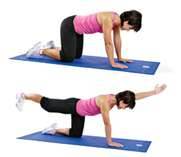

Supine opposite arm/leg raise.  Begin on your hands and knees.  Your hands are directly under your shoulders and your knees are directly under your hips at right angles to the floor.  Make your legs and feet parallel and hip distance apart.  Take a moment to slide your scapula (wing bones) down your back so that your shoulders are away from your ears, your chest is open, and your scapula are settled on your back, not poking up.  Extend your right arm straight in front of you and your left leg straight behind you at the same time. Your arm and leg will be parallel to the floor. This is the pose that reminds some people of a bird dog.

Hip raise on a stability ball.  Start by lying down, arms out, palms facing down. Rest the lower legs on the ball.  Lift the hips upward until the body is straight.  Slowly return to the starting position.


Russian twist on a stability ball.  Lay on ball, with shoulder blades on ball and hips pushed up high off ground.  Place hands together, or hold a single dumbbell.  Keeping your hips up, turn your shoulders to the right so they are perpendicular to the ground.  Twist back to the starting position, then twist to the other side.


I have bad news and good news about core workouts.
First, the bad news:  While core strength training may be an effective training method for improving performance in runners, you might end up with not much more than a strong set of core muscles.  When I reviewed the Outside magazine “Ten Biggest Fitness Myths” article, the question was raised whether whether core-specific training benefits athletic performance at all. In one study, a group of collegiate rowers who ­added an eight-week regimen of core exercises to their regular rowing ­workouts wound up with stronger cores, but their rowing performances remained the same. A group of Division I varsity football players were also tested, and researchers found almost no correlation between a strong core and athletic performance.
The good news is not only that the the law of specificity still works - running not only can help make you a better runner- but new studies show that running does work your midsection. 

Six-pack abs, and a better 5K time.  Gee, what a great idea!

Monday, June 4, 2012

Be Consistent

For five years, I used to run every Sunday morning, as well as four-to-five other runs each week, with a dozen fellow (kind-of-serious) age group runners. Aging, family moves, injuries, marriage/divorce, role changes and other transitions splintered the group over the next four or five years. Next thing we knew it was little more than my wife and I going out to a location to run our (separate) training runs. At that time we decided the Sunday run needed a little kick in the shorts.


One of the take-aways from our frequent visits to New Orleans was tying in breakfast with the group run, something which our friends in the 5:20 Club have done for a long time. We needed to find runners who were able to handle six-to-eight miles at a time, but didn’t mind spending a little time socializing over breakfast. The most fearful thing about group runs, especially for runners who aren’t fire-breathing, type-A, stay-a-half-step-ahead-of-the-pack types, is that they will be left behind the pack to fend for themselves. After a year we’ve managed to develop a small (core) group of four-and-eight runners. We meet up to run (sometimes walk, depending on aches and pains) every Sunday morning; three or four different locations during the autumn, winter and spring, and on the beach during the summer. We exercise for 60-to-90 minutes, then clean up and sit down for breakfast or brunch.

Running is recreation. For some (like this coach) it is almost an obsession. But for the overwhelming majority of runners it is not a means of earning a living. I receive questions from a lot of people; often they ask about what it will take to improve their 5,000 meter run time, others want to know about training for a marathon. When it all comes down to the nuts-and-bolts of training, of being a runner, perspective is of the greatest importance.

A case in point: my wife’s (Canadian) co-workers and their family members participated in the recent Ottawa Race Weekend (2K and 5K) events on a warm late-May afternoon. That evening, over grilled burgers and chicken, the general consensus of the group was that they enjoyed the event but they all felt some run training would be beneficial. I agreed to provide a simple training plan as long as they (and I) understood: We have demands and commitments which fill the majority of our waking hours.

Starting out as a runner doesn’t necessarily require 60 minutes a day, seven days a week dedication. Most anyone would say that is a recipe for injury, burnout and frustration. Most people who run because they want to improve their health and eventually participate in an organized (short) road race can probably get by with 30 minutes a day for four to five days a week. If you don't have 30 minutes, but you can spare 20, that is better than nothing at all. Does the time have to be completely filled with running? Not necessarily. If you need to walk, walk until you can run again. Add running as you can tolerate. The most important thing in the training – and this goes for more-experienced runners as well as rank newbies – is to BE CONSISTENT.

Inconsistent runners can be, and often are, the type of person Dr. Jack Daniels would classify as “coach frustrators.” We coaches can see the potential within them; they verbally express the desire to do what is necessary to improve, but they are noticeably absent when it comes time to reinforce their talk with effort. The goal for all runners is to develop a consistent running habit; not just to say no to rolling back over in bed after the alarm goes off (which we all fight), but to – at the least – become and stay healthy, lifelong recreational runners.

Monday, December 12, 2011

One Excuse Is As Good As Another

Even coaches suffer from demotivation, especially coaches who like bright, sunny mornings. I used to think seasonal affective disorder was a bunch of bologna until I spent an autumn in Chicago. September was great, the first half of October was pretty good. The last four weeks I spent in a deep blue funk, praying for sunshine that never seemed to come. So I guess that's one of the reasons I sat, grumbling, over a cup of coffee and a slice of toast with Nutella the other morning. Was I ready to go out and run with my wife and a couple of our friends? Not necessarily. The gray skies had me wishing for a pot of coffee and a thick book of mindless reading.

On top of this, my mood was not helped by the gentle, persistent ache in my ankles and feet. I raced a 10K the previous day. I commented about the previous day's exertions, saying something like "a tale of two 5Ks, one good and one bad." I ran the first half at my desired 10K pace, then realized my (5K) fitness did not transfer well to the (10K) distance. Rather than risk regression, or worse, reinjury, I shut down the effort on the return trip, adjusting the pace to a minute slower per mile.

Most "hobby joggers" (as some would judge by my performance) would be pleased with a 46-minute 10K. Most people (still) recovering from injuries would call it a good day. However, the ghost of race performances past can trouble the aging and rehabilitating runner. Really, I should be happy to be out on the roads and still running, right?

How many times do runners use a variety of excuses - some lame, others less so - to justify a performance that did not quite meet up to their expectations?

Some of the better excuses I like to hear sound a lot like these:

"I wore the wrong shoes." - In my humble opinion, one of the best and most valid. This excuse is more common with guys who keep half-a-dozen pair of running shoes, in varying states of life, around the house. I've put my singlet, extra socks, race belt, dry post-race clothes, and so on, in my bag the night before, left the house on the morning of the race with all my gear in my bag, but forgot the shoes in which I was going to race. So, I had to wear the pair of retired "kick-around" shoes which had no cushioning left. That's one of those 5Ks I wanted to get over with quickly; one that felt like it would take forever.

The only situation worse than to show up to the race with the wrong shoes is to show with no shoes.

"I wore too much clothing." - This is particularly true for less-experienced runners taking on longer-distance events. I've stood at marathon finish lines, five (or more) hours after the start, with temperatures twenty degrees above the optimum race day temperature. It scares me to see participants layered in tights and warm-up suits staggering toward the chute.

Less often heard is the converse; very few runners under-dress for the conditions. I'm one of those crazy persons who will race in a singlet, high-cut racing shorts, and a hat or gloves. This last weekend I used a pair of arm-warmers and felt good until the end...a little on the warm side because of the knit cap, though. And, strangely enough, there were at least two guys out shirtless in the 40-degree weather.

"It was too (hot/cold/windy/humid)." - Weather conditions happen. And in many cases, unless you're talking marathons, the entire field contends with identical factors. There's not much a runner can do, except train when and where the weather dictates. And don't forget to take advantage of tactics which involve the climate. There's no law that says you have to not draft behind a runner when you're traveling into the wind, right?

"I didn't hydrate/eat properly." In many ways runners are like charcoal grills. You can pile fuel for the burning and light a match, but sometimes, in order to burn fuel you have to have some tinder or an accelerant. Some runners can eat as little as a candy bar before a race; others have to hit the buffet table.

Then comes the issue of hydration, which can be screwed up in quantity or quality. Ask any runner who's had a "barley-based liquid dinner" the night before a race how they performed. Most - after a couple of aspirin - will tell you they would like to have had the previous evening as a "do-over." Beer has fewer carbohydrates than most of us care to admit.

"The course was too long/short." - I measure courses, so I hear this one more often than I care to admit. The fallacy behind this complaint lies in a couple of factors: First, the length discrepancy is most often described in terms of time, rather than in distance. Second, the persons who complain in terms of distance usually gauge it based upon a consumer-grade GPS receiver.

If I hear 'the course was (number) seconds long,' my hearing shuts off. If I hear 'my GPS said the course was...' I patiently explain to them the limitations of consumer-grade GPS receivers, the exact distance of the race course, and the protocols (often) used to measure. For thirty seconds. At which point their hearing shuts off.

"This was a training run." - This is not necessarily a bad excuse, in my opinion. At least, if you're a top-shelf runner in training for a big race somewhere down the line.

If you are in a situation where you pin a bib number on your shirt/top, or attach it to your race number belt, it's a race. I've always been of the opinion that one should not race unless one is race-ready.

Which is probably why I shouldn't have raced the other weekend. But sometimes we have to get out among our fellow runners and blow the carbon out of the exhaust pipes. Maybe the best thing we can do is be honest with ourselves and say, 'I'm out running, and whatever happens, happens.'

Certainly sounds a lot better than all the unsavory alternatives of not running, right?

Tuesday, April 20, 2010

Multisport as a Metaphor for Life

Just back from a long (and often seemingly-lost) weekend in New Orleans. I don't go to NOLA for no special reason; nearly every time (like almost any trip away from home) has something to do with running or multisport. Nice way to go through life, in my humble opinion.

While I'd love to say the weekend was a complete & utter success it was not. I'm still dealing with a serious fear of open water swimming, something which has affected me since last year in Panama City. I had the strangest feeling of panic earlier in the week as we were discussing swim courses & initially attributed it to one-too-many cups of Starbucks. Unlike a twelve-step program, realizing you have a problem is probably not the hardest step.

A couple of things I learned this weekend which might even parallel life:

Bargaining does not work with every adversary. I went out to do the traditional Saturday morning run along Lakeshore with New Orleans' 5:20 club. At the 3.5-mile point, I backed off my 7:30-per-mile pace, looked out toward the calm (at that moment!) waters of Lake Ponchartrain & began to make peace with her. The next morning's conditions were (supposedly) as placid as the day before...but conditions became more challenging in the two hours between arriving at transition & the wave start. I remember someone saying a phrase some time back about running being eighty percent mental & the other half physical. Triathlon, however, is not running. It's one-hundred percent mental & the other half physical. If your head isn't all there it's not going to be a good day.

Always have an eighty-percent solution. Since the IM70.3 NOLA event has attracted many first-time triathletes, the race director left an opt-out option. A great idea, in my humble opinion, especially when nearly 30 persons were either taken from the water or bailed on the swim before the finish of the 1.2-mile leg. I'm not certain how many took the opt-out, but in hindsight, I might have felt worse about the day if I had. Getting in the water & getting my butt kicked was better than not getting in at all.

Attitude is everything. After the obligatory 30 seconds of oh, cr*p, not another day like Panama City...the race staff told me I could still do the opt out. Suh-weet! I hadn't ridden my Softride time trial bike since IM week in Panama City, & really wanted to know how much benefit my new (F.I.S.T.) set-up & new (Gray) aero helmet would provide on what I initially perceived as a wicked good bike course. I was half correct; the bike course definitely had its share of wickedness, two bridges to climb - one right after the other - within the first ten kilometers...this course is an out-and-back, so the same challenges in the first ten would be there for the last ten, when we were fatigued. At first, the wind on the course was relatively light & in our face, but began to increase in strength & shift in direction, leaving few places on the course where a racer would benefit from it. I noted after a slight sluggishness in the bike's handling after the 50-kilometer mark, just a few miles after the mid-point. As the ride progressed, the sluggishness increased, & I knew from looking down at the tire patch that a flat was in my near future. Finally, at 48 miles, I realized the road conditions of the next eight miles plus the mushy tire could possibly lead to a very bad day. So, I stopped to try & repair the leak. After attempting to refill the tire, I found the issue was, er, something deeper...a cracked valve stem extender, literally something I could not repair. Fortunately, the trooper protecting the course was able to call bike technical support...who didn't show for an hour & a half.
When you're in a situation like that you can either become Eeyore & bemoan your fate with a face long enough to eat corn out of a pop bottle, or you can channel Normann Stadler in Kona, circa 2005 ("another flat $&#*^% tire!"). But since I was feeling fairly good to be alive & not in an emergency department, I decided to laugh at my fate. Come on, how many guys run the risk of pulling what I would call a "double DNF" in one days' racing? Not many. Of course, if I had been more smart about the issue I would have pulled off the road at the overpass where there was shade, but I was thinking more along the lines of communication & not so much speed of response at the moment. If I had known it was going to take at least 90 minutes for tech to show, I probably would have ridden up to the overpass & taken advantage of the shade. So, silly me, I stood in the sun & nearly dehydrated myself. Tech, once they caught up with me, got me back on the chain gang again very quickly, with a couple of bottles of water to boot. My buddy Dixie came past about five minutes before tech did, so my goal was to catch him some time before the finish line.
Patience IS a virtue. The one thing I did not want to have on the run was a repeat of Augusta, where I hammered the first three miles & struggled the next ten. I knew if I was aggressive with my hydration & electrolytes during the bike & continued with it as far into the run as possible I might not have a bad day, or at least wouldn't have the kick me to the curb cramping I had from mile seven to the finish at Augusta. The plan was to run ten light poles, followed by walking one, plus I would walk as I took fluid at the aid stations on the course. Since there were stations every mile I did not wear my hydration belt, but took hits from my gel/electrolyte flask every second aid station.
I encountered Dixie at the only bridge on the run course, somewhere between the second or third mile, & passed him like he was tied to a tree. However, he was close enough behind throughout the run we saw each other on every switchback through City Park. Nothing like unadulterated fear a buddy is going to catch up with your butt to make you keep moving as quickly as possible. After the ninth mile there was just about nothing left in the tank, which seemed to be a good a time as any to engage in a brisk walk & see what strength I could recover. Amazingly, I was able to get back on the groove at mile ten, just before the exit of City Park...and just in time for the roughest patch of pavement on the entire run, Esplanade Avenue. I've run up & down Esplanade many times in the past ten years or so; knowing the best of the worst conditioned road I've ever raced upon was going to be a benefit. Again, it was the ten-to-one ratio, & things seemed to work fairly well until mile 13 when whatever reserves I might have had in store were depleted. Of course, by that time you have a new fuel source, namely loud music & cheering spectators. Most of them don't have a clue how bad you feel by that time, & I think they'd gladly give the functioning half of their liver to you if they could.
So, all you can do is suck it up & look like you're really STRONG when all you want to do is sit by the side of the road on the curb & drink two or three beers. Repeating as tolerated.
There's NOTHING like a finish line. But you want to look good for the photographers & the friends who finished hours before you did, so you tighten up the loose fasteners & set yourself up for a strong finishing kick which tells people: 'yeah, I did this, & if they asked me to do it tomorrow I probably would...as long as you're out here waiting for me again.'

Monday, March 8, 2010

The Greeter of the Pack

Another weekend in the great out-of-doors has ended. While there's still a bit of a chill in the air, there's no doubt spring is just around the corner. While it's still difficult to get myself motivated and out the door some mornings, at least I don't feel so badly about it once I'm on the move. Suzanne managed to somehow talk me into a near-instant replay of last Saturday's run: Do three miles to a coffee joint, stop for a cup & a bite, then do three miles back to the house. Seemed like a lousy idea at first; Weather Channel had the conditions listed as in the low 40s with a wind chill in the high 30s. While I had my Garmin & my HR strap on to keep track of the important data it wasn't the be all, end all for the morning. Suzanne wanted to get out of the house for a run & she wanted to have coffee. So be it.
Fortunately, the sun was bright, the air was slowly warming up & the sidewalks even seemed like a welcoming environment. It wasn't Esplanade Avenue to Community Coffee or the 5:20 Club, but it was close enough. The very combination of ingredients, including the presence of my loving wife, was just enough to make the morning's first effort seem like just enough.
Once we got back to the house the trials of real life, such as they are in Chez' Bowen, reared their head once more: Walk the dog, get the last-minute business accomplished, fit the swim workout in & go work packet pick-up in Gulf Breeze for Sunday's Midway 8K.

Sunday was just as nice, but the solo 10-miler hurt like hell. Perhaps it was still too soon since the half-marathon to do that many miles as a long run, but I can never tell when I'm going to have a nice Sunday morning...so... Home to walk the dog, then clean up & get some breakfast before heading over to the race to set up. Okay, so I forgot my laptop & had to go back home for it; I owe the company a round of brewskies for that transgression. I never forget my "coach hat", my "RRCA rep hat", and my soapbox. And I got to use them all yesterday at the event.
A young lady asked the inevitable question about headphone use at the registration table. Beverly was almost dead-on accurate with her response; I think she's heard my sermonizing as much as Steven has. We mentioned to her that as a RRCA event club, & because our event was covered by RRCA's event insurance, we were obliged to strongly discourage her from using the headphones. However, we were only going to strongly discourage her because of the inherent safety risks; she was going to run on a course which was not completely closed to traffic. While we did have volunteer workers at as many intersections as possible (another topic for future rumination - volunteers...) we could not completely guarantee her safety in the event an insane (or even sane!) motor vehicle operator decided to suddenly overtake her.

As a small event we want to develop a clientele. We also want to help educate runners & triathletes on safe practices. The first baby step we can do, & intend to do, is mention the hazards the headphones can cause...especially if the volume is jacked up so high the wearer cannot hear. (I still laugh at the comment of the masters' winner: He was doing a cool-down on the course with his phones on, & heard my car's stereo blaring about a quarter mile away from where he was. I thanked him for keeping the volume down low enough to hear his surroundings.) It's not like we have a means to enforce such a policy right now. But if we begin to tell participants it's hazardous to use those things, perhaps when we put a prohibition statement on a race flyer they'll abide by the request.
Okay, I'm off the soapbox for now. My wife has always told me I should participate in a race from the rear of the field in order to see (as Jacob Riis might have put it:) how the other pack lives. Since the local constabulary sent only one patrolman to cover the course, the race director & I were responsible for the lead & follow vehicles. George took the lead vehicle; I had the follow. There's a whole different dynamic when you're following walkers, compared to the elbows-&-a$$#@(@s pack you see at the front end of a race. I suspected I was going to spend the next 60-to-75 minutes following along with the walk division. Close, but not close enough, moose-breath. The last participant took a little over 90 minutes. That was the bad news. Was there good news? Kinda-sorta.
The weather was wonderful. We're talking roll-the-window-down,-lean-your-elbow-out-the-window-because-hanging-your-whole-head-out-would-look-silly wonderful. Unfortunately, I couldn't find a good radio station to play outside of the local NPR stations. Ah, one of those moments where I kick myself in the butt for leaving my favorite CDs at home...& not snagging up Suzanne's iPod to plug in the accessory jack, Jack. Oh, and this lady wanted so badly to give up at the first half-mile. She turned to look at me and wave me on forward, but I told her I was the follow vehicle, & while she was the last participant she was going to make it just fine. I didn't want to tell her how badly it would bite to not finish an eight-kilometer walk. So, I rolled along just behind her with the flashers flashing, plucking up course signs after she passed.
When she got to the last half mile to go, her husband came out to walk along with her. I continued to do my thing & she continued to do hers. At the last 100 yards before the finish, I rolled along side her & called out: "You know what that feeling is right now? What you're feeling is accomplishment!"
After that, I rolled into the parking lot & made a beeline for a beer & some italian bread. My day was pretty much complete. I can't say I picked up any observations from the @$$-end of the field, save for the fact that sometimes it's just something to finish...which was more than I could say for the two teenagers who turned off the course a block ahead of the woman an hour before her finish.