So, How Many Hats Do You Wear?

My photo
Pensacola, Florida, United States
Husband. *Dog Dad.* Instructional Systems Specialist. Runner. (Swim-challenged) Triathlete (on hiatus). USATF LDR Surveyor. USAT (Elite Rules) CRO/2, NTO/1. RRCA Rep., FL (North). Observer Of The Human Condition.
Showing posts with label participation. Show all posts

Sunday, September 11, 2011

So You're Thinking About Triathlon, Eh?

So you're thinking about doing a triathlon event, huh? I'll admit I like the sport a great deal, which makes perfect sense if you've read my postings from a couple of years ago. Multisport is great because it's an inclusive bunch; the type-A folks, the rank recreational participants and even the professionals are all pretty much together on the same course and the same conditions.

I've participated in the sport at a variety of levels; athlete, event volunteer, course coordinator, and race director. Over the past four months, I've worn the red polo shirt of a USAT official and worked the water, transition, bike and run courses of sprint, intermediate and long distance events.

I walked through the transition area of an intermediate (Olympic distance) triathlon during the first week of September and heard someone say, 'oh, the penalty guys are here.' That's one way to hurt someone's feelings, even if they are wearing a red or zebra-striped polo shirt.

The role of a USAT certified official blends two different professions, that of educator and of law enforcer. Before the gun goes off, the referee/s work to make certain the "playing field" is safe and fair for everyone. The head referee for a race wears a zebra-striped shirt and serves as the final authority when it comes to the rules and penalties. Any violation written by an assistant referee (who wear red shirts) is verified or can be nullified by the head referee, depending on the assistant's description. Not even the race director can overturn a violation penalty. The zebra serves as defense counsel, prosecution, judge, jury and (regrettably, sometimes) executioner.

The referees check the water temperature to determine if wetsuits can be used, review the transition layout to every athlete travels the same amount of distance as their fellow participants, checks to make certain bikes are safe, legal, numbered and racked correctly, looks at helmets and equipment to make certain they meet USAT standards, and answers rules-related questions.

Once the gun goes off, it's time to enforce the rules.

Often, new and relatively-inexperienced participants suffer - at the least first-race or tri-newbie angst, at the worst variable time penalties and even disqualification - for mistakes made in training or in training groups. Really.

I think back to my first handful of races; I would have been penalized at least twice in my first triathlon and probably disqualified in my first long-distance triathlon for rules I said I knew and agreed to follow when I signed my event waiver. So, not only am I talking from the perspective of a guy who knows most all of the relevant rules, I'm talking from a guy who's seen or broken most of the easily-broken rules.

So, let's talk about some things you can do to make those first few races go more smoothly.

Before you go inside transition, make sure you've mounted your race numbers on your bike and helmet. Both should be clearly visible from the left-hand side. Make certain your body marking is clear and large. If the race director provides body marking tattoos, place them slowly and carefully. Most importantly, check to see whether your tires are inflated, gears shift and - most importantly - the ends of your handlebars are plugged. If they aren't, ask a transition volunteer to direct you to bike tech support. In the case of the bar ends, they have to be plugged or you won't be able to ride that bike. Of all the rules referees are charged to enforce the bar end rule is one of the three which can lead to a disqualification.

Once you are in transition, it's all about you. Some events are more stringent than others in keeping family members out of transition. It's both for the safety of the racers and the security of their gear; some bikes I've seen are two months' worth of paychecks on skinny tires.

Once you find your rack area, place your bike either with the handlebars on the rack or hang it by the saddle. Now take a look at your bike. Whatever way you have racked it, the space from the rail from where you hung the bike out to where your bike wheel touches the ground is space which is reserved for your gear. If there's no space in the area where you are supposed to rack your bike, talk to the racers in that area, a transition volunteer or a referee to help adjust the bikes. Staggering so every second bike faces the same direction allows each racer to have a space up to 75 centimeters wide (the legal maximum width of a bicycle according to USAT competition rules) for their gear.


Take a moment or two to look at the layout of really experienced triathletes. You'll find they have less gear than the less-experienced athlete. It's not necessarily that they have more on the bike, but they've learned to bring the least amount of gear necessary for their event. I recall the layout of a guy in my age group from my first triathlon; he had a stool for a seat, a bucket for his feet, not to mention the towel, helmet, bike shoes, water bottle, etc. His wife stepped in to assist him in transition, too, but that's another story.


So the gun has gone off and you got through the swim - I'm usually smiling about this point, because if anything is going to do me in it's going to be the swim.

Once you've come out of the water and entered transition for the first time, think: Slow is smooth. Smooth is fast. Put on the helmet first. Set it properly on your head. Facing forward - only the pros are required to wear their helmet properly, but a properly worn helmet is a helmet which might save your life. Buckle the chin strap. Good. Now work on everything else. Once you have the shoes and helmet on, walk quickly and smoothly to the mount line, then get on the bike.

The unbuckled chinstrap can get you in a world of trouble if you mount your bike; it's a variable time penalty in transition and a disqualification if you're on the course. I've seen new racers with buckled chinstraps which hang down like they were playing hockey. Or the helmet is tilted back on their head; especially ladies who have pinned their hair up. The helmet has to fit snugly; a loose helmet is one which won't protect the head in a crash.

I saw an athlete walk through transition toward the mount line at a recent race. I called out, 'racer number (blank)...racer number (blank)...YO, DUDE!' He couldn't hear me. He was wearing an iPod. Another racer had a set of headphones hanging around his neck.

Music headphones are not allowed in triathlon events. Even if they aren't on your ears. Outside of being dangerous on the bike, because it's impossible to tell who or what may be approaching, USAT considers music players, cell phones and radio devices unauthorized equipment, something which can be used to provide a tempo (pace) reinforcement or possibly provide you information on the location of fellow competitors. Either way you want to look at the use, it merits a variable time penalty.

The bike leg of a triathlon has four very simple rules; ride on the right hand side of the road. Pass on the left hand side of the road. Stay back three bike lengths from any rider in front of you. Make the pass in 15 seconds; once you make the pass keep pedaling and move to the right side of the road. If you're passed, move back three bike lengths before trying to make a pass. The hard part, usually, is that inexperienced riders are used to riding side-by-side with friends or being closer than three bike lengths apart from another rider.

Hear those motorcycles? That's the referees. They're riding along to make certain all the riders are following the rules. A group of riders on the road is usually a tell-tale sign for the motorcycle and referee to come watch and make sure everyone is playing fairly.

Sometimes the sound of a cycle will make riders tighten up their distance or position. Other times it will force a rider to attempt the pass because they were too close when we arrived - 7 meters/23 feet is closer than most people think, but once you're within that space there's only one legal way out. Through the front. In 15 seconds.

If someone is drafting off you, don't yell at them or argue. If there is enough referee coverage on the course they'll be eventually found out.

When you get to transition, slow down before you hit the dismount line. Get off the bike, then walk into the transition. Again, remember the mantra...slow is smooth. Smooth is fast. Set your bike on the rack, remove your helmet, then put on your shoes.

We've had many racers ask whether their spouse/child/friend can run with them on the run course. Only if they run with everyone else, we tell them. Impossible? Only one family member and hundreds of runners? I guess it wouldn't be fair then, would it? They can stand along the curb and cheer you on, but don't use your cell phone to chat with them. Remember, those things aren't allowed, right?

And while we're talking about being on the course, make certain that everything you take with you during the event stays with you. Don't toss your empty bike bottles or gel packets unless you're literally in sight of an aid station. A lot of towns really are down on triathlon events because the participants treat their roadways and lots like it is their own personal rubbish bin.

And if you find you've been penalized after the event, the head referee normally stays until the end of the awards presentations to answer rules and violation questions. They might have written your violation, or their assistant/s may have. Either way, they will be able to explain what was seen on course and how it violated the rules.

Multisport is like golf for the high-strung: You can have the perfect race and still find areas which need improvement. You can focus on one area and get really good, then suddenly find out you've slipped in the other two. So, it's a balance of power, speed, technique and smarts...two hours of racing can whip your butt for the day...or you can achieve a state of euphoria after six hours. Find the distance you like and try it out.

Monday, March 8, 2010

The Greeter of the Pack

Another weekend in the great out-of-doors has ended. While there's still a bit of a chill in the air, there's no doubt spring is just around the corner. While it's still difficult to get myself motivated and out the door some mornings, at least I don't feel so badly about it once I'm on the move. Suzanne managed to somehow talk me into a near-instant replay of last Saturday's run: Do three miles to a coffee joint, stop for a cup & a bite, then do three miles back to the house. Seemed like a lousy idea at first; Weather Channel had the conditions listed as in the low 40s with a wind chill in the high 30s. While I had my Garmin & my HR strap on to keep track of the important data it wasn't the be all, end all for the morning. Suzanne wanted to get out of the house for a run & she wanted to have coffee. So be it.
Fortunately, the sun was bright, the air was slowly warming up & the sidewalks even seemed like a welcoming environment. It wasn't Esplanade Avenue to Community Coffee or the 5:20 Club, but it was close enough. The very combination of ingredients, including the presence of my loving wife, was just enough to make the morning's first effort seem like just enough.
Once we got back to the house the trials of real life, such as they are in Chez' Bowen, reared their head once more: Walk the dog, get the last-minute business accomplished, fit the swim workout in & go work packet pick-up in Gulf Breeze for Sunday's Midway 8K.

Sunday was just as nice, but the solo 10-miler hurt like hell. Perhaps it was still too soon since the half-marathon to do that many miles as a long run, but I can never tell when I'm going to have a nice Sunday morning...so... Home to walk the dog, then clean up & get some breakfast before heading over to the race to set up. Okay, so I forgot my laptop & had to go back home for it; I owe the company a round of brewskies for that transgression. I never forget my "coach hat", my "RRCA rep hat", and my soapbox. And I got to use them all yesterday at the event.
A young lady asked the inevitable question about headphone use at the registration table. Beverly was almost dead-on accurate with her response; I think she's heard my sermonizing as much as Steven has. We mentioned to her that as a RRCA event club, & because our event was covered by RRCA's event insurance, we were obliged to strongly discourage her from using the headphones. However, we were only going to strongly discourage her because of the inherent safety risks; she was going to run on a course which was not completely closed to traffic. While we did have volunteer workers at as many intersections as possible (another topic for future rumination - volunteers...) we could not completely guarantee her safety in the event an insane (or even sane!) motor vehicle operator decided to suddenly overtake her.

As a small event we want to develop a clientele. We also want to help educate runners & triathletes on safe practices. The first baby step we can do, & intend to do, is mention the hazards the headphones can cause...especially if the volume is jacked up so high the wearer cannot hear. (I still laugh at the comment of the masters' winner: He was doing a cool-down on the course with his phones on, & heard my car's stereo blaring about a quarter mile away from where he was. I thanked him for keeping the volume down low enough to hear his surroundings.) It's not like we have a means to enforce such a policy right now. But if we begin to tell participants it's hazardous to use those things, perhaps when we put a prohibition statement on a race flyer they'll abide by the request.
Okay, I'm off the soapbox for now. My wife has always told me I should participate in a race from the rear of the field in order to see (as Jacob Riis might have put it:) how the other pack lives. Since the local constabulary sent only one patrolman to cover the course, the race director & I were responsible for the lead & follow vehicles. George took the lead vehicle; I had the follow. There's a whole different dynamic when you're following walkers, compared to the elbows-&-a$$#@(@s pack you see at the front end of a race. I suspected I was going to spend the next 60-to-75 minutes following along with the walk division. Close, but not close enough, moose-breath. The last participant took a little over 90 minutes. That was the bad news. Was there good news? Kinda-sorta.
The weather was wonderful. We're talking roll-the-window-down,-lean-your-elbow-out-the-window-because-hanging-your-whole-head-out-would-look-silly wonderful. Unfortunately, I couldn't find a good radio station to play outside of the local NPR stations. Ah, one of those moments where I kick myself in the butt for leaving my favorite CDs at home...& not snagging up Suzanne's iPod to plug in the accessory jack, Jack. Oh, and this lady wanted so badly to give up at the first half-mile. She turned to look at me and wave me on forward, but I told her I was the follow vehicle, & while she was the last participant she was going to make it just fine. I didn't want to tell her how badly it would bite to not finish an eight-kilometer walk. So, I rolled along just behind her with the flashers flashing, plucking up course signs after she passed.
When she got to the last half mile to go, her husband came out to walk along with her. I continued to do my thing & she continued to do hers. At the last 100 yards before the finish, I rolled along side her & called out: "You know what that feeling is right now? What you're feeling is accomplishment!"
After that, I rolled into the parking lot & made a beeline for a beer & some italian bread. My day was pretty much complete. I can't say I picked up any observations from the @$$-end of the field, save for the fact that sometimes it's just something to finish...which was more than I could say for the two teenagers who turned off the course a block ahead of the woman an hour before her finish.

Tuesday, March 2, 2010

The Handicapper General Has Determined...

Not one of the typical threats we see on the road. Bart Yasso in Indonesia, I believe...

One of my wife's favorite science fiction short stories is a satire on social equality written by the late Kurt Vonnegut. In the story, "Harrison Bergeron," the more intelligent, athletic or beautiful a member of society is, the more they are handicapped so no one person will feel inferior to another. The main character, Harrison, is exceptionally intelligent, strong & attractive; the Handicapper General forces him to wear eyeglasses designed to give him headaches, black caps over his teeth, forty pounds of birdshot around his neck, another 300 pounds of weight strapped to his body, a rubber ball on his nose...& headphones which play distracting noises.
At first, we laugh at the thought of a society which forces each of us to be equal by handicapping the more gifted; if we were better than someone else we would never willingly submit ourselves to such a regime. If we were less gifted we wouldn't mind being enhanced some, but we wouldn't feel right about the more gifted being handicapped.
Would we? On either account?
I was at a Rock n' Roll Marathon event & heard about a conversation between a Rock n' Roll staff member & an out-of-town participant asking about headphone use. The participant asked if headphones were going to be allowed on the course. The staffer decided, rather than give a yes-or-no answer, to find out exactly what made this participant tick:
Staffer - "Okay...let me ask you something. Do you know the name of this event?"
Participant - "Yes. It's the Rock n' Roll Marathon."
Staffer - "And you're from out of town?"
Participant - "Yes. Philadelphia."
Staffer - "So you flew here to run this event?"
Participant - "Yes. We've been here all week."
Staffer - "Did you use the discount registration code for the event?"
Participant - "No."
At this point, the staffer quickly estimated what the trip cost the participant & said: "...so, you're willing to spend thousands of dollars for a week at the Rock n' Roll Marathon, an event with some of the best live music this city has to offer, & you would prefer to listen to your own music...?"
How many times have we run races in headphones, never listening to the cheering of spectators, the sound of our own labored breathing as we run, the music playing from stereos in houses or on curbs or corners, or, if we spent a few (more) bucks at an event like RnR, there are bands playing local music for our pleasure at every mile? Running closer to the middle or back of the pack at races can often sound like a silent movie without the piano background; every runner is tuned into their own little world. No one talks to any one.
Yet, we tell our non-running friends we go to races to meet people.
So, we willingly handicap, isolate, ourselves on the course with 100 decibels of sound blaring into our ears, enough to drown the siren of the emergency vehicle taking the unfortunate runner who "crashed & burned" a mile away from us to the hospital...we might have passed without knowing they were in distress because we were in our own little world. Those same 100 decibels are only a little less damaging to our ears than standing next to our mother's Electrolux vacuum cleaner...right now. Over time we handicap ourselves more permanently; wrecking our hearing with long-term exposure to loud everything, until we can't hear even the most sublime of sounds.
Why? Because we seek pleasure & avoid pain. We want to go to our happy place. We want to detach ourself from the message our brain is sending. Timothy Noakes' Central Governor Theory of Endurance says the brain tells us to stop or slow down because our brain wants the glycogen our muscles burn as fuel for itself, as well as the heart & lungs...it wants to keep us alive, even if we cannot run. Our brain is greedy. But when we detach ourself from the brain's "message center" which warns us of the damage we "might" do if we keep running, we also detach ourself from the same message center which warns us a threat (overtaking runner, bicyclist, mugger, automobile, etc.) is approaching from behind.
I hear the often rhetorical question, "well, what about folks who are deaf?" There are folks who are unable to hear, but as a result the senses of sight & touch have become more acute. Not so with those of us who still retain the ability to hear until we place headphone in ear. We can't see behind us & probably don't even think about looking because our happy place is better than anywhere we want to be at the moment.
We don't need a Handicapper General. Most of us do it to ourselves. Rather than be a Harrison Bergeron, willing to die as an unfettered person & release people from long-tolerated handicaps, we'd rather wallow in our equality & accept when others are shackled.

Sunday, October 25, 2009

Following Your Bliss

It's definitely "beer o'clock" here in the P'handle. Been up since four a.m. & in a state (fairly much) of "on-the-go" since five-ish. Not much difference between the wake-up time for participants of a triathlon & the workers & volunteers who make it possible.

There's always (so it seems) some sort of crisis, some kind of "oops, we gotta get this issue worked through" moment...and we had a little bit of it this morning, but it was all right...once we got the solution. While it's tiring, maddening, frustrating, and sometimes even boring, it's also rewarding. I think every race participant should work with a race promoter at least once a year, & I'm not talking about one of those 'two-hour, packet pick-up' cushy, beer-in-one-hand, marker-in-the-other jobs. Ride the back of a rental truck setting up & picking up cones. Hand out water at an aid station of a marathon, or a 70.3. Tear down & put away speakers, tables, & various/sundry supplies.

It makes the thank you of the back-of-the-packer that much more sweet...if you hear it. It definitely warms the heart of the race director, just in case you hadn't figured.
FOLLOW-UP, Monday, Oct 26:
The need - or my need to rant - about volunteerism is as much aimed at myself as the next person. More often than not, people are in the throes of training for a long-distance triathlon are predisposed toward selfishness & self-centeredness. I used to have a t-shirt that summed it up precisely: 'as a matter of fact, the world does revolve around me.' It might still be tucked away in one of my dresser drawers.
I guess last week was either National Volunteer Week, Make A Difference Day, or one of those marketing ploys to get people off their behinds to do something they probably should be doing anyway...helping their fellow man. You'd have thought I'd have caught the message through the weeks' comics. It took until some time around Thursday for me to figure it.
To follow on to the 'marathoning' post from a few days back, someone posted a comment about how much different the triathlon community is from the running community. In many ways I cannot help but agree. Many tri-geeks are personable and approachable...a couple are grade-A type-A...ain't going there right now... But, some are tightly focused on their own training, & can't/won't take time to teach newer tri-geeks some of the tips & tricks which make racing less painful and more fun. In the back of my mind, I think it would solve some of the 'on your left, on your left, oh, $#!+...' moments you hear about, especially on the bike course.
(I can't help but feel grateful to a number of local tri-geeks who I've managed to corner at local shops...they've provided great advice/counsel and helped me get past the intimidation factor of the long-distance event up to this time. Thanks again, dudes & dude-ettes...you know who you are!)

Friday, October 23, 2009

Do I Consider You A Marathoner? Why Not?

Some of my running friends are in a bit of an uproar over this morning's New York Times article.
There are a number of runners who chafe at the thought of slow, plodding penguins having the nerve to call themselves marathoners. They believe slower participants have diluted the challenge of the marathon distance & lessened the cachet of their identity as - gasp - a marathoner.
Once you read the article, you'll realize something seriously missing. There are no 'elite' marathoners quoted in the article. I think in their case a marathon is "another day at the office." To the elite marathoner, slow participants are a non-issue. It's the folks who are slightly more slow & plodding than they - John Bingham calls them "slightly fast runners" - who are kvetching like a bunch of whiny, wounded animals.
While the trend is for marathon finish times to become more slow, as cited by Running USA, that may be more due to the democratization of the marathon than anything else. Remember that concept of selectivity we all learned about in college psychology? That was the same reason more students in graduate school scored no lower than a "C." Grad school was more selective to get in, & the grades reflected that very fact.
So, when Mr. or Ms. Marathon Race Director opened their event to the lumpenproletariat, the great unwashed run/walking masses, they spread out the total range of the bell curve a bit more. Of course, I don't think all of the race directors are pleased with the unintended consequences of larger fields of slightly slower participants...it means more time for the course to be closed off for safety reasons. Some events have taken to instituting cut-off times. Which is all right, in my opinion. If you can't make the cut-off, you'll look for another event where your chances of finishing is better. If I were a penguin looking for a marathon & saw a cut-off faster than my best effort, I'd find another event & say, 'their loss. Sucks to be that RD.'

Frankly, I haven't mastered the marathon yet. My best effort is in the high-threes, my worst in the mid-four range. I marvel at the elites as well as the three-hour folks. I'm not going to think any less of a person who wants to go out & do a marathon. But, what I'd like to see is running programs/coaches work over an extended period of time with their charges.
First, coaches need to be honest with the athlete about the social stigma which exists about plodding/walk-running/penguining...whatever the faster people want to call slow-paced participation.
Then, work with the person; get them off the couch doing 5Ks for six months-to-a year, then 10Ks, then half-marathons. After a couple of years of consistent training and racing shorter distances, then put them on a conservative, mostly run-based training program focusing on a marathon that has entry-level marathoner-friendly conditions...preferably a small one.
I'd personally recommend something as small as the Tallahassee Marathon, (next years' RRCA Southern Region Marathon Championship) which has about 250-300 participants, or Melbourne's Space Coast Marathon, which is on a very flat course. I'm not saying they can't do Chicago, New York, Honolulu, Disney, Marine Corps or any of the big name ones, but I'd rather see them get their first marathon in on a course where they can learn the art of marathoning, rather than be treated like children of a lesser god by wanna-be elites, fairly fast runners, & Runners' World/Slowtwitch/Let's Run.com forum posters, the gatekeepers of marathon/road running purity.

Tuesday, September 1, 2009

Ask Coach, Kona, and Good Ab Days

Ran into the above cartoon as I was pondering my swimming prowess (or lack of it) yesterday morning. Wonder how many would-be triathletes would take up the sport if there was an "Arm Floatie" division (kind of like the Clydesdale/Athena division, or the Fat Tire division...) at the local event. The only saving grace I can think of for my own pitiful skills, outside of what I mentioned yesterday (10-percent of a typical triathlon), is obvious...I can only improve.
And it is true. I know because I'm not as horrible a swimmer as I used to be nearly two years ago. Someday I hope to be able to no longer use the 'I grew up in the freaking desert' excuse for my lousy swimming. I might find another one, or I might just resign myself to the knowledge that, unlike dolphins, I can type 60-plus words-per-minute. Take that, Flipper.

Seems one of my athletes has a girlfriend in her early fifties, who has not run consistently until this last year. They ran a 5K course near their house, finishing in a little under 40 minutes. The conversation continues: 'I could see her putting in 35-36ish without much problem. With proper training, I see (but haven't said, of course) a 30ish in her future. What do I do with her now? Track? A steady plan? She's not a competitor at heart, just a happy participant, but I know she'd like to progress. Advice?'
I didn't mention I felt "a happy participant" was a great goal - heaven knows with the number of cranky people I've seen after a 5,000-meter road race, we could use a few more happy participants. So, I suggested 'steady running. Let her go out, run & enjoy herself. If she gets the bug to compete & thinks she needs to improve, then you point her in the general direction of your "friendly neighborhood Jedi master." If you push she might rebel. If I push she might rebel. Let the incentive come from within.'
Sounds like one of my local triathlete friends will be paying a few more large bills between now & October 10th; he qualified for the Ironman Triathlon World Championships in Kona, Hawai'i. Talk about the flip side of the coin; yesterday a friend misses the privilege of finishing her second Ironman by eight minutes on the bike, today three knuckleheads at that same triathlon decide not to accept a Kona slot (For those of you who may not know, Kona is Boston for tri-geeks. You either pay lots of money to get a charity slot or you work your butt off & qualify.). Some times the circumstances beyond your control are in your favor, I guess. Congratulations, Mark. I guess Steven and I will be riding the IM Florida course about the same time you're making your way back toward Dig Me Beach.
One of my friends has motivated me to try & achieve the goal of having "good ab days." For lack of a better definition, I guess that means getting some definition in the abdominal area...which means getting rid of some of the adipose deposited in the general vicinity of my mid-section for starters. To facilitate these metabolic (diabolic?) changes, it seems necessary to profoundly cut back on french fried darn near everything. That's a lot easier than it looks, especially if you're the type who doesn't take lunch in with you.
Most fast food joints have menu offerings like Henry Ford's 'Model-A Dictum:' You can have anything you want, as long as it's deep-fried.

Good Ab Days notwithstanding, the dietary advice & counsel provided by six-time Ironman world champion Mark Allen & Huichol shaman Brant Secunda in their recent work, Fit Soul Fit Body, only made more & more sense. Something that flies in the face of if the furnace is hot enough it will burn anything. Face it, it ain't going to get any easier to become a lean, mean triathlon/running/swimming/bicycling/coaching machine if some sensible chances don't come to pass. Doesn't mean I can't enjoy myself, or my food.
It's balance, friends, that counts.

Monday, August 3, 2009

Post-Bushwacker...Keeping It Real

It's the middle of a Monday morning & I'm sitting at my home office desk. A temporary situation, due to the fact my loving wife is going on the road again - please, no Willie Nelson music. Thank you. I'll drop her at the airport, then go in to my real office & commence to do my real work.

This last weekend was the running event which (kind of) kicks off the autumn racing season for a lot of local runners; a point-to-point 5K from Gulf Breeze to Pensacola Beach. Most of the folks who participate in the event do so because they know the post-race event is really good. Hey, when you can get over a thousand people (not counting bandits) to run in (EDITORIAL COMMENT: Hyperbole follows) a billion degree heat & near-maximum humidity conditions, you know it isn't for the medals or the race shirt. It really has to do with the post-race party. In my humble opinion, the Capt'n Fun group does the post-race as well as any other large club in the country.

But, talking to my friend Aaron...or at least with Betsy, his wife...the next day, one thing we don't do real well (the same goes for a lot of local events) is racewalking. Aaron racewalks because he's had one of his hips replaced; no running for him, to say the least. It doesn't mean he's slow, though...he's a ten-minute per mile (perhaps faster than that!) kind of guy. The only way you're going to beat him in a racewalk is either work at it - or cheat by running.

How can you tell when a racewalker is running? Simple enough...if you take the time to look closely. I've seen racewalkers with both feet off the ground before - definitely cheating.

Here's the problem. USA Track and Field controls racewalking. They train judges/officials in the technique & lay down the rules. Road Runners Club of America supports recreational runners, as well as walkers who do so because they are unable to run. RRCA clubs & many events - at least the ones here - get themselves in a real kettle of fish because they decide to set up a 'racewalking' division and provide awards for those people who consider 3.1 miles too far (There are some days when I consider 3.106856 miles too far.) to run.

So what do you do, Mr. or Ms. Race Director? If you have an event that's big enough to attract real racewalkers from out of the area...the ones who have seen USATF officials & participated in real racewalking events where improper technique is disqualified, do you tell these folks to suck it up and drive on? Do you make the effort to get USATF judges to officiate your racewalk division, or perhaps restructure & rename it a fitness walker division?
(I would love to use an inflammatory, pejorative term here, but I worry about the ability of my hips, knees, & other joints to carry me at my speeds for the rest of my mortal existence! Hubris tends to bite me squarely in the backside.)

It's kind of a shame to hear we do wrong by a number of people in the community...especially the ones who decide to travel three hours one way, spend a week of holiday time, beaucoups of dough, etc., etc., etc. There are people within the local community who know enough about the sport to judge an event or two, perhaps even enough to teach proper technique.

If we're going to do it, let's keep it real. If not, tap the kegs before the start & have a fun run.

Wednesday, May 20, 2009

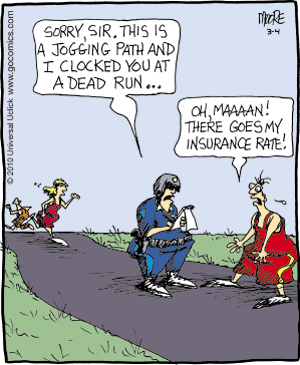
Things Which Make Insurers Go Hm...

Every once in a while you feel fortunate to be not in the position of an event director. While driving from Pensacola to Gulf Breeze after the aquathon portion of the Three-Mile Bridge Swim I had the pleasure (or misfortune) to be behind a pack of cyclists who were participating in a veteran's "freedom ride" from Pensacola to Pensacola Beach & back.
Riding 18-to-20 miles is not a difficult task if you're on a road racing or triathlon bike, wearing proper equipment & taking the necessary preparation. It's a tad more challenging on a mountain (fat-tire) bike because of the weight, increased tread contact patch, & stuff like that. Of course, clmbing isn't so bad because of the granny gear; that's the 19-to-25-tooth small, small ring on the front of the real serious mountain bikes which allow the rider to climb most any hill. BUT: If you are on a P.O.S. single-speed Wal-Mart special, without water bottles...riding in baggy cotton bermuda shorts, a t-shirt, & a baseball cap...two words come to mind: Long Day.
As an event director-guy, I nearly shrieked in horror at the sight of nearly a dozen riders in what the Italian cycling commentators would call the grupetto, and what the French would call the autobus...helmetless, plodding away at a cadence guaranteed to blow their knees off at the start of the Three-Mile Bridge's hump. One of the grupetto dismounted from the bike at the beginning of the hump in order to walk it to the top. 'What's that person going to do when they get to the Bob Sikes?'

Exactly the rationale for signing waivers.
I've always wondered why event waivers were not printed in clear, simple language. Why would an event director allow a person who obviously had not prepared for a 20-mile bike ride, much less a 10-miler, to participate in such an event? When does the event director take the participant aside & say, 'while I appreciate your service & I want you to participate & enjoy yourself, I don't believe you've prepared sufficiently for this?' Certainly, I know this was a military appreciation month, veteran-focused event, but you have to set a floor-level standard.

Of course, what would have been even more cool would have been to see the spandex-clad, hard-butt bike monsters at the front of the peloton, who were traveling at 15-20 miles per hour without any effort whatsoever, slow up and ride along with these poor souls. Perhaps teach them a little rudimentary bicycle operation (something my old boss would have called Gear Shifting For Bears of Little Brain); encourage them on the climbs which were soon to come. Perhaps, even, remember the realm from which they escaped.
I've read a few comments about the enmity between bikies and tri-geeks. Bikies think triathletes have no bike-handling skills, & tri-geeks think bikers are a bunch of elitist snobs who prefer to wheel-suck. I'm perhaps painting with too broad of a brush.

But way too often the people who have developed a certain degree of knowledge, skill & ability in their particular sport are less than willing to share what they know with the newcomer. Often the newbie looks at the proficient athlete & believes they are unwilling to share knowledge...perhaps there needs to be more rides like the one the other weekend to get the gung-ho bikers & the I'm only riding my bike to the grocery store bikers together. Hey, it's all the same type of equipment. Perhaps then the average automobile driver wouldn't consider every cyclist as a person who lost their license or can't afford to drive a car (in many cases the economic facts might be true but it's not completely across the board).

Tuesday, September 23, 2008

Introspection Blues - or - Oops I Did It Again

“This is for me the essence of true romance. Sharing the things we know & love with those of my kind. Libations, sensations that stagger the mind.” – ‘Deacon Blues’, Steely Dan (1977)
Well, I talked about the fact in past years I’ve become introspective (some say moody) during the month of September, taking stock of accomplishments. Part of it could be because of some latent religious belief, some of it is the end of the federal government’s fiscal year. It may also have to do with several birthdays that occur within that time frame. I didn’t spend that much emotional coin on introspection (as I was saying) until after a swim in the sound & a quick bike ride the other weekend ago. All I could think of was old Steely Dan songs & the perfect environment for listening to them, which seemed to be that particular morning. Oops, I did it again.
I ran in fewer local road races this past year, which made many locals ask whether I was injured. This was so during the first three or four months because of the achilles’ tendon injury from almost a year ago, but I am almost out of the woods; well, except for the run/bike/run workout the other weekend which quickly turned into a run/bike. I would have hammered through in the past to prove how much of an animal I am, but now I’d like to say I don’t care what everyone’s opinion is of me. It’s not completely true, but it’s getting there.
It’s a different perspective being on the sideline, standing on a street corner, writing workout routines, working a finish chute, handing out cups of water or sports drink, or helping to produce an event from the ground-up. When you're injured it's a complete & utter b!tch, but when you're healthy & you can make the decision to not race it's sometimes enlightening.
While it’s important as a racer to get your face (or singlet, if you represent a team or sponsor) noticed in the crowd; to earn that hardware at a local (regional, national) race, the time a runner has as a racer is fleetingly brief. If they’re wise they realize this truth before the first major injury comes & learn to adjust their perspective on “this running thing.” That truth: Participation is key. The goal is to not become, in the words of John Parker, Jr., Once A Runner. It’s more important to be able to get up early on a weekend morning, when sunlight is golden & air is comfortable, & spend some time engaging in bipedal locomotion with a handful of friends. (My friends Betsy & Aaron & the 5:20 Club reminded me of that truth.) I’m not certain whether it’s the run or the post-run activity that makes it special; something as planned as coffee & breakfast at a restaurant or as simple as standing around dripping puddles of well-earned sweat on a parking lot while drinking sports drink & shooting the breeze. Ask me in a year & I might be able to tell you more.
Now, a question from one of my athletes...
I’ve been toting my plastic bottle with my energy drink to the track all summer. Now I read that some of the ingredients in plastic bottles may cause health problems. Any recommendations?
Stop reading; you have nothing to fear but fear itself. Well, not quite. It’s not what your bottle is made of, but what can grow out of the warm, damp sugary stuff left inside that is more likely to cause health problems. To minimize the risk:
1. Keep your bottle clean. Rinse the bottle out with water after you are done with your workout & before you toss it into your warm automobile. You’ll forget to bring the bottle from the car; I do it all of the time. This way, all you’ll have in the bottle when you remember it the next morning is a bit of warm water, not a high-school science project gone wrong. And when you clean the bottle, use a bottle brush & warm, soapy water.
2. Purchase a Nalgene (or aluminum) bottle. Nalgene is break-resistant, easy to clean and doesn’t have any chemicals that will leach into your drink. The aluminum bottles are also lined so your fluid tastes like fluid. Both types of bottles are a little pricey but last a long time, so you won’t feel guilty about filling the landfill with plastic.
3. Replace your bottles regularly. Don’t get sentimentally attached to that bottle you got at an event two years ago. If you’re using your bottles strictly at the track or to stash on the course for Sunday long runs, buy inexpensive ones. Good bike bottles are a little more expensive because they’re built to withstand the rigors of riding & the potential for drops. Those of you who do long distance triathlons can get rid of the oldest bottles out on the bike course, at an aid station; anywhere else will get you penalized for abandoning equipment. You’ll find (reputable) sellers on eBay (if you need to find one, ask me) who sell bottles in cases of 12 or 24. A case for 20 bucks, including shipping, is a sure cure to keeping a bottle beyond its useful life.
So now I’ve done you a favor & provided an item you can put on every runner’s birthday or holiday gift list, except for me. I already have a case of bottles, thanks.