My formative years were in a small town in the desert of the Southwestern US. Folks like my family (Northeastern White Anglo-Saxon Protestants) were the minority. Fortunately for my sister and me we quickly were "adopted" into a Latino family who lived next door to my family's business. We learned in those first years about the importance of family, an understanding of traditions which were (at that time) foreign to us, and a great deal of respect for the home in which we were invited. When in Rome, it is best to do as the Romans do.
I believe this attitude has helped as I've grown, traveled and experienced some things. One certain way to upset the locals, especially in some cultures which are a departure from what we consider "the norm," is to violate it. Some cultures will take the offense with the amount of seasoning necessary and move on. Others might be a little less tolerant. The other way is to completely ignore or disregard what the culture considers tradition, strongly-held belief, or common practice.
The Hash House Harriers (a.k.a. the Hash) and "hashing" (a recreational activity which often merges the intake of beer with running on roads, trails, and paths of widely-varying quality) is a culture all its own. Traditions, norms, folkways and social mores of the Hash can vary by group, depending on the surrounding culture. A (perhaps too-)simple way to describe these traditions, norms, folkways, and social mores would be to parallel them with religious doctrine. In fact, John Wesley's dictum: 'in essentials, unity; in non-essentials, liberty; in all things, charity' is probably most correct.
The essentials, in my humble opinion, are:
1. Beverages - Either beer, water, or both. Soda or sports drink is kind of out on the edge of acceptable.
2. Trail - The distance and degree of difficulty are up to the person or persons laying out the trail.
3. Circle - An opportunity for encouraging traditions, norms, folkways, and social mores, as well as having a few laughs...and more beverages.
4. On-After - Jewish have "oneg shabbat." Protestants have Piccadilly (or Furr's, if you prefer) Cafeteria, or Golden Corral, or Ryan's Buffet. A good hasher always leaves room for more beer...and food...and beer. That's where the fellowship of the "saints" continues. Not necessarily required, but some good stories do come out there.
The songs sung and names given to each member of the Hash (proof of the member's group identity - both in the individual Hash and the Hash catholic) can range from tame to scatological. Those are Wesleyan non-essentials. But...how would you feel if someone in your immediate family decided to go to a church service with you, six-pack of beer in tow? While you're taking very deep breaths, waiting for the ceiling to cave in or a thunderbolt to come out of the heavens...they're sitting in the back row, noisily cracking open a can or two while chatting on their cell phone.
To me, that's what it feels like when a "named" hasher shows up at another Hash's event and says, "I don't do circle." Next thing you know they're holding a conversation in earshot of the group trying to engage in their traditions.
It's difficult to be charitable toward these folks.
If they're not into Circle because what happens might make them look stupid, here's a news flash. Hashing was not intended to be acceptable. It's a way to blow off steam, to run and play and let your inner five-year-old out...with all the grown-up benefits. And there are groups who want to make it acceptable. That's fine, but when you're in someone else's "cathedral," sitting in someone else's "pew," at least sit quietly if you don't agree with the preacher...or have a seat in the car in the parking lot.
And please, don't call yourself a hasher. At least not in my presence. You can leave your hat on.

So, How Many Hats Do You Wear?

- Michael Bowen
- Pensacola, Florida, United States
- Husband. *Dog Dad.* Instructional Systems Specialist. Runner. (Swim-challenged) Triathlete (on hiatus). USATF LDR Surveyor. USAT (Elite Rules) CRO/2, NTO/1. RRCA Rep., FL (North). Observer Of The Human Condition.
Showing posts with label attitude. Show all posts
Showing posts with label attitude. Show all posts
Monday, March 12, 2012


Monday, September 6, 2010
Whatever Doesn't Kill Me...
My retired racing greyhound trotted in from his morning visit to the backyard after his Sunday morning breakfast. On most days, Rubin likes to come back into the kitchen, check to see whether he can mooch a little bit of peanut butter, then heads back to his sleeping blanket at the foot of our bed. This last Sunday, he stopped by a small pile of clothing neatly laid on the back porch table & proceeded to engage in a lengthy sniff-through. While the clothing & shoes of a typical running enthusiast like me would normally interest my dog, he seemed a touch more interested in the clothes I wore the previous evening.
The reason for the increased interest? Perhaps it had to do with the information he gained. A suburban dog can learn a lot of new stuff when perusing clothes worn while running over (through?) trails and a few drainage ditches choked with low-hanging branches, fallen limbs, standing water, thorn bushes, and so forth. He learned standing water & plant material has a smell which is not like perspiration. Why did "dad's" clothing smell like swamp, & not sweat?
I have several friends who, while not hard-core road runners, enjoy the challenge of what is known as "hare & hounds" running. While the sources which explain the history of this activity, the traditions which surround the activity & the groups which engage in it...in varying frequencies...vary in quality and quantity, these facts which appear to be to be most true:
- A group of people meet in a location.
- One or two are sent off to lay a trail, with a brief lead time before the rest are sent in pursuit.
- A social gathering begins at trail's end, where songs are sung, beverages are consumed, & general runner-like fellowship occurs.
I've run with a couple of groups which play the "hare & hounds" game over the past year or so, & the one unique quality you can say is common among all of the groups - like Wesley's take on the non-essentials of any religion - is diversity. Two groups are active where we live, with several others in a one-hour radius of our home:
- One considers themselves a "family-friendly" group.
- The other has a t-shirt which says, "if the devil doesn't make you do it, we probably will."
I wouldn't say they're "night & day" in their approach totally across the board, but...I've been to the exact same number of runs with each group, & they do vary in their degree of challenge. I'm one of those who can hold my own on a semi-urban course of roads, parks and sidewalks, but reality sets in when we get out in the country. You can guess where I have acquired more scars on my legs. The nickname I earned is fitting for my "life" as a coach, as well as my attitude about running through thorn bushes, branches, brush, standing water, and more-challenging terrain. It's humbling when a "semi-accomplished road racer" is falling on his back side in three feet of standing water. I've destroyed a pair of perfectly decent training shoes in the past month, for which I'm less than enthused.
But it's a chance for my wife & I to spend "quality time" together; she's only a minute away, in front or behind, depending on the course. The mental aspect of problem solving, cooperation & communication sharpens us both, too. We like both of the groups in varying degrees, for a really good reason: doing the "paper chase" every couple of weekends breaks the "race Saturday, long day Sunday, easy run Monday and Wednesday, speed work Tuesday & Thursday, rest Friday..." mentality. We meet & run with some really cool people, have some good laughs, & we never quite know what the terrain is going to be like with either bunch.
But we've learned a pair of good knee-high socks is worth it's weight in antibiotic ointment.
Friday, April 30, 2010
Make Yourself A Good Noise
Now we all got the hand for the gimme, we all got the mouth for the much obliged
But when it comes down to the giving back we give the eye to the other guy
Oh, it seems that so much trouble is simply caused by the angry word
Although silence can be a virtue I say it's a good noise that's preferred
Now you've got every right and reason to be down in the dumps today
Aren't you just adding to the problem if you've got nothing good to say?
Sure there are wars, disease, injustice, rich men walking on your hands
But tell me how can you ever take a breath of hope talking down your fellow man?
("Good Noise," John Gorka, 1994)

We all have heard the chestnut: "You Are What You Eat." I've joked in the past that if I were to limit my dietary intake to the Little Debbie snack cakes I rarely eat now, I'd look like a Little Debbie cake; round, filled with junk, probably wrapped in plastic and stuffed in some box. But I had a bit of an object lesson the other day about the social, mental and emotional dietary requirements (both intake and output) of an athlete/coach/race director/organization guy.
 I had an all-you-can-eat-negativity-salad-bar moment earlier this week. While the person with whom I was chatting had some good points and perhaps a justifiable beef I knew it was in my best interests to not over-agree with them. To borrow from a former Mossad agent, Victor Ostrovsky (his book: "By Way Of Deception"): 'when I am sitting in conversation with my friend, I know that I am not sitting in a conversation with his.' To wit: While I might withhold the sources of my conversations within these spaces in the interest of protecting their identity, I know if I were to talk smack about someone...even within these spaces...even if it were truth, I'd be the recipient of an unmitigated scheissesturm.
But, the conversation made me think about how I am when I'm in a critical mood. If I had been smart I would have backed the pace off to a much slower one than I was going, or taken a cut-off for a shorter course to get out of the conversation. I mentioned to my wife (and another friend over a beer) that evening: 'my God in heaven, is THAT what people have to put up with when they talk with me!?'
 So, now it's time for me to watch the emotional and spiritual food I dole out to my friends, athletes, cohorts, and members of the running/multisport community. I would much rather be a source of encouragement and nourishment than one whose negative funk can be smelled yards away.
Tell me the truth - what are you living for? Tell me why, why are you near?
'Cause if you cannot make yourself a good noise then tell me what you're doing here?

But when it comes down to the giving back we give the eye to the other guy
Oh, it seems that so much trouble is simply caused by the angry word
Although silence can be a virtue I say it's a good noise that's preferred
Now you've got every right and reason to be down in the dumps today
Aren't you just adding to the problem if you've got nothing good to say?
Sure there are wars, disease, injustice, rich men walking on your hands
But tell me how can you ever take a breath of hope talking down your fellow man?
("Good Noise," John Gorka, 1994)
A friend I was stationed with in Germany back in the 1980s, one of my karate instructors, used to eat kimchi. Kimchi, for those of you who have not encountered the Orient, is Korean pickled cabbage and other vegetables. The closest thing I can compare it with is a cross between sauerkraut, wasabi and perhaps horseradish. You could tell when Joe had recently eaten kimchi, especially on warm summer days. Joe didn't have to sweat all that much for you to tell the last time he had eaten a jar. There was no denial on his part, either; Joe would make no bones about the amount of high-octane Korean kraut he took in. It seemed to do him well at karate tournaments (fortunately for him there was no rule against eating rotten veggies); but it limited his odds of dates, too.

We all have heard the chestnut: "You Are What You Eat." I've joked in the past that if I were to limit my dietary intake to the Little Debbie snack cakes I rarely eat now, I'd look like a Little Debbie cake; round, filled with junk, probably wrapped in plastic and stuffed in some box. But I had a bit of an object lesson the other day about the social, mental and emotional dietary requirements (both intake and output) of an athlete/coach/race director/organization guy.
It's not so simple as taking a precautionary sniff in order to tell the physical, emotional and spiritual diet of a person. I have met people who gave me a serious case of the heebie-jeebies before I ever really tried to know more about them...sometimes things just don't seem right with the guy/gal. And we all have dealt with people who made us feel uncomfortable or dirty or wary with the first words spoken; what can you do but suck it up and get through the conversation, then run for the Brillo pad and bleach or hope like mad the person proves you wrong in the future.
But there's only so much you can take of a dose of negativity from someone around you until you want to avoid them, because they're a Doug/Debbie Downer.
I had an all-you-can-eat-negativity-salad-bar moment earlier this week. While the person with whom I was chatting had some good points and perhaps a justifiable beef I knew it was in my best interests to not over-agree with them. To borrow from a former Mossad agent, Victor Ostrovsky (his book: "By Way Of Deception"): 'when I am sitting in conversation with my friend, I know that I am not sitting in a conversation with his.' To wit: While I might withhold the sources of my conversations within these spaces in the interest of protecting their identity, I know if I were to talk smack about someone...even within these spaces...even if it were truth, I'd be the recipient of an unmitigated scheissesturm.But, the conversation made me think about how I am when I'm in a critical mood. If I had been smart I would have backed the pace off to a much slower one than I was going, or taken a cut-off for a shorter course to get out of the conversation. I mentioned to my wife (and another friend over a beer) that evening: 'my God in heaven, is THAT what people have to put up with when they talk with me!?'
So, now it's time for me to watch the emotional and spiritual food I dole out to my friends, athletes, cohorts, and members of the running/multisport community. I would much rather be a source of encouragement and nourishment than one whose negative funk can be smelled yards away.Tell me the truth - what are you living for? Tell me why, why are you near?
'Cause if you cannot make yourself a good noise then tell me what you're doing here?
Tuesday, April 20, 2010
Multisport as a Metaphor for Life
Just back from a long (and often seemingly-lost) weekend in New Orleans. I don't go to NOLA for no special reason; nearly every time (like almost any trip away from home) has something to do with running or multisport. Nice way to go through life, in my humble opinion.
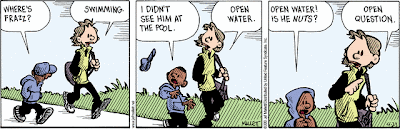
While I'd love to say the weekend was a complete & utter success it was not. I'm still dealing with a serious fear of open water swimming, something which has affected me since last year in Panama City. I had the strangest feeling of panic earlier in the week as we were discussing swim courses & initially attributed it to one-too-many cups of Starbucks. Unlike a twelve-step program, realizing you have a problem is probably not the hardest step.
A couple of things I learned this weekend which might even parallel life:
Bargaining does not work with every adversary. I went out to do the traditional Saturday morning run along Lakeshore with New Orleans' 5:20 club. At the 3.5-mile point, I backed off my 7:30-per-mile pace, looked out toward the calm (at that moment!) waters of Lake Ponchartrain & began to make peace with her. The next morning's conditions were (supposedly) as placid as the day before...but conditions became more challenging in the two hours between arriving at transition & the wave start. I remember someone saying a phrase some time back about running being eighty percent mental & the other half physical. Triathlon, however, is not running. It's one-hundred percent mental & the other half physical. If your head isn't all there it's not going to be a good day.
Always have an eighty-percent solution. Since the IM70.3 NOLA event has attracted many first-time triathletes, the race director left an opt-out option. A great idea, in my humble opinion, especially when nearly 30 persons were either taken from the water or bailed on the swim before the finish of the 1.2-mile leg. I'm not certain how many took the opt-out, but in hindsight, I might have felt worse about the day if I had. Getting in the water & getting my butt kicked was better than not getting in at all.
Attitude is everything. After the obligatory 30 seconds of oh, cr*p, not another day like Panama City...the race staff told me I could still do the opt out. Suh-weet! I hadn't ridden my Softride time trial bike since IM week in Panama City, & really wanted to know how much benefit my new (F.I.S.T.) set-up & new (Gray) aero helmet would provide on what I initially perceived as a wicked good bike course. I was half correct; the bike course definitely had its share of wickedness, two bridges to climb - one right after the other - within the first ten kilometers...this course is an out-and-back, so the same challenges in the first ten would be there for the last ten, when we were fatigued. At first, the wind on the course was relatively light & in our face, but began to increase in strength & shift in direction, leaving few places on the course where a racer would benefit from it. I noted after a slight sluggishness in the bike's handling after the 50-kilometer mark, just a few miles after the mid-point. As the ride progressed, the sluggishness increased, & I knew from looking down at the tire patch that a flat was in my near future. Finally, at 48 miles, I realized the road conditions of the next eight miles plus the mushy tire could possibly lead to a very bad day. So, I stopped to try & repair the leak. After attempting to refill the tire, I found the issue was, er, something deeper...a cracked valve stem extender, literally something I could not repair. Fortunately, the trooper protecting the course was able to call bike technical support...who didn't show for an hour & a half.
When you're in a situation like that you can either become Eeyore & bemoan your fate with a face long enough to eat corn out of a pop bottle, or you can channel Normann Stadler in Kona, circa 2005 ("another flat $&#*^% tire!"). But since I was feeling fairly good to be alive & not in an emergency department, I decided to laugh at my fate. Come on, how many guys run the risk of pulling what I would call a "double DNF" in one days' racing? Not many. Of course, if I had been more smart about the issue I would have pulled off the road at the overpass where there was shade, but I was thinking more along the lines of communication & not so much speed of response at the moment. If I had known it was going to take at least 90 minutes for tech to show, I probably would have ridden up to the overpass & taken advantage of the shade. So, silly me, I stood in the sun & nearly dehydrated myself. Tech, once they caught up with me, got me back on the chain gang again very quickly, with a couple of bottles of water to boot. My buddy Dixie came past about five minutes before tech did, so my goal was to catch him some time before the finish line.
Patience IS a virtue. The one thing I did not want to have on the run was a repeat of Augusta, where I hammered the first three miles & struggled the next ten. I knew if I was aggressive with my hydration & electrolytes during the bike & continued with it as far into the run as possible I might not have a bad day, or at least wouldn't have the kick me to the curb cramping I had from mile seven to the finish at Augusta. The plan was to run ten light poles, followed by walking one, plus I would walk as I took fluid at the aid stations on the course. Since there were stations every mile I did not wear my hydration belt, but took hits from my gel/electrolyte flask every second aid station.
I encountered Dixie at the only bridge on the run course, somewhere between the second or third mile, & passed him like he was tied to a tree. However, he was close enough behind throughout the run we saw each other on every switchback through City Park. Nothing like unadulterated fear a buddy is going to catch up with your butt to make you keep moving as quickly as possible. After the ninth mile there was just about nothing left in the tank, which seemed to be a good a time as any to engage in a brisk walk & see what strength I could recover. Amazingly, I was able to get back on the groove at mile ten, just before the exit of City Park...and just in time for the roughest patch of pavement on the entire run, Esplanade Avenue. I've run up & down Esplanade many times in the past ten years or so; knowing the best of the worst conditioned road I've ever raced upon was going to be a benefit. Again, it was the ten-to-one ratio, & things seemed to work fairly well until mile 13 when whatever reserves I might have had in store were depleted. Of course, by that time you have a new fuel source, namely loud music & cheering spectators. Most of them don't have a clue how bad you feel by that time, & I think they'd gladly give the functioning half of their liver to you if they could.
So, all you can do is suck it up & look like you're really STRONG when all you want to do is sit by the side of the road on the curb & drink two or three beers. Repeating as tolerated.
There's NOTHING like a finish line. But you want to look good for the photographers & the friends who finished hours before you did, so you tighten up the loose fasteners & set yourself up for a strong finishing kick which tells people: 'yeah, I did this, & if they asked me to do it tomorrow I probably would...as long as you're out here waiting for me again.'
Monday, December 21, 2009
Easy Days
 Sounds like the kind of place I want to spend some time in this time next year. Ah, but that will depend mostly on the wishes of COMNAVWIFELANT, also known as "Mrs. Java," "Coffee-Mate," or..."she who must be obeyed."
Fortunately for me, this years' endurance challenges smoothly segued into:
1. a reasonable level of training, namely the building of a right solid base, and
2. my wife's wish to run another half-marathon after a year's hiatus from systematic training.
So, I took the challenge of being husband and coach all at the same time...again...and got her back into the run training regimen she had a couple of years ago. Suzanne's strength is the ability to (like the Energizer Bunny) go for a consistent pace over an extended period of time. Brute, blistering speed is not her forte.
The biggest challenge for her, unfortunately, is the fact she is one of the few at her ability level who enjoys doing what I like to assign (to my athletes); moderate-distance training sessions of up to an hour two-or-three times a week, with speed work once-or twice a week. Oh, yes, don't forget the run of at least an hour once a week. That means she spends a lot of time doing her workouts alone. At least I can find someone within 30 seconds/mile pace to run with me...most of the time. However, since the middle of last month I've made a conscious effort to run easy with her at least once a week.
Don't know how many of you have ever tried to run a minute-to-two minutes/mile slower than your average training pace, but it can be a little painful. Especially after 60 minutes. I dreaded the prospect of those first runs at such a sedate pace, remembering vividly the damage I did to myself along Waikiki a couple of years back. All right, I have to admit part of the problem had to do with the fact I was in very old running shoes...and had recently done damage to my achilles at the beach half-marathon.
But once I figured out how to do the right thing - run for a period of time/distance, then turn and run back to my wife - everything went well. As it was, she was never really more than about two blocks back from me over the course of a single mile, so I could gently jog back. It also allowed her to know the exact route which we were going to use for a six-mile run, or an eight-mile run, or what the route for the distance she needed to cover was going to be (GPS plus Google Maps equals a very good estimate of how far you've gone.).
This particular attitude persisted over the last month, with other runners who are a little faster than my wife also benefiting from the small change in my training regimen. As they've come out they've had the opportunity to learn the loop we train on & build their confidence.
So, what has it done to my speed? Well, I ratcheted up the pace the other night on the beach, doing a 6.2-mile loop. The first mile or two were in the 7:30/mile pace, after that the splits started to come down between 5-and-7 seconds a mile, until I was running the last two miles in the high-six minute/mile range. Yes, it hurt. But it was a good hurt. I hadn't been at that particular pace for about two, or maybe three, months. But I also hadn't done any real speed work since September, either.
So, if you want to develop speed you need to learn how to run comfortably at speed. But once you've learned how it feels, you can't be hurt by emphasizing the runs which maintain base fitness.
Thursday, March 19, 2009
How Do I PR?
If you're a relatively new runner personal best times come in large portions of time. As time progresses & your new-found fitness starts to plateau to the level where you will stay (hopefully) unless injury strikes, those personal bests come at a higher price & in smaller increments; a second here & there. Doesn't make the later personal bests any less sweet.

Consistent, systematic training will help you to maintain fitness, combat boredom & burnout, & reduce the risk of injury. You probably can chant - whether or not you follow my advice - my thoughts about training by now:
- Develop a consistent pattern of workouts, which should include long runs of at least one hour once a week, speed work on the road or track once or twice a week, tempo running once a week, & easy runs during the remainder.
- Train all year, with an easy week per month & an easy month per year.
- Rest, as well as cross-training with an elliptical trainer, bicycle, swimming, or light weight training, is underrated.
- Listen to your body.
- Wear the right equipment.
- Learn to pace yourself without being dependent on the watch or the GPS. But do you train like you want to race? Do you think about drafting, passing, tactics, running tangents, starting & finishing pace, & overall strategy for your goal event when you train? Who do you want to be near or ahead of at the end of the first mile, the second mile, & so on? What is your plan for the entire race; what will you do different on a hilly course than a flat course? What are you going to do if things go bad?
Every workout, every run you do must have a purpose. Every repeat you do on the track needs to be done at the right intensity. Your attitude, & how you perform your road runs & speed work directly correlate to how you will perform on race day.
How did I know? I was familiar with the others & their tendency to go hard the first one-third & hang on for dear life at the end. Guess what? It happened exactly the way I figured. Two of the four slowly came back to us with a mile to go; another was reeled in with half a mile left, & we ended up dropping one of them at that point. There was no panic, & no valiant efforts, just a patient, steady, smart (training!) run.
Friday, April 18, 2008
Strengths And Weaknesses
 It's a nice day today; sunshine, blue waters, a little breeze here and there. Vicious rumor has it the weather won't be so nice over the weekend. That's all right. I'll settle for something close to nice, considering the alternative. I could be working. Worse yet, I could be unemployed and looking for a j-o-b. That's right: As the song in the end of the Monty Python movie, Life of Brian goes, '...always look at the bright side of life.'
I haven't touched my bike (save for putting on and taking off my race wheels) at all this week; no spinning class and no ride since Sunday morning. I'm not that concerned about the bike, because right now it's probably the most confident discipline I have. I'll need to have a decent swim and a strong run in order to have a better finish than last year. It would be nice to finish a little higher in the age group, but if I finish with a better time than last year and don't score any hardware, that's all right, too. My goal is to put all three disciplines together without looking stoopid.
One of the uber-gods of triathlon/coaching/mental and spiritual aspects of athletics, Mark Allen, wrote a really neat piece for this week's on-line version of Triathlete magazine, talking about how to fix your weakest link in the sport. The biggest thing I take away is to, as he said, work on your weaknesses to make them strengths. If you can take your race, regardless of the distance, and work it backwards to the beginning, you will probably find where things begin to go awry. At that particular point is where you can find the weaknesses in your own training.
I've talked about some of this before. Often we train our strengths and try to overcompensate so our weaknesses don't (we hope!) show on race day. If you (like me) tend to peter out in the latter stages of a 10-K run, it might mean looking at more 20-to-30-minute tempo runs. Other folks may go out too quickly in the first half mile of a 5-K, and that's all she wrote during the remaining 2.6 miles of the race. Some 500-to-1000-meter repeats at a consistent, sustainable pace, with brief rest intervals might do the trick. Lack that acceleration to get away from a pack in the middle of the race, or you're not able to kick at the end? How about some acceleration drills of 150-to-350 meters?
One area that can't be trained on the road or the track, or the gym, or the pool, is that gray area between our ears. Some coaches are great at tapping into the mind of the individual athlete, making them believe they are capable of great things. Others like to use tools like (as Mark Wetmore was quoted...) "ridicule and sarcasm..." to influence the athlete to think, 'well, I'll prove that blankety-blank wrong by succeeding where they think I can't.'
It takes honesty on both the athlete and the coach to look at a performance and ask the question, 'okay, where did things go wrong?' Not that every performance needs to be picked apart with a fine-toothed comb; some days nearly everything goes right and you say 'cool, I think we're on the right track.' However, more often than not we can find something to work on if we look hard enough.
Just make certain to enjoy yourself; there's plenty of folks who can't get out to do what many of us are blessed with by opportunity or physical ability. As for me, my thoughts will be with my sister this weekend, especially as I try to turn the scenery along the southern Alabama coast into a blur on my triathlon bike.
Subscribe to:
Posts (Atom)