So, How Many Hats Do You Wear?

My photo
Pensacola, Florida, United States
Husband. *Dog Dad.* Instructional Systems Specialist. Runner. (Swim-challenged) Triathlete (on hiatus). USATF LDR Surveyor. USAT (Elite Rules) CRO/2, NTO/1. RRCA Rep., FL (North). Observer Of The Human Condition.
Showing posts with label strength. Show all posts

Friday, September 28, 2012

Core Workouts? Is That Little "Something-Something" Worth It?

Let’s say you’re a middle-of-the-pack 5K runner.  You probably spend five or six hours a week doing a weekend long run, one or two speed workouts, and the social group/recovery runs.  Maybe you do an hour, perhaps two, of cross-training, which could be swimming, spinning or pumping iron at the local gym.  But you feel compelled to add a little "something-something" to your training regimen which will improve your 5K time, if you only knew what would be the most efficient use of your time. 
Maybe someone suggested you work on your core – the muscles at the abdomen, hips, and back which transform that slinky of our human spine into something a little more resilient.  Is focusing on your core really help you run better?  How do you know if your core is strong?  And what kind of exercises will give me a strong core?
Sato and Mokha (Journal of Strength & Conditioning Research, Vol.23, Ed.1, 2009) placed a group of runners on a six-week core strength training program to see whether their run performance, ground reaction force (how their limbs contacted the running surface), and lower extremity stability would improve.  Both the control and the treatment groups improved their 5K time at the end of the six-week study (which the researchers attributed to several variables), but the group which was placed on the core strength training program had a greater run time improvement, and no perceived change in stride mechanics (from ground reaction force variables) or lower leg stability. 
What differed from previous studies on the benefits of core strength training was the higher training volume (four times rather than two a week in other studies), as well as a two-week progression in set volume; the subjects continually had to adapt to an increased stimulus.  The exercises used in the study included:

Abdominal crunch on a stability ball.  Sit on the ball with your feet flat on the floor at about shoulder-width apart. Place your arms crossed on your chest, or hands behind your head. Walk your feet out a few steps until your lower back is on the ball, then curl your torso up until your shoulders are up off the ball. Hold the position for a moment, then lower and repeat.


Back extension on a stability ball.  Lie prone, with your upper torso draped over the ball, and your fingers and toes on the floor. Extend your spine and lift your head and your chest. Return to the starting position.
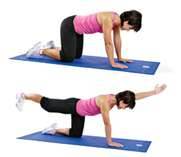

Supine opposite arm/leg raise.  Begin on your hands and knees.  Your hands are directly under your shoulders and your knees are directly under your hips at right angles to the floor.  Make your legs and feet parallel and hip distance apart.  Take a moment to slide your scapula (wing bones) down your back so that your shoulders are away from your ears, your chest is open, and your scapula are settled on your back, not poking up.  Extend your right arm straight in front of you and your left leg straight behind you at the same time. Your arm and leg will be parallel to the floor. This is the pose that reminds some people of a bird dog.

Hip raise on a stability ball.  Start by lying down, arms out, palms facing down. Rest the lower legs on the ball.  Lift the hips upward until the body is straight.  Slowly return to the starting position.


Russian twist on a stability ball.  Lay on ball, with shoulder blades on ball and hips pushed up high off ground.  Place hands together, or hold a single dumbbell.  Keeping your hips up, turn your shoulders to the right so they are perpendicular to the ground.  Twist back to the starting position, then twist to the other side.


I have bad news and good news about core workouts.
First, the bad news:  While core strength training may be an effective training method for improving performance in runners, you might end up with not much more than a strong set of core muscles.  When I reviewed the Outside magazine “Ten Biggest Fitness Myths” article, the question was raised whether whether core-specific training benefits athletic performance at all. In one study, a group of collegiate rowers who ­added an eight-week regimen of core exercises to their regular rowing ­workouts wound up with stronger cores, but their rowing performances remained the same. A group of Division I varsity football players were also tested, and researchers found almost no correlation between a strong core and athletic performance.
The good news is not only that the the law of specificity still works - running not only can help make you a better runner- but new studies show that running does work your midsection. 

Six-pack abs, and a better 5K time.  Gee, what a great idea!

Monday, December 7, 2009

It's a Rebus, Ya Butthead...

(A tip of the swim cap/cycling helmet/running visor to "Chuckie V" Veylupek. A little more obscure & cryptic than his road sign, but hey! That's the way I am, right?)
So, the end of the calendar year is always great fun for me. Not only does it allow me to scale back the running or cycling I do in order to spend more quality time - running - with my wife, I also get to play my favorite puzzle game, called "What The Heck Did We Do Wrong This Year?"

Well, it's not the official name of the game, but it's the working title for what new twist do we want to try in our training to replace the things that didn't do so well last year? I know, it's not as catchy as Scrambled Eggs, which was the working title for one of the greatest pop tunes of the past fifty years (kudos to anyone who knows the title - I don't have anything special I can give, short of my admiration!), but it will have to do.
Last year I tossed the fairly-well tried-and-true three weeks on, one week off training intensity cycle right out the window for a shorter three/four/five day on, one day off cycle. Unfortunately, I don't control all of the workout factors; I can swim up to six days a week (seven if I wish to engage in open-water!), and I can bike, run or do strength training almost any time I please. But sometimes I like the idea of getting out on a ride, or a social run, with a friend. We're social animals, we humans. While we may not have identical training goals & our physiological make-up varies by chronological & training age, there are times we like to have someone else suffering along with us.
So, this year I have decided to carpe the damned diem...seize the day. There are enough social-like training-like situations where I can get the necessary intensity in without feeling like the Lone Doggone Ranger. Rather than focus strictly on hard mileage/yardage, I've borrowed from a number of guides to gauge the volume & the balance between the disciplines.
The first guide is from Joe Friel's The Triathlete's Training Bible (I have the next-to-most-recent-edition). Since I'm focusing on two IM 70.3 events this year & I'm a middling-to-back-of-the-pack (blame it on my swimming) participant, I'm looking at the middle of Friel's 500-to-700 hours of training per year window. So, when I look at the amount of time I spent this year it's not going to be a big change, time-wise (this makes my wife very happy!). Friel has a week-by-week breakdown through each of the base, build, and prep cycles leading to the event, & the events are far enough apart to give me a chance to re-cycle through base & build in the summer.

Even neater than this, Friel lays out a division of hours per day for each week. Sundays have the most time available; which seems in line with most middle-class triathletes, & the week slowly tapers off in hours for training, with Saturday being the shortest day of the week, where your most intense stuff, or your C & B races, fit in. But there are days where my swim work is 'etched in stone' because of my masters' group, & the twice-weekly Six At Six beatdown is becoming a regular thing again...so there's a healthy chunk of the week taken up. But it's probably a better thing to have a little too little training volume than too much, right? I doubt if anyone ever got injured from undertraining over time.
The second tool is Dan Empfield's aerobic points system. For me to get out & run 8-to-12 miles on the weekend, 8 miles in the middle of the week, & five-to eight miles worth on the elliptical trainer (or treadmill, if I'm not too beat up) may...or may not...be such a good thing, especially in light of how badly I swim. Empfield's point of view, as well as many other coaches is race your strengths, train your limiters.
(If you're strictly running you will be better served by Jack Daniels' points system, which is published in the latest version of Daniels' Running Formula. But if you're a beginner tri-geek you might want to use this guide to keep your training balanced...so you don't spend too much time working on the stuff in which you are already good.)
Empfield's system works like this:
1 mile cycling = 1 point
1/4 mile running (~400 meters on track!) = 1 point
100 meters (yards) swimming = 1 point
I did a little bit of adaptation because of my tendency to beat myself up on the run: If I use the elliptical trainer (with a heart rate monitor!), I'll divide the time spent on the ET by 2.4-to-3.3 (2.4 if the average heart rate is closer to maximum, 3.3 if the average is closer to 50 percent) and give that score to the ET workout. (In essence, it's a way to equate elliptical trainer with cycle!) So, 25 miles of running might equate to 100 miles on the bike or 10,000m (yd) in the pool.
A hard-core runner might not need to develop strength by hitting the weight room, & some triathlon coaches consider hitting the pool to be better than pumping iron. Empfield prefers weights, so, every five minutes pumping weight (after 20 minutes) earns a point. A one-hour session would give you 12 points, but that assumes no lollygagging, definitely a hard-core weight session.
If there's a weakness in your training or you aren't certain how to balance out life & training, or the disciplines for which you are training, it helps to figure out what some of the good coaches are doing or telling their charges...might work for you; might not. We're all an experiment of one. Don't do the same thing over again if you're looking for different results.

Tuesday, October 20, 2009

A Thought On Tapering

...or two. I guess this train of thought started last Wednesday evening during our "easy" 60-minute run on the beach. Quite frankly, it felt like a bit of a slog for a good portion of the run; just couldn't get comfortable. The heart rate wasn't going sky high...in fact, it seemed quite reasonable. Just a little bit of lead in the legs. When we got back to the start I had to admit I was glad we kind of went off the beaten path; heaven knows I'd have been tempted to slap it into B-for-boogie...and might have felt like ten pounds of used kitty litter afterward.
That kind of feeling has persisted for this past week, & almost two. I'm certain lots of it has to do with a subconscious effort to conserve energies for the day. But it's not like I'm really going into taper mode. Friends who know I'm (about) three weeks out from the Ironman have hinted, 'yeah, you should be starting your taper next week...' Trouble is, I am not certain what I'm supposed to be tapering from.
The bicycle crash, by necessity, forced me to back off about 30-percent of my intended training volume. I've had to limit my swimming to twice a week, & at an intensity which is just comfortable enough to not strain the trapezius, deltoid, or latissimus muscles on the left side...unfortunately, life has managed to make up for the lost efforts. If you've ever tried to get out of a Mercedes sedan on the passenger side, it requires a certain degree of assistance from the left arm to help roll you out. So, when I whine about wanting to drive it has as much to do with physical comfort as it does with personal autonomy.
I managed to do well through the long bike ride on the IM FL course, so there's little to worry about there. Even running, when the shoulder feels good & hasn't been over-stressed, is all right. The heart rate is good. And now, the weather has become almost nice. So it's not like I'm really going to cut back on volume that much...or intensity...not until next weekend.
At that point it's going to be little more than a single hour of a single activity. Spend a little more time with the feet up, with the coffee pot, with the good book, with the light jazz or baroque music. Definitely. I'll revert back to one of the things I said before...just kind of be like my greyhound: eat when I can, go out when I want, & rest otherwise.
So, I'm not really tapering as much as maintaining.

Tuesday, May 5, 2009

Doing Doubles

Nature, who for the perfect maintenance...of her general equilibrium, has sometimes need of...this impulse, now that one, in accordance with what she requires. - Marquis de Sade

Since the beginning of the year I've done, in varying degrees of frequency, two workouts a day. I first did doubles during the summer before my last semester of college, because I was running cross-country. Your body goes through a multitude of feelings and responses during a period where you're doing two workouts that range from good ol' garden variety fatigue to unending hunger/thirst, to depression, to (if you do it correctly) a sense of feeling, as Travis Tritt once sung, Ten Foot Tall & Bulletproof.

Triathletes, especially the ones training for long distance events, do doubles almost by necessity. Heck, if anyone who took up triathlon were independently wealthy they'd get up at 8, swim from 9 to 10, then go for an easy one-hour ride or a 30-minute jog, followed by a long, lazy afternoon in front of the tube talking to the dog. HOWEVER...most tri-geeks (and some of their coaches) have real jobs. We would much rather talk about the trip we've just returned from or the next event we're going to do; it's lots more fun than talking about your doughnut-munching co-workers (or cow-workers, as one of my athletes likes to call them...) or the last batch of paperwork you had to turn into smaller batches of paperwork for the benefit of your company.

The challenge comes in balancing the morning effort & the evening effort. In order to make double workouts most effective, so I am learning, is to ensure there is enough time to recover so you're not completely wiped out or on the fast track to an overuse injury. Even if you decide to separate your run workouts with a cross-training effort (for triathletes, the non-impact sports of triathlon, swimming & cycling) it's still important to adjust between hard efforts, easy efforts, long durations & short ones. If doing the same workout at the same intensity over the same duration twice a day doesn't bore you to the point you decide to not get out of bed after the first week...it will certainly beat you down so you end up with...yep...an overuse injury.

Nutrition & hydration are also important, before, during and in between workouts. Extended endurance training may burn off fat, but too much can break down muscle. So, you want to make certain to eat good food throughout the day. Someone like Don Kardong might recommend you avoid a diet that discourages the use of ice cream (okay, at least you can have dessert in moderation); your body ends up chasing down anything it can burn after a certain point in time...and you don't want it to be muscle.Oh, and there will be times when you have to listen to your body to shut down a workout when pain arrives. You'll know pain, it feels much different than discomfort. There'll be days when you absolutely have to rest. Do it. There's a good reason. Sometimes you have to do the one-mile test: Go out for one mile, or perhaps the first half mile out & back on your planned run. If you still feel bad call it a day & rest. If you feel fine after a mile, go right ahead & continue...but take an extra easy workout or two.

As you approach the target event, you might want to cut back to one workout a day during the week or two weeks just before...your body won't know what to do with the extra energy come race morning.

Friday, April 18, 2008

Strengths And Weaknesses

It's a nice day today; sunshine, blue waters, a little breeze here and there. Vicious rumor has it the weather won't be so nice over the weekend. That's all right. I'll settle for something close to nice, considering the alternative. I could be working. Worse yet, I could be unemployed and looking for a j-o-b. That's right: As the song in the end of the Monty Python movie, Life of Brian goes, '...always look at the bright side of life.'
I haven't touched my bike (save for putting on and taking off my race wheels) at all this week; no spinning class and no ride since Sunday morning. I'm not that concerned about the bike, because right now it's probably the most confident discipline I have. I'll need to have a decent swim and a strong run in order to have a better finish than last year. It would be nice to finish a little higher in the age group, but if I finish with a better time than last year and don't score any hardware, that's all right, too. My goal is to put all three disciplines together without looking stoopid.
One of the uber-gods of triathlon/coaching/mental and spiritual aspects of athletics, Mark Allen, wrote a really neat piece for this week's on-line version of Triathlete magazine, talking about how to fix your weakest link in the sport. The biggest thing I take away is to, as he said, work on your weaknesses to make them strengths. If you can take your race, regardless of the distance, and work it backwards to the beginning, you will probably find where things begin to go awry. At that particular point is where you can find the weaknesses in your own training.
I've talked about some of this before. Often we train our strengths and try to overcompensate so our weaknesses don't (we hope!) show on race day. If you (like me) tend to peter out in the latter stages of a 10-K run, it might mean looking at more 20-to-30-minute tempo runs. Other folks may go out too quickly in the first half mile of a 5-K, and that's all she wrote during the remaining 2.6 miles of the race. Some 500-to-1000-meter repeats at a consistent, sustainable pace, with brief rest intervals might do the trick. Lack that acceleration to get away from a pack in the middle of the race, or you're not able to kick at the end? How about some acceleration drills of 150-to-350 meters?
One area that can't be trained on the road or the track, or the gym, or the pool, is that gray area between our ears. Some coaches are great at tapping into the mind of the individual athlete, making them believe they are capable of great things. Others like to use tools like (as Mark Wetmore was quoted...) "ridicule and sarcasm..." to influence the athlete to think, 'well, I'll prove that blankety-blank wrong by succeeding where they think I can't.'
It takes honesty on both the athlete and the coach to look at a performance and ask the question, 'okay, where did things go wrong?' Not that every performance needs to be picked apart with a fine-toothed comb; some days nearly everything goes right and you say 'cool, I think we're on the right track.' However, more often than not we can find something to work on if we look hard enough.
Just make certain to enjoy yourself; there's plenty of folks who can't get out to do what many of us are blessed with by opportunity or physical ability. As for me, my thoughts will be with my sister this weekend, especially as I try to turn the scenery along the southern Alabama coast into a blur on my triathlon bike.