When it comes to danger, the 16 weeks of the calendar year which contain the (autumn and) winter holidays from Hallowe'en to St. Valentine's Day can be much like treading through the swamp. Especially if you like sweets and pastries.
Early on, it's candy corn and bite-sized chocolates. We still have enough daylight to add on an extra mile or two to make up for the itty-bitty indiscretions. And then we turn the clocks back for daylight saving time, just in time to be surrounded by darkness.
So now we're hip deep -- and getting deeper -- into it. Thanksgiving, St. Nicholas, Chanukah, Christmas, New Year's; the deepest point of the muck and mire. Pumpkin pie...latkes...fruitcake...the extra beer...the champagne toast at midnight...it's all there in your face, even at the workplace (save for the booze!). Each holiday has it's share of temptations social and gastronomic. While one misstep isn't going to slide you down a bacon grease-covered pole to a pudgy purgatory, a series of poorly-thought-out decisions can destroy months of hard-earned fitness and disciplined weight control.
I have varied my approach to the holidays from year to year:
Training continues without change - every social function, dinner party and snack item takes a back seat to the daily or twice-daily workout. This is often the least desirable option in the mind of our spouses or family members, especially the ones who did not understand our running and fitness passion in the first place. Some cities are more holiday event-focused than others. I regularly receive e-mails from runners taking time to visit family members. They usually asked if they could join in a group workout, or if there was a race during a particular weekend.
Short, easy workouts - many have heard the adage, especially when talking about the budget: 'a million dollars here, a million dollars there, next thing you know you are talking about real money.' Same thing goes for workout duration. A holiday social function after work hours can really place a damper on that 60-minute run you originally had on the training plan. And, worst of all, you know there's going to be all that fantastic finger food you never get during the rest of the year. There's no law (at least in most work places) that says you can't take your walking shoes into work and exchange your midday bologna-and-cheese sandwich and chips at the desk for an energy bar and a 30-minute stroll outdoors.
Rest - some coaches have their athletes on planned periods of rest or decreased intensity; one day a week, one week a month, and some to the point of even one month a year. I have my doubts the top athletes allow themselves to go completely couch potato for an entire month. But the down month can be a good time to engage in less-intense, non-sport-specific activity. I remember hearing multiple Ironman World Champion Peter Reid talk about spending his down time "like a normal human being" cross-country skiing and watching television with close friends.
A 30-day period of complete rest, especially during the holiday month, seems a supreme test of willpower to me. When given the choice between no pumpkin pie and no workout, and pie and the (seemingly irrational) desire to get off the couch for 60-to-90 minutes...
I like pie. I'll fit my workout in some time during the day.

So, How Many Hats Do You Wear?

- Michael Bowen
- Pensacola, Florida, United States
- Husband. *Dog Dad.* Instructional Systems Specialist. Runner. (Swim-challenged) Triathlete (on hiatus). USATF LDR Surveyor. USAT (Elite Rules) CRO/2, NTO/1. RRCA Rep., FL (North). Observer Of The Human Condition.
Showing posts with label easy days. Show all posts
Showing posts with label easy days. Show all posts
Tuesday, November 20, 2012


Tuesday, October 14, 2008
Aquatic Alchemy
How do you know when you're fatigued & would benefit from an easier easy day, or a day off? If you have an easy day scheduled and the effort seems hard, or you have cross-training scheduled and the effort seems hard...you understand where I'm going here, I hope. Case in point: I hadn't raced in three months; so I jumped into a local, low-key 5,000-meter road race last weekend to show good-will (the race organizer serves as public safety coordinator on the island where we produce a couple of events) & to test my fitness. At the worst I could call it a hard workout without too much shame. While I ran 15-20 seconds slower than my typical 5K result this time of year (blame that nasty little headwind on the outbound) the rest of the performance was pretty much to my satisfaction.
 Sunday morning's eight-miler was a trudge. No worries; a couple of years back, one of the guys I used to run with always said: 'the day after a hard race, run easy; the day after a good race, run easy.' Naturally, it was more difficult to run easy after a good race; you were stoked over your fitness, blah, blah, blah... But I think every one of us were a little beat from recent efforts, so it wasn't a bad morning...if you look past the ten pounds of used kitty litter in an eight-pound bag feeling in your legs.
 The one place I always find out how badly beat down (beat up?) I am in the physical sense is the pool. You can fake the track or the road by altering the course to make your effort easier. The pool, however, is another story. Well, I stand corrected. You can fake the pool if you're swimming a solo workout by lengthening the intervals, or in my case, use the entire interval. If you're not training alone and you have a bad day you either pray for them to be hurting worse than you, or hope like hell your lane-mates won't water polo (for those of you who haven't seen water polo, it's a legalized form of the dunk tag you used to play as a kid in the neighborhood pool, with a volleyball added to make it look like a sport) your sorry @$$ when they catch you on the fourth of six 150s or 200s.
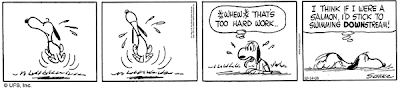 A bad day in the pool can be told by how the water feels. For me, the water becomes the consistency of peanut butter; you're getting a good catch on the strokes, but man, that pull is a complete and utter bee-yotch. Maybe I would have benefited from taking Friday - my normal rest day - off, rather than putting my Speedo Aquabeat MP3 player through its paces. I decided, since we had a non-training day (and a 59-minute hit) to make up for missing Tuesday morning's swim; (refer back to my comments in You Love The Thunder...Not!) disregarding my own dictum...to hit the pool for an hour. I decided to do 60 x 40yds freestyle on the 60. For those of you doing the math, that's 2400 yards of swimming. I averaged between 44 and 47 seconds for each repeat. For those of you who coach swimmers or swim well, you know that's not impressive. When you extrapolate that workout out to a 50yd pool, it was probably 40 x 50yds on the 1:15, averaging between 55 and 59 seconds for each.
Sunday morning's eight-miler was a trudge. No worries; a couple of years back, one of the guys I used to run with always said: 'the day after a hard race, run easy; the day after a good race, run easy.' Naturally, it was more difficult to run easy after a good race; you were stoked over your fitness, blah, blah, blah... But I think every one of us were a little beat from recent efforts, so it wasn't a bad morning...if you look past the ten pounds of used kitty litter in an eight-pound bag feeling in your legs. The one place I always find out how badly beat down (beat up?) I am in the physical sense is the pool. You can fake the track or the road by altering the course to make your effort easier. The pool, however, is another story. Well, I stand corrected. You can fake the pool if you're swimming a solo workout by lengthening the intervals, or in my case, use the entire interval. If you're not training alone and you have a bad day you either pray for them to be hurting worse than you, or hope like hell your lane-mates won't water polo (for those of you who haven't seen water polo, it's a legalized form of the dunk tag you used to play as a kid in the neighborhood pool, with a volleyball added to make it look like a sport) your sorry @$$ when they catch you on the fourth of six 150s or 200s.A bad day in the pool can be told by how the water feels. For me, the water becomes the consistency of peanut butter; you're getting a good catch on the strokes, but man, that pull is a complete and utter bee-yotch. Maybe I would have benefited from taking Friday - my normal rest day - off, rather than putting my Speedo Aquabeat MP3 player through its paces. I decided, since we had a non-training day (and a 59-minute hit) to make up for missing Tuesday morning's swim; (refer back to my comments in You Love The Thunder...Not!) disregarding my own dictum...to hit the pool for an hour. I decided to do 60 x 40yds freestyle on the 60. For those of you doing the math, that's 2400 yards of swimming. I averaged between 44 and 47 seconds for each repeat. For those of you who coach swimmers or swim well, you know that's not impressive. When you extrapolate that workout out to a 50yd pool, it was probably 40 x 50yds on the 1:15, averaging between 55 and 59 seconds for each.
Ah, but it was fun. Now we can get back to the schedule the way it should be. I'll get a rest day somewhere. Probably while I'm flying to Dubai.
Tuesday, May 20, 2008
You Should Be Dancing
 Yesterday was the first two-workout day since the triathlon. At first, I was impatient about waiting for Suzanne to get off work; she wanted to run while I jogged. Since hindsight is not only perfect but magnified it wasn't such a bad idea: I'd have hammered six to eight miles in the mid-80-degree heat and hated myself this morning, rather than jogged four miles at 10-minute-per mile pace...and hated myself this morning. For me, yesterday, the operating word was easy run. Man, the term 'easy' anything is hard to deal with. I've tried to amble, ramble, saunter, shuffle, jog at Suzanne's pace before, with disastrous results. It hurts to run much slower than you're capable of running. But it was fun.
As a form of gratitude, she took me to Beef O' Brady's for a bite and a beer. We ended up chattering about family stuff, both her side and mine, while keeping an eye peeled on the hockey and baseball. She saw Dancing With The Stars briefly on the toob, but then the fine people at Beef's changed the channel. I'll admit I've watched all of one episode of Dancing, while Suzanne was out of town. It was one of those lost-weekend-sit-with-the-dog-make-noises-and-channel-surf moments I get so few of...thank God. Doesn't matter who is on there...I don't want to watch another installment. One more piece of evidence that makes my pet project, The Endurance Channel, seem like a good thing.
 Kind of how I felt after the MSNBC thing this weekend. Once again, I loved watching the womens marathon trials, but I had my heart set on the mens triathlon trials. All I could sense was a warm drizzle, and it was a sunny day where I was sitting. Ugh.
If you're into road racing, any track and field event longer than 800 meters, or triathlon of nearly any length, I think you can get behind my complaint. It doesn't matter whether it's college, professional or Olympic sport, the commercial value seems pretty well nonexistent. More often than not, you get commentary from Al Trautwig, telling you 'go out to your neighborhood school track and try to run 12 laps, at 64 seconds for each lap'. Dude, most of the American teevee-viewing public would rather down 12 cans of light beer at 64 seconds a can. I do like Al Trautwig, though. He gets better every year through working the Tour De France with Bob Roll, Phil Liggett and Paul Sherwen. American broadcasters would do well to spend some time working with the European networks in order to learn the finer points of sports commentary, especially vis-a-vis endurance sport. Who knows, we might learn a little something about endurance sport; other nations do this too. Wow. What a concept.
 Ah. It's probably good I don't have any of those skills. I do get the occasional coach me for a month before I have to run my physical fitness test so I can drop five minutes off my 1.5-mile run time requests, but no offer of kissing as compensation...thank God.
 Kind of how I felt after the MSNBC thing this weekend. Once again, I loved watching the womens marathon trials, but I had my heart set on the mens triathlon trials. All I could sense was a warm drizzle, and it was a sunny day where I was sitting. Ugh.
If you're into road racing, any track and field event longer than 800 meters, or triathlon of nearly any length, I think you can get behind my complaint. It doesn't matter whether it's college, professional or Olympic sport, the commercial value seems pretty well nonexistent. More often than not, you get commentary from Al Trautwig, telling you 'go out to your neighborhood school track and try to run 12 laps, at 64 seconds for each lap'. Dude, most of the American teevee-viewing public would rather down 12 cans of light beer at 64 seconds a can. I do like Al Trautwig, though. He gets better every year through working the Tour De France with Bob Roll, Phil Liggett and Paul Sherwen. American broadcasters would do well to spend some time working with the European networks in order to learn the finer points of sports commentary, especially vis-a-vis endurance sport. Who knows, we might learn a little something about endurance sport; other nations do this too. Wow. What a concept.
Ah. It's probably good I don't have any of those skills. I do get the occasional coach me for a month before I have to run my physical fitness test so I can drop five minutes off my 1.5-mile run time requests, but no offer of kissing as compensation...thank God.Thursday, March 27, 2008
Detraining and Retraining
 This week has been a quote-unquote easy week. However, I cannot say my body can tell the difference between an easy week and a hard week at this particular point in time. On Monday afternoon my body would have called this week hard. However, after yesterday afternoon's run, my physiology clearly said things were all right and that I was on the right track. Sure, my heart rate was a little higher than I would have liked it for eight miles, but I did the same loop I ran six weeks ago a minute faster, without stopping the watch at two intersections and felt better about the whole thing this time.
I could find a lot of excuses for why I'm not where I would like to be at this time of the year, but I have to agree with my coach's dictum: gains in distance running (and endurance sport) is as much a function of patience as it is of pace.
It's important to get out and do something, even if it isn't directly related to your main sport, as many days in a row as possible. Run, jog, bike, briskly walk, do jumping jacks...because, beloved, the concept of detraining is reality, as real as the rising numbers on the scale and the doctor's chart. Life gets in the way. Business gets in the way. Weather gets in the way. And worst of all, our own laziness gets in the way. My education psychology professor might have had it correct when he told us, one quiet spring evening in grad school: 'If you don't use it, you lose it. If you do use it, it breaks.' But I'd rather Super Glue it together than walk around the track looking for it a second/third/fourth time.
Triathlete/coach Chuck ("Chuckie V") Veylupek wrote something very politically incorrect in his blog, inspired by the attitude of some walkers on the track where he was training a neo-pro triathlete.

"The human body-yours-is the single most amazing instrument you will ever own. You will own it from the day you are born right up until the moment you die; it's the only "thing" you will own throughout that entire span. Don't be ashamed of your body, no matter what condition it's in. Learn to cherish it and befriend it, or the date of your demise may come sooner than you realize. Change your ways before it's too late, and though it may already be too late to ever be fully healthy, it's never too late to try. Diabetes Type II is preventable. Heart disease is preventable. Obesity is preventable. Cancer (to a lesser extent) is preventable. Bad health is preventable. Death is, um, delay-able. Walk on ladies, walk on. But do me a favor: don't despise Angela because she cares about herself more than you do. Your mumbles are as loud as each of your foot-strikes."
I have fun challenging athletes who have developed their fitness over time. I care about the entry-level runners who come to me, but with the fit athlete it means I can pull more tricks out of my little black bag without worrying if they will come up dinged from too much training. Retraining the detrained athlete can be frustrating, both to the athlete and the coach...most coaches would rather not see their athletes regress into that state. That's why many of them have little regard for excuses...doesn't mean they haven't used them at one time or another, but they know what those excuses do.
So, as Chuckie V said: Cherish and befriend your body. Keep it trained. Make your coach use their imagination when developing your next workout. :)
Monday, March 17, 2008
A Matter of Quality

The other week, I came out to the track at five minutes before the start of practice and found a team member jogging laps. Rather than be pleased at their motivation to start early, I was a little less than happy. ‘You’re not going to need those junk miles,’ I said, ‘do you know what I have planned for this workout?’ It’s not so much that I wanted to be authoritarian; I looked at conditions and adjusted my plan accordingly…in this particular case, I moved the warm-up from the track out onto the trails. It’s almost a month before the last races of the late spring season here (we don't race anything other than triathlons during the summer here!), so the time for easy-paced mileage is beginning to pass, at least at the track. The track workouts for my more experienced team members is going to increase (a little) in intensity; higher perceived effort, shorter rest interval or longer distance…two of the three (in the case of some team members, all three) variables more often than not.
It’s almost a month before the last races of the late spring season here (we don't race anything other than triathlons during the summer here!), so the time for easy-paced mileage is beginning to pass, at least at the track. The track workouts for my more experienced team members is going to increase (a little) in intensity; higher perceived effort, shorter rest interval or longer distance…two of the three (in the case of some team members, all three) variables more often than not. I made a comment while writing last month's club newsletter, something to the extent of ‘if you’re not running the repeat at the right intensity level you’re wasting your time.’ This also lends itself to a phrase one of my college coaches used to remind me, ‘you can run hard and you can run long, but you don’t run hard AND long.’ Easy days are where your body - and your mind - makes its gains in fitness. If you hammer all of your workouts, day after day after day…your mind will probably rebel (burnout); hopefully before the point where your body breaks down and you suffer an injury that will leave you frustrated and focusing on rehabilitation.
 How do you gauge how hard you’re working; when to back off, when to take it easy? I gauge my workouts by percentage of maximum heart rate above 50 percent (by tens, so 50-59 percent would merit a 1, 60-69 a 2, 70-79 a 3, and so on...) multiplied by time, so if I run for 60 minutes at 50 percent of max heart rate, I score a 60 (1 x 60). Ride a bike for four hours at 50 percent effort would equal 240 (240 x 1), the same as an hour of running with an average heart rate of 80-90 percent (60 x 4), more or less.
 You can check your pulse at the end of repeats – rather than your stopwatch - in much the same way as I check my athletes if they have no monitor and I want to know how hard they've been working. A perceived effort scale to “ballpark” your effort works great for weight training, where heart rates are less intense, if you don't want to check your pulse all afternoon.
 If you felt the effort on a track workout was 8 on a 1-to-10 scale, then subtract five and multiply by the workout duration (90 minutes, usually), which would give, in this case, a 270. A number in the 100s is an “easy” day; a score above 300 might merit easy workouts for the next day or two, or perhaps a rest day and an easy day. If you’re not doing too much the next day at work you can probably stand to go out and run for an hour, as long as you keep the effort between a 6 and a 7 on that 10-point perceived effort scale.
 As you approach the racing season, if performing well is your goal, your training focus needs to move away from ‘more miles are better’ and closer to ‘how comfortable am I at this speed? Can I hold this for an entire race?’
 If you felt the effort on a track workout was 8 on a 1-to-10 scale, then subtract five and multiply by the workout duration (90 minutes, usually), which would give, in this case, a 270. A number in the 100s is an “easy” day; a score above 300 might merit easy workouts for the next day or two, or perhaps a rest day and an easy day. If you’re not doing too much the next day at work you can probably stand to go out and run for an hour, as long as you keep the effort between a 6 and a 7 on that 10-point perceived effort scale.
 As you approach the racing season, if performing well is your goal, your training focus needs to move away from ‘more miles are better’ and closer to ‘how comfortable am I at this speed? Can I hold this for an entire race?’
Subscribe to:
Posts (Atom)